The Heart: Three Perspectives - not a pump, not a ram, but a
living organism...
Standard Definition:
The Heart: a hollow muscular organ that receives blood from
the veins and propels it through the arteries. In humans the heart is located
behind the lower part of the breastbone, slightly to the left of center.
Structure and Function: the heart is a dual pump circulating
blood through two separate systems, each consisting of an atrium and a
ventricle. The heart contracts and relaxes the walls of the atria and
ventricles to circulate the blood. Blood is carried to the heart's right atrium
through two large veins: the superior vena cava and the inferior vena cava. The
right atrium contracts, transferring the blood to the right ventricle, which
sends it to the lungs. After the blood receives oxygen from the lungs, it
returns to the heart's left atrium. The left atrium contracts, forcing the
blood into the left ventricle and then into the aorta, which passes the blood
throughout the body.
Ralph Marinelli, BSME:
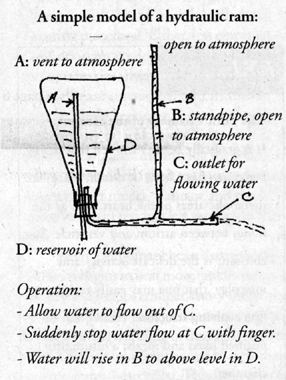 In my opinion, references to the heart as hydraulic ram may
do more damage than good. In his mention R. Steiner only meant to convey the
idea that a Dr. Karl Schmidt woke up one day from the consensus idea that the
heart is a pressure pump, and proposed the idea of the hydraulic ram. This was
not to say that Schmidt understood how the blood is propelled. Steiner said
that the kernel of truth grasped by Schmidt was that momentum, not pressure,
has a proximate role in the propulsion of the blood. The heart is not a pump,
nor is it a hydraulic ram. The momentum in the ram is of animate amorphous
fluid. The momentum in the blood is that of a self-propelled organism, with
its organic form. being the vortex.
In my opinion, references to the heart as hydraulic ram may
do more damage than good. In his mention R. Steiner only meant to convey the
idea that a Dr. Karl Schmidt woke up one day from the consensus idea that the
heart is a pressure pump, and proposed the idea of the hydraulic ram. This was
not to say that Schmidt understood how the blood is propelled. Steiner said
that the kernel of truth grasped by Schmidt was that momentum, not pressure,
has a proximate role in the propulsion of the blood. The heart is not a pump,
nor is it a hydraulic ram. The momentum in the ram is of animate amorphous
fluid. The momentum in the blood is that of a self-propelled organism, with
its organic form. being the vortex.
In the hydraulic ram, the water flow is suddenly stopped to
increase pressure that causes momentum, Thus, in the ram, pressure has a role
in propulsion. In the heart, pressure has no propulsive role. In the heart the
forward flow of the vortexing blood is dammed (stopped); its energy transferred
to increase the velocity in the vortex. In turn, the increased vortex velocity
induces a larger etheric force to further speed up (enliven and strengthen) the
blood. This is by no means the complete process of blood propulsion, but it is
certainly different from the flow of water in a hydraulic ram.
We have an hydraulic ram in our lab but we show it in
connection with detailed discussions of momentum, not to illustrate blood flow
or heart function.
Ralph Marinelli is a
retired US Army Chief of Research and Development of electrical, mechanical,
and thermal components and systems. Currently he is director of the Rudolf Steiner
Research Center,
Royal Oaks, MI
Anna Lups, M.D.:
From the very first moment, the embryo develops in three
layers. The ectoderm, on the outside, is largely a layer of nerve cells. It is
the layer of form. The endoderm is the metabolic layer on the inside, developing
substance. They are separated by the mesoderm, the layer that develops most rapidly.
It is the only layer with cell movement, active circulating cells in blood
vessels, all moving in an organized, purposeful way. This can be seen under the
microscope. There is interaction with all the organs from the beginning,
pushing and pulling, bringing and taking away, a dynamic interaction moving
from the periphery. The information of what to do comes from a higher level.
Then, suddenly, after 2-3 days of activity a bulging or
focus takes place at the center (just in front of the brain) and the blood flow
begins to strive towards that point. At first this bulge is a simple organ,
like the capillaries, lined with endothelium (cells that originate with blood
cells). At a decisive moment, approximately at six weeks, it suddenly divides
into four chambers. At ten weeks there is a heart beat. However, it is not
until the first breath is drawn that the heart becomes as we know it, separated
from the placenta, receiving blood in spiral movements and releasing it. In
fact, the heart is a receiving organ, with suction created by a vacuum, alternating
with relaxation.
It is an absurdity to believe that such a little organ as
the heart would pump blood all through the body. 90% of the blood is in the
venous capillaries at any one time, and the total capillary surface area is
approximately 3,000 miles!
Anna Lups has a
medical practice, Liberty Healing Arts, in Hudson and in Woodstock, NY