According to Dr. Otto Wolff, The Anthroposophic Approach to
Medicine, Volt, Cardiodoron (Cordiodoron) is a comprehensive remedy for the
cardiac circulatory system. It goes back to indications given by Rudolf Steiner
and is one of the remedies for typical illnesses. It consists of the plants
Primula, Onopordum and Hyoscyamus, which undergo a special preparation:
digestio is a pharmaceutical process employing the mild warmth of 98.6°F, the
mean temperature of the human blood.
 None of these plants was known at the time to have an effect
on the heart or circulation. An understanding of their effect is based not only
on the scientific knowledge of the substances they contain but is complemented
by concepts derived from spiritual research. Thus, the specificity of
Cardiodoron (Cordiodoron) is that it really addresses the interaction of the
heart and the circulatory system, e.g. the center and periphery.
None of these plants was known at the time to have an effect
on the heart or circulation. An understanding of their effect is based not only
on the scientific knowledge of the substances they contain but is complemented
by concepts derived from spiritual research. Thus, the specificity of
Cardiodoron (Cordiodoron) is that it really addresses the interaction of the
heart and the circulatory system, e.g. the center and periphery.
"It is better to team up the heart and circulation in
such a way that they mutually carry and support each other. The corresponding
medicine would have to have a point of departure in the periphery, another one
in the heart, and a third one that connects the other two. This threefolding of
the cardiovascular system is actually reflected in Cardiodoron." (Otto Wolff,
Remedies for Typical Diseases).
Primula veris (Cowslip) supports the anabolic process of the
heart through its sulfuric nature and has mild cardiac stimulating properties.
Through this spring plant, the "cosmic life force" is gathered and
led via the periphery into the living blood of the organism. Its point of
therapeutic action is the periphery of the vascular system and the large
surface area in the capillaries.
Hyoscyamus (Henbane) acts as a mediator between Primula
veris and Onopordon. This mid-summer plant's large, rhythmically undulating
leaves show a strongly rhythmic structure. Rhythm, the swinging back and forth
between two poles, is the uniting element between the capillaries at the
periphery and the heart at the center. Thus, it harmonizes the region of the
arterial vasculature.
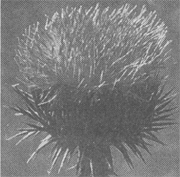
Onopordum (Scotch Thistle) supports the catabolic processes
in the heart and stimulates its activity. This later summer plant overcomes the
forces of the earth through the forces of silica active in the Thistle family
and evident in the thorns. Onopordum's field of action extends to the heart,
the deepest center point of the circulation where the blood, which has fallen
away from the cosmic, etheric forces, has to be renewed.
Prepared by: Michele Sanz-Cardona (Medical Manager, Weleda)
and Petra
Augenstein-Caporale (Chief Pharmacist, Weleda).