The importance of finding the right indoor shoes at home and
in school
As teachers, therapists and parents we work each day to help
guide children through their journey of incarnation onto the earth. As we do
this, we must keep in mind the need to address issues of the feet. In the
process of growing from our heads down into our feet, we can recognize that the
feet are the final connection to the earth, and are needed to help us feel
grounded and to carry us through the world.
Indoor and outdoor shoes must be appropriate and well-made.
They must stay securely on the foot, and be made of materials that breathe,
provide safety, warmth, and flexibility.
Articulation and dexterity of the feet and toes can be improved
through games utilizing the feet. Have children pick up marbles with the toes
while standing. When accomplished, try hopping or skipping while holding the
marbles.
It is challenging to find appropriate indoor shoes for our
kindergarten children. Many of the children I have observed over the last few
years as a traveling Remedial Education
Consultant struggle to find a healthy connection on the
earth, and their shoes are not helping! Remember that children, young children
especially, rarely tell us that their shoes do not fit properly or that their
feet hurt. They have not yet developed an awareness of their feet. That is why
it is so difficult to buy them shoes.
Please ask yourself the following questions concerning each
child's shoes: Are the shoes the appropriate size for the child? Do the shoes
stay securely on the feet? Do they give enough support to the arch and ankle?
Are they flexible enough for creative play and to support healthy balance and
movement of the whole body? Do the shoes keep the child's feet warm and dry? Do
the shoes or slippers cover the ankles? (This helps to keep the child's feet
and lower legs warm.)
Issues of the feet include:
Warmth — Wearing thick, dry socks of thin or thick wool,
keeping the ankle covered promotes warmth in the feet and legs. Children become
very cranky when they are cold.
Tension — Tension is carried in the toes of the child and
can be released by applying deep pressure massage before bed. Lavender oil is
relaxing and soothing for bedtime.
Form — Issues that need to be observed and addressed at an
early age while the child is still growing include high arches, flat feet,
toeing in, splaying out, prolapsed feet, toe walkers, heel walkers, too much
levity (always seem to be skipping) or too much gravity (children who can't
jump). Therapeutic Eurythmy, remedial and physical therapy exercises can be
used to address specific issues with the structure of the feet.
The floors in most kindergartens are either wooden or
carpeted. Depending upon the type of shoe sole, the child may feel
unsteady—their shoes slip or slide on the floor surface. Leather or thin rubber
soles help to keep the feet from slipping during play time and circle time
movement activities. I have often seen children wearing back-less slippers. These
cause the feet to slide out of the backs during free play time, and can cause
the child to shuffle when walking in an effort to keep the slippers from
falling off the feet. I have also seen children wearing slip-ons which come
over the ankles, but the child is totally unaware that they are walking all
over the slipper crushing down the sides. Sneakers tend to come untied, cause
the feet to sweat, and then become cold. Other children wear ballet shoes,
which are too small or tight and have an awkward thick padding under the center
of the foot. These shoes do not help the children feel grounded or secure on
the earth.
 What can we tell parents about finding the best indoor shoes
for their children? Here is a possible list: It may take some time and the
child must try them on and walk around before you buy them. Proper fit—not
too loose and not too tight. A good flexible sole, which gives a good surface
for the child to feel grounded and balanced, leather or thick non-stick wool.
The sides should come over the ankle to promote maximum warmth; children lose
warmth through their delicate ankles. Laces are an option, but they need to be
properly tied and double knotted as soon as they are put on. Velcro is fine for
the younger children, but older children do not learn how to tie
their shoes if Velcro is exclusively worn.
What can we tell parents about finding the best indoor shoes
for their children? Here is a possible list: It may take some time and the
child must try them on and walk around before you buy them. Proper fit—not
too loose and not too tight. A good flexible sole, which gives a good surface
for the child to feel grounded and balanced, leather or thick non-stick wool.
The sides should come over the ankle to promote maximum warmth; children lose
warmth through their delicate ankles. Laces are an option, but they need to be
properly tied and double knotted as soon as they are put on. Velcro is fine for
the younger children, but older children do not learn how to tie
their shoes if Velcro is exclusively worn.
Children need to feel that they stand and move on the earth
with security, strength and grace. The shoes that we place on their feet should
be a support, not a hindrance to this experience. When it is really warm in the
house or outside, children can benefit from feeling the carpet, grass or sand
with their bare toes and feet. Remember—warm, healthy feet make for a happy
child.
Rachel Ross is a Therapeutic Eurythmist, Remedial Education
Consultant, Certified Special Education Teacher Pre-K—12, Core Faculty Member
for the Waldorf Education Remedial Teacher Program, Secretary for the AHE. One
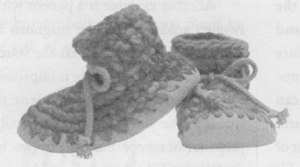
recommended indoor shoe, from Laurie Clark, kindergarten teacher, Denver, CO:
Homespun wool rainbow knitted slippers, fleece lined, goes over the ankle and
has a soft leather sole, from Padraig Cottage Industries, 1-800-881-2848,
Association for a Healing Education ANE News — November 2003. Photo courtesy Padraig Cottage Industries.