The art of providing first aid stands in a distinctive
position among the healing arts. It requires not only a caregiver's knowledge
and skill, but also the courage to step into unforeseen circumstances with the
will to offer aid to another human being.
Among our health care needs, the treatment of trauma and
injury is universal to the human condition. Traumatic events carry the element
of the unexpected and the need for immediate care, highlighting the importance
of preparedness. If we are not prepared to meet such events, the results can be
devastating. Therefore, a working knowledge of first aid should be the domain
not only of health care professionals: anyone who wishes to be of service to
his fellow man, regardless of his occupation or station in life, would do well
to take up this art as a practical and life-affirming skill.
The impulse to come to another's aid in times of distress is
exemplified in the image of the Good Samaritan, who reminds us of our human
capacity to love our neighbor -- irrespective of nationality, bloodlines, or
geographical borders. This love exists not only as a feeling, but becomes an active
deed of service.
Historically, the establishment of an organized system of
first aid arose during the 19th century, out of the work of Jean Henri Dunant,
a Swiss humanitarian. So taken by the horrors of war and seeing the suffering
of those injured and left on the battlefield to die, he organized emergency
services to aid both Austrian and French wounded at the Battle of Solferino in
June 1859. Credited with founding the Red Cross, he proposed the formation of
international voluntary relief services at the Geneva Convention in 1864 and
helped to establish the first multilateral agreement among governments for the
care of the war wounded, whether enemy or friend. The Red Cross would later
become an international movement, its scope extending beyond aid to soldiers,
prisoners, and civilian victims of war. Today it is also renowned for providing
worldwide humanitarian relief to victims of natural disasters, instruction in
first aid and accident prevention, and water safety training.
Shortly after the outbreak of World War I, Rudolf Steiner
addressed the sufferings of war and care for the wounded through a series of
lectures and practical first aid courses, given on the stage of the first
Goetheanum. One such, known as the Bandage Course, 1 was given in 1914 out of a
need to bring hope and spiritual insight to the events of the war. The themes
resounding from these lectures are that, above all, one must trust in the force
and power of the spirit, and that from this, one will be guided toward the
right action in times of emergencies. Steiner also spoke of the necessity to
imbue man's spiritual striving with a feeling of brotherly love, so that the
Christ impulse may work in us. Through this kind of spiritual striving combined
with practical skill, we prepare for what life brings. One may say,
"Wherever these events may take us, whatever they will demand from us, we
will act in confidence of the victory of the spirit." These themes are
just as relevant today as they were nearly a century ago.
Among the many homeopathic first aid remedies, Arnica stands
as the universal trauma remedy and has often been referred to as "the
helios of the gods." Wonderfully healing for a wide range of first aid
conditions, Arnica may be applied externally in various forms, as well as taken
internally. Hypericum, Symphytum, Rhus fox and Calendula are also great healers
and, along with Arnica, are among some of the best remedies for conditions such
as strains, sprains, fractures, bruises, and cuts. Remedies for emotion trauma
and acute distress include Ignatia, Aconite, Rescue Remedy, and Melissengeist.
FIRST AID BAG CONTENTS
Standard Materials:
Sterile gauze pads 2x2 and 4x4 Roller gauze
Triangular bandages (to hold dressings in place or to make an arm sling)
Band-aids in assorted sizes
Tape
Antiseptic wipes
Scissors and tweezers
Instant cool packs
Disposable gloves
Resuscitation mask or face shield
Saline eyewash
Syrup of ipecac
Activated charcoal
Rescue blanket
Flashlight (with extra batteries in a separate bag)
Antibiotic ointment
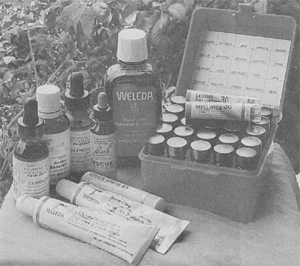
Homeopathic Additions:
Homeopathic internal remedy kit
Rescue Remedy drops
Arnica ointment
Arnica essence
Melissengeist drops
Calendula ointment or
Hypercal ointment (blend of Hypericum and Calendula)
Hypercal tincture
Burn Care gel
Sting gel
Euphrasia tincture (for eye irrigation)
1. Thoughts for the Times, on the Destinies of Man and
Peoples
Laura Josephson, CCH, RSHom(NA) is a certified classical
homeopath with a private practice in Nyack, New York. She is the author of the
recently published book, A Homeopathic Handbook of Natural Remedies, (Random
House, 2002)
Jeanne Schirm, RN currently works as a school nurse in the
public school system and also serves as a consultant to Green Meadow Waldorf
School. She is an instructor for the American Red Cross and the American Heart
Association.
HOLISTIC FIRST AID COURSE
By combining the best of conventional, classical homeopathic
and anthroposophical first aid healing principles, Jean Schirm, and Laura
Josephson have developed a unique, artful, and lively training program that
aims to impart the knowledge, skill, and confidence needed for anyone to
provide first aid effectively.
Informed in part by Rudolf Steiner's Bandage Course, the
two-day training offers hands-on practical skills, including the art of
bandaging, applying compresses, immobilizing an injured limb, and stopping
bleeding. Vital emergency assessment skills are also taught, enabling
participants to recognize and treat conditions such as shock, heat exhaustion,
and many types of injuries. A variety of classical homeopathic and
anthroposophical remedies are presented in detail so that participants can
administer them effectively in a wide range of emergency conditions. Live first
aid scenarios are enacted, inviting participation from volunteers. For more
information email lj@artifactory.com.
 HOMEOPATHIC FIRST AID REMEDIES
Keep on hand for more urgent conditions
ACONITE – ANXIETY, fright, panic attacks, restlessness, FEAR
OF DEATH; EMOTIONAL SHOCK, from trauma or seeing frightful events; EYE INJURY, also
SUDDEN ONSET OF FEVER, often with thirst, after exposure to cold or wind; first
stage of COLDS or flu.
APIS MELLIFICA - INSECT BITES, ALLERGIC REACTIONS, HIVES;
much swelling of affected area, heat, redness, stinging and burning pains;
symptoms are worse from heat, better from cool applications.
ARNICA MONTANA - TRAUMA, physical (or emotional); from a
FALL, BLOW, ACCIDENT, many types of INJURIES; traumatic SHOCK; fractures,
bruising, bleeding; achiness and injuries from physical exertion. Person says,
"I'm fine" when evidently not.
ARSENICUM ALBUM – Nausea, diarrhea, vomiting; FOOD
POISONING; FLU-like symptoms accompanied by weakness, restlessness, and
anxiety; CHEMICAL POISONING; Chilliness, thirst for small sips often; fearful
to be alone and worried expression.
BELLADONNA –INFLAMMATION; SUDDEN ONSET OF FEVER, hot, red,
dry, skin; HEAT STROKE with red face; HEADACHE, throbbing; SORE THROAT,
TONSILLITIS, EARACHE; pulsating pains; feels better lying in the dark.
CANTHARIS - SCALDS AND BURNS, where BLISTERS form that burn
and itch; severely painful burns; also for urinary tract infection with marked
burning pains.
CARGO VEGETABILIS – FAINTING, COLLAPSE; WEAKNESS, difficult
breathing; DROWNING; ASPHYXIATION; wheezing; blueness of skin, coldness, with a
desire to be fanned: "air hunger;" Carbon gas poisoning, lack of
oxygen; also BELCHING, flatulence, bloating after eating with strong desire for
fresh air.
HYPERICUM – NERVE PAIN from trauma, especially to fingers,
toes, teeth; crush injuries, puncture wounds, or superficial wounds with sharp,
shooting pains; SPINAL INJURY, WHIPLASH; sharp pains in teeth following dental
procedures.
LEDUM PALUSTRE –First remedy for most PUNCTURE WOUNDS, many
insect bites including lyme-ticks; tetanus; Affected part often feels cold and
is relieved by cold applications; Also for eye trauma.
RHOS TOXICODENDRON - BACK STRAINS, SPRAINS, overexertion
injuries; to joints, tendonitis; pains are worse during first movements after
rest, and feel better after continued gentle motion; "rusty gate"
syndrome, with restlessness; also POISON IVY rash. —Laura Josephson and Jeanne
Schirm