(Original title: Bachs
Bluetentherapie im Verhaeltnis zur anthroposophischen Medizin.
Merkurstab 1994; 47:497-506. English by A. R. Meuss, FIL, MTA.)
Bach's Medical System
Even as a boy, Edward Bach (24 September 1886 - 27 November 1936) hoped
to discover the principle that could be used to cure all diseases. As a medical
student he was conscious of the strong bias in school medicine. When he first
came in contact with patients he felt that their psychological and personal
symptoms were much more important than the physical symptoms. He
trained as a bacteriologist and produced vaccines (nosodes) from the
intestinal microorganisms, injecting patients with their own nosodes. He
achieved remarkable results with this method, later modifying it and giving
the nosodes only by mouth. He then found in Hahnemann's Organon much
of what he himself had discovered in working with his nosodes.
In July, 1917 Bach had a severe pulmonary hemorrhage requiring
surgery. He was in a coma for some time.
He developed his nosode therapy further at the London Homeopathic
Hospital, believing that he had found the therapeutic principle to treat the
condition called psora by Hahnemann. He differentiated between seven
groups of bacteria, calling them 1) Proteus, 2) Dysentery, 3) Morgan, 4)
Fecalis, 5) Coli mutabile, 6) Gaertner, and 7) No. 7. In clinical use, the mental
symptoms and temperament of the patient became the most important
indications. He thus arrived at seven clearly-defined personality types, with
the seven nosodes corresponding to these. His approach was based on the
bacteriologic, pharmaceutic and clinical investigations he was involved in
more or less night and day. The lights would always be on in his laboratory,
and the light shining from his laboratory windows was called "the light that
never goes out" by the hospital staff.
The successes achieved with the nosodes failed to satisfy Bach, however.
He had quite a large laboratory by then with a number of assistants and was
much sought after as a London physician. Yet he suddenly gave it all up. In
1928, at the age of 42, came a turning point in his life. He was looking for
plants to replace his nosodes for purer remedies. He went to the world of
nature, gathering plants, potentizing them or their active principles, but
found again and again that nothing equaled the power of his nosodes.
One night he was attending a dinner in a large banquet hall. He had
attended somewhat unwillingly and was not really enjoying himself. To pass
the time he was watching the people sitting at the table. Suddenly he realized
that the whole of humanity consisted of groups of clearly definable types and
that every one of the people present in the large hall belonged to one of these
groups.(1) He realized that there had to be more than seven types. He perceived
that it was not the case that particular diseases were characteristic of a group,
but that the members of a particular group would show similar or the same
reactions to various diseases. Initially he established twelve personality
types, indicating twelve flowers for their treatment. One of his booklets was
therefore entitled The Twelve Healers. He realized that he was on the threshold
of discovering a completely new system of clinical medicine. He also had a
feeling that he would find a new method of preparation that differed from
existing techniques in being extremely simple. He left London at this point,
burned all earlier lectures and essays, and started a migrant kind of life in
Wales, where he discovered one medicinal plant after the other.
Bach's primary intuition - using the term in his sense - had been that
there are twelve personality types which he distinguished according to
mental and characterological aspects:
1) fear
2) terror
3) mental torture or worry
4) indecision
5) indifference, boredom
6) doubt or discouragement
7) over-concern
8) weakness
9) self-distrust
10) impatience
11) over-enthusiasm
12) pride or aloofness
Bach found a natural remedy for each of these, perceiving the connection
directly when encountering the plant:
1) fear
2) terror
3) mental torture or worry
4) indecision
5) indifference, boredom
6) doubt or discouragement
7) over-concern
8) weakness
9) self-distrust
10) impatience
11) over-enthusiasm
12) pride or aloofness
|
Mimulus
Rock Rose
Agrimony
Scleranthus
Clematis
Autumn Gentian
Chicory
Centaury
Cerato
Impatiens
Vervain
Water Violet
|
The results achieved with these remedies, used according to the mental
typology, satisfied Bach greatly. They were much better than those he had
known with his nosodes. Most of the readers of this journal will be familiar
with Cichorium intybus, a plant Rudolf Steiner investigated in spiritual
science.(2) The story of a patient treated with Cichorium intybus by E. Bach will,
therefore, be of interest. According to Bach, Chicory is indicated for people
who are over-concerned and like to interfere in other people's affairs:
A lady, aged seventy, had severe indigestion with pain over the heart. She
had had attacks for some years but worse of late, the cardiac pain and
fluttering necessitating rest in bed for one or two weeks at a time.
She was an energetic type, over-concerned about the welfare of her family
and household, continually worrying aver trifles and never happy unless
her children were near her, full of self-pity if they did not come and see her
frequently.
She was given Chicory regularly for two months. Improvement began at
once and the trouble entirely disappeared at the end of the second month,
and when last seen, one year later, she had had no return. She also became
calmer and less worried about her family, giving them more freedom and so
increasing not only their happiness but her own.(3)
According to Bach, the physical disease had been caused by lack of
harmony between soul and spirit, personality and higher self. Disease as
such is beneficial and serves us well: it is a corrective, pointing to a lesson to
be learned. Essentially there are twelve faults to be recognized. The disease
will be cured if we develop the virtue that balances the fault. In support, or
even on its own, the appropriate flower therapy is indicated for each fault.
Bach's writings thus contain lists such as the following:(4)
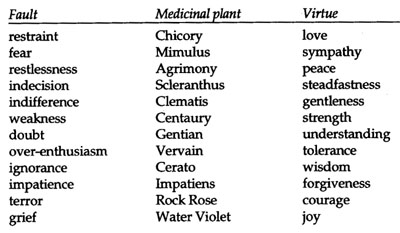
This establishes a kind of pastoral medical and phytotherapeutic
connection.
Continuing his researches. Bach found seven more medicinal plants and
published The Twelve Healers and Seven Helpers. He now had a range of 19
medicines. In the last two years of his life he discovered a another 19 medicines
using a different method of research. Bach himself would develop a
certain negative mental state or a physical illness, and he always knew that
he would recover as soon as he found the appropriate medicine. This method
of pharmacognosy through self treatment required great courage of his
convictions and an unshakeable faith in his mission. The additional 19
medicines were largely taken from trees (oak, elm, larch, hornbeam, etc.) and
prepared not by the sun method, which will be described below, but - with
the exception of White Chestnut - by decoction. Bach mainly used this
second series of remedies for patients who did not respond too well to the
first series.
Bach's system of medicine thus involves 2 x 19 = 38 remedies. The
famous Rescue Remedy (Bach emergency drops and ointment) is a
combination of Rock Rose, Impatiens, Clematis, Star of Bethlehem and
Cherry Plum.
The first book published by Bach following the discovery of his flower
remedies was Heal Thyself. Physical illnesses are psychological in origin. If we
deal with our psychological problems we shall be well, contented and happy.
The function of the new remedies was to help patients to overcome the
negative states of soul that caused the illness.
And so come out, my brothers and sisters, into the glorious sunshine of
the knowledge of your Divinity, and earnestly and steadfastly set to work to
join in happiness and communicating happiness ...(5)
Bach rejected poisonous plants and metals as medicinal agents. He
would only use the flowers, for the flower, containing the potential seed,
concentrates the vital powers of the plant.
Walking through the fields on a May morning and seeing the glittering
dew drops all around. Bach thought that a dew drop must contain some of
the properties of the plant on which it rested. The heat of the sun, he felt,
extracted the active principles of the plant, so that the dew drop would be
fully charged with its powers. He had the sensitivity to differentiate between
sun-irradiated dew drops and those that were in the shade, and found that
sun-irradiated dew drops were the more effective. Gathering dew being very
time-consuming. Bach chose a method by which the freshly gathered flowers
were placed in a dish of clear water and exposed to direct sunlight. He
described his sun method in a paper published in Homeopathic World.(6)
A glass bowl, as thin-walled as possible, was filled almost to the brim
with pure water, preferably from a spring. Sufficient flower heads were
placed in the bowl to cover the surface completely. A cloudless day would be
chosen, and the flowers were picked after they had been in the sunlight for
about two hours. The bowl was then placed in the sun, changing its position
from time to time so that the light of the sun was fully on the surface, with the
whole bowl bathed in light. A quarter of the liquid was poured off after three,
four and seven hours respectively, adding about 20 percent of pure alcohol to
the drawn-off liquid, which would represent the third, fourth and seventh
potencies respectively.
It is evident from the above that Bach - in the initial stages of developing
the method - equated the period of exposure to the sun with different
potencies. It also shows that Bach would originally pick the flowers two
hours after sunrise at the earliest and that some of the tinctures were not
ready until nine hours after sunrise, in the afternoon. Later (The Twelve
Healers, 1933) he said the flowers should be exposed to the sun until the petals
just started to fade. Ultimately the instruction was to expose to the sun for
four hours, and that is the method used today. Even today, the four-hour
period may well extend beyond noon.(7)
The method was, therefore, to take the place of potentization for Bach's
researches had shown that this was the best way of ensuring medicinal
powers. Bach wrote in 1930 that people should not reject the method on
account of its simplicity; the further scientific research advanced, the greater
would be recognition of the principle of simplicity in the whole of creation.(6)
In his view, the system could be used to cure all diseases:
Whatever the disease, the result of this disharmony, we may be quite sure
that the cure is well within our powers of accomplishment, for our souls
never ask of us more than we can very easily do.(4)
Any disease, however serious, however long-standing, will be cured by
restoring to the patient happiness and desire to carry on.
Examples he gave were "arthritis, cancer, asthma, etc." and also "measles."
A few weeks before his death he spoke of "all diseases normally known in this
country."
There is no need to tell you of the Great Healing Properties of these
Remedies, more than to say that hundreds and thousands of people have
been brought back to health.
He compared his cures to the melting of snow:
They [the Bach Flowers] cure not by attacking disease but by flooding
our bodies with the beautiful vibrations of our Higher Nature, in the
presence of which disease melts as snow in the sunshine.(9)
He also stated that his method was very simple, requiring "no medical
knowledge whatsoever."(8) "The whole principle of Healing by this method is
so simple as can be understood by almost everyone."(8)
Anthroposophic Point of View
A comparison between Bach's method and anthroposophic medicine will not
only throw a light on the Bach Flowers but, if we look at anthroposophic
medicine in the mirror of another system, some of the principles of
anthroposophic medicine emerge more clearly.
What are the origins of disease?
Bach saw the origin of physical illnesses in the human psyche. The mental
symptoms were much more important to him than physical symptoms.
Edward Bach (1886-1936) and Rudolf Steiner (1861-1925) were of one mind
regarding the psychic origin of physical illnesses. "The disease is merely an
abnormality in the individual's life of feeling,"(10) said Rudolf Steiner, and
Edward Bach had clearly developed the "perceptive eye for the inner life"(10)
that Rudolf Steiner hoped physicians would develop. In anthroposophic
medicine this concept of disease is, however, only one among many, and it is
immediately reversed when it comes to "mental" diseases, the syndromes
known in the field of psychiatry. Depression and mania, compulsive
neuroses or delusional states have their origin in the patient's physical body.
Other concepts arise, for instance, if we consider the human being from the
point of view of the four aspects, its threefold nature, or the polarity between
the upper and lower human being.
If a physical illness has its origin in the patient's soul life, does this permit
us to give low value to physical symptoms? Let us imagine two patients who,
in Bach's terms, are both over-concerned. Let us say one has a heart condition
and the other a liver disease. Heart and liver are different worlds, and so it
cannot be one and the same. Here we see that it really matters if we are able
to distinguish between body, soul and spirit. Anthroposophy considers not
only the psyche, which may affect the individual's vital processes, but also
the spiritual nature of a person which is embodied and active in the organs.
Seen in this light, disease is "the physical Imagination of spiritual life,"(11)
and I differentiate between two different spiritual realities when making the
distinction between hemolytic and hepatocellular icterus. The soul is
undoubtedly more spiritual than the body, but the latter is more perfect in its
kind. If we compare the marvelous structure of the heart or the brain and
their finely attuned functions with the uncertainties and instability of our
feelings, it is evident that the physical body, of its kind, is the most perfect
aspect of the human being. Any approach to medicine must, therefore, base
itself on a study of the physical body; otherwise it can have no solid
foundation.
One-sided or all-round methods?
Bach used only flowers for his medicines, the only exception being Rock
Water, water from medicinal springs.
Anthroposophically speaking, flowers act on the metabolic pole, i.e. the
area where Bach had collected his nosodes at an earlier stage. The fact that he
used plants to influence the soul is understandable from the anthroposophic
point of view. Mineral medicines act on the human ego, plants on the soul
(astral) body, animal substances on the life body, and human substances (e.g.
blood preparations) on the physical body.(12) The flower actually has a soul
aspect, showing nature's changing facial expressions in a poetic way.
Bach, therefore, had the right ideas concerning both disease and his
Flower Remedies, but he made them the sole and exclusive principle to the
point where there are no limits, and one loses one's bearings.
Some dietary advice given by Rudolf Steiner may demonstrate this. The
metabolic/sulphur pole is dominant in fair-haired children, the nerve/sense
pole in dark-haired children.(13) To correct such a bias, Steiner advised that
fair-haired children should be given root vegetables, dark-haired children
aromatic fruits. The effect of such a diet given to children also influences the
soul,(13) and we really ought to demonstrate this empirically by conducting
long-term trials. But we can understand the principle even without this. A
fair-haired child, with the emphasis on metabolism, would thus be given root
vegetables and a dark-haired child, with the emphasis on nerves and senses,
fruit to correct the bias. Anthroposophic medical treatment is also based on
the principle that human beings have an upside-down plant inside them. The
Flower Remedies deal with one aspect of this. The other, polar root aspect
and the third, mediating leaf aspect are missing. People using the Flower
Remedies, therefore, have no clear understanding of what they are doing. For
what do I really know about an effective medicine if I do not also know the
medicine which acts in the opposite way?
Many mothers today give Bach Flower Remedies to their children as a
form of prophylactic psychological medicine. In view of the above, one
would expect the Flower Remedies to increase the bias in a fair-haired child,
in whom the flowering/sulphur is already dominant, while they may be
expected to have a balancing effect in dark-haired children.
Medicines free from poison?
Bach rejected poisonous plants such as Belladonna and Aconite, even in
potentized form. Steiner would occasionally prescribe substances in doses
that came close to the toxic range (e.g. Mercurius vivus nat., in Thuja comp.).
Here again, the physical body can teach us how to find the right way. It
produces numerous toxic substances, e.g. CO2, phosphorus, iron, bilirubin,
etc., all of which are also detoxified. Classic exogenous toxins such as
morphine and strophanthin have been known for years to be endogenous as
well, with small amounts produced in the body. Everything normal and
healthy in one organ is unhealthy or a toxin for the next organ. Consider the
way the brain floats calmly in the cerebrospinal fluid, like an iceberg; in the
heart the same macroscopic calm would signify cardiac arrest and, therefore,
death. The inner life, which proved of such interest to Bach, can only exist in
the body by slightly poisoning it all the time; the state of unconsciousness we
enter in sleep will then correct this again. If a disease develops in which
vegetative, regenerative, sleep-like metabolic forces dominate, e.g. a febrile
inflammation, toxic substances are indicated that will strengthen the waking-
up pole, which has become too weak, and thus counteract the overweening
metabolic, going-to-sleep pole. Belladonna 3x or 4x may be indicated in such
a case, not as a homeopathic simile, but for the above reasons. Belladonna 30x
would be contraindicated, for if the origin is perceived to be in the metabolic
pole, we have to intervene there, and this is successfully done by using low,
material potencies.
To be able to cope with the widest possible range of situations - and
Edward Bach clearly wanted this - we have to understand that it is "a
nonsense to dream of non-poisonous medicine".(14)
Self-treatment or self-education?
One of Bach's most important social impulses is that of self-treatment. Apart
from the simplicity of his method, this is probably one of the main reasons
why the system is so widespread, having become highly popular in recent
years.
As already mentioned. Bach's first publication was Heal Thyself. Steiner
asked young doctors to make it part of their medical ethics not to treat
themselves and not to lay claim to the benefits of the medicines for
themselves.(15) This was clearly said with reference to medical treatment.
In terms of general hygiene it is, of course, justifiable and indeed highly
necessary to strive for health. "Striving for health" is the first condition for
entering on the spiritual path (Knowledge of the Higher Worlds). Tried and
proven aids are eurythmy(16) and the exercises connected with the lectures on
Overcoming Nervousness and Practical Training in Thought.(17)
At this psychological level, self-treatment - if we may call it such -
is far from simple, requiring a great deal of effort and will power. It
is, in fact, a matter of self-education. The "heal yourself" impulse
should not take the place of self-education. We are well on the way to
this, however, when we read in the prospectuses of the Bach Center in
England that Bach Flower therapy is "preventive medicine for the
psyche", serving to "build character" and that the long-term goal of
Bach Flower therapy is to achieve "purity of soul and, therefore,
maximum personal development and stability".
Under the pretext of treatment something entirely different is offered
here: the self-education impulse is obscured. Purity of soul is a goal that in
anthroposophic terms can only be achieved through numerous incarnations
and, in Christian terms, only on the Day of Judgment. In selling their products
the manufacturers of Bach Flower Remedies want to provide something to be
acquired passively which, in fact, can never be provided from outside: self-
knowledge, self-education, character improvement, purity of soul.
As far as I can see, this impulse was not of primary concern to Bach
himself; he truly wanted to heal physical diseases by treating the soul. Bach
was convinced that his system would cure every disease.
Sun method or powers of morning and evening?
Rudolf Steiner introduced new, complicated manufacturing methods for a
whole range of anthroposophic medicines. Examples are the machine used to
produce mistletoe preparations and the method of producing Kalium acet.
comp. c. Stibio. His suggestions were based on certain insights, e.g. that
mistletoe as it occurs in nature, is a "decadent process"(18) It is often necessary
to complete the work of nature, using the art of pharmacy.
Edward Bach's main concern, on the other hand, was to find a simple
method on which human beings have minimum influence. His sun method
exposes the medicinal substances to direct sunlight, and initially he would
start two hours after sunrise at the earliest, with exposure times of three to
seven hours, depending on the "potency" required. The method was
developed further, and today a standard exposure time of four hours is used,
often until noon or later. Originally, noontide was always part of the process.
Steiner, on the other hand, advised against using the noon or midnight
powers of the sun, recommending utilization of the powers of morning and
evening, with direct sunlight playing no role in this, the aim being, among
other things, to avoid the use of alcohol as a preservative. Bach was unable to
manage without alcohol for his remedies. Steiner spoke of the different
nature of the powers of noon and midnight, predicting their future effects in
the East and West.(19) A time will come when "those who have knowledge in
the cosmos will fight one another.(19) It will be an American secret how the
powers of noon can be made to serve the ahrimanic double,(19) to paralyze the
powers of morning and evening. And the powers of midnight will be used in
Eastern occultism to bypass the Christ impulse.
Readers may judge for themselves if Bach's sun method may be seen in
connection with the above-mentioned American secret or not. The fact is that
Edward Bach, coming after Samuel Hahnemann and after Rudolf Steiner,
discovered a method of preparing medicines that uses the noontide powers
of direct sunlight.
Questions we have to ask in relation to that method are: what happens
when the flowers are thus exposed to the sun? Which physical substances
and non-physical creative powers are transferred to the water? Is this the
equivalent of potentization, as Bach believed it to be?
Should we use medicines for which the principle of action is unknown?
Twelve and seven
Bach discovered 7 nosodes, 12 human types, 12 healers and 7 helpers, and
then another 12 + 7 = 19 remedies, after which he declared the system to be
complete. He himself never spoke of the meaning of those figures. Without
going into speculation, let us recall, however, that the major turning point in
Edward Bach's life came when he realized that the whole of humanity is
made up of 12 types. In Anthroposophy we speak of the individual human
being, and initially only of the physical body which consists of 12 senses or
has embryologically evolved through the forces that come from the 12
regions of the zodiac. The individual human being, and initially only the life
(ether) body, differentiates into 7 stages of life, a 7-fold metal or planetary
process. Numerous further differentiations and aspects make the individual
person a being of body, soul and spirit, a marvelous, artistically
metamorphosed, highly complex mirror of the cosmos. We feel growing
admiration and profound reverence as we learn to perceive this human
being. For Edward Bach, it seems, the whole of humanity was simply and
easily divided into 12 types, his system being so simple that even 38 types are
easy to understand. This has resulted in a simple, practical method that
requires "no medical knowledge whatever" and "can be understood by
almost everyone."(8)
Simple or Complex?
In Nora Week's book the terms "simple" and "simplicity" are used dozens of
times.
The keynote of Edward Bach's life was simplicity and it was also the keynote
of his final work - the new system of herbal medicine.(1)
Tempting words - "the genius of simplicity" - but there is also a certain
arrogance which should not be overlooked.
Since Edward Bach's days, a vast number of harmful effects on the
environment have become known, among them thalidomide, the Chenobyl
disaster, the natural catastrophe of the Aral Sea, the plague of toads in
Australia, the ozone hole in the stratosphere, ozone pollution near ground
level, the hothouse effect, mad cow disease (BSE) due to meat being fed to
herbivores, etc. All of these were caused by human beings, sometimes on
expert advice. The common denominator is a biased, simplistic approach,
and failure to think of all possible consequences. Simplicity of thinking is the
banner headline when we consider the causes of today's natural disasters.
The longing for simple ways of thinking arises from the desire to avoid effort.
Life, the world and the human being are many-layered and complex, and in
using methods that are too simple and one-sided we destroy them.
Bach's Flower therapy is as one-sided as it is simple. The original claims
for universality have no doubt been found to be relative in practice. Bach's
successors now want to offer "inner development in the form of drops", and
the tremendous spread of Bach's Flower Remedies is a product of our age, a
product of avoidance of effort.
Friedwart Husemann, MD
Maria-Eich-Str. 57A
D-82166 Graefelfing bei Muenchen, Germany
References
1 Weeks N. The Medical Discoveries of Edward each, Physician. Saffron Walden: C.W. Daniel Co. Ltd 1940.
2 Steiner R. Spiritual Science and Medicine (GA 312). Lecture of 30 Mar 1920. Tr. not known. London: Rudolf Steiner Press 1975.
3 WeeksN.Loc.dt. p. 73.
4
Bach E. Free Thyself. In The Original Writings of Edward Bach by J.
Howard and J. Ramsell. Saffron Walden: C.W. Daniel Co. Ltd 1990.
5 Bach E. Heal Thyself. Saffron Walden: C.W. Daniel Co. Ltd 1933.
6 Bach E. New Remedies and New Uses. Homeopathic World 1930.
7
Information kindly given to J. B. Williamson, Graefelfing, Germany, who
telephoned John Ramsell at the Bach Center of 13 June 1994.
8
Bach E. Masonic Lecture 1936. In The Original Writings of Edward Bach
by J. Howard and J. Ramsell. Saffron Walden: C.W. Daniel Co. Ltd 1990.
9
Bach E. Ye Suffer from Yourselves. Address given at Southport, Feb
1931. In The Original Writings of Edward Bach by J. Howard and J.
Ramsell. Saffron Walden: C.W. Daniel Co. Ltd 1990.
10
Steiner R. Eight Lectures to Doctors (in GA 316). Domach, 3 Jan 1924.
Tr. not known. MS translation R % at Rudolf Steiner House Library,
London.
11 Ibid. 8 Jan 1924.
12
Steiner R. An Outline ofAnthroposophical Medical Research (in GA 319).
Lecture given in London on 28 August 1924. Tr. not known. London:
Rudolf Steiner Press 1939.
13 Steiner R. Curative Education (GA 317). Lecture of 30 Jun 1924. Tr. M. Adams. London: Rudolf Steiner Press 1972.
14
Steiner R. Fundamentals of Anthroposophical Medicine (in GA 314).
Stuttgart, 28 Oct 1922. Tr. A. Wulsin. Spring Valley MY: Mercury 1986.
15 Steiner R. Eight Lectures to Doctors. 7 & 8 Jan 1924.
16 Steiner R. Curative Eurythmy (GA 315). Tr. K. Krohn. Lecture of 16 Apr 1921. London: Rudolf Steiner Press 1983.
17
Steiner R. Overcoming Nervousness (in GA 143). Lecture given in Munich
on January 1912. Tr. R. Querido & G. Church. New York:
Anthroposophic Press 1973; Practical Training in Thought (in GA 108).
Lecture given in Karlsruhe on
18
January 1909. Tr. H. Monges, rev. G. Church. New York: Anthroposophic
Press 1974.
18 Steiner R. Anthr. Therapy, Lectures to Doctors (in GA 319). London,
3 Sept. 1923. Tr. R. Mansell. Long Beach, CA.: Rudolf Steiner Research
Foundation 1984.
19
Steiner R. The Wrong and Right Use of Esoteric Knowledge (in GA 178).
Lecture of 25 November 1923. Tr. D. Davy. London: Rudolf Steiner Press
1966. On the subject of the ahrimanic double see also Steiner R.
Geographic Medicine and the Mystery of the Double (in GA 178). Lecture
of 16 November 1917. Tr. A. Wulsin. Spring Valley: Mercury Press 1986.