pgs. 11-17.doc
(Original title: Taurin - ein neuer Wirkstoff in Erfrischungsgetraenken. Merkurstab 1994; 47:588-94. English by A.R. Meuss, FIL, MTA)
It seems that people have been looking for refreshment to overcome tiredness
through the ages. Vegetable stimulants were used for the purpose. It is
remarkable that people in all parts of the world knew which local plants had
that effect. Much later, all of those plants were found to contain caffeine as
the stimulant principle. Appreciable amounts are only found in the plants
that are still used for the purpose today. Chemical analysis has revealed no
other plants that contain sufficient caffeine to have a stimulant effect, though
about 77 plants are now known to produce the compound, generally in very
small quantities. It is also important 10 note that all caffeine-producing plants
grow in hot climates.
"First-generation" stimulant drinks are coffee (1-2%), tea (4.3%), mate
(1.25%), guarana (4.2% and cola (1-2%). The caffeine content of the part of the
plant used is given in parentheses. The tea shrub originated in the area between
India and China; mate comes from the region of the Parana River in
South America. Guarana grows near the Orinoco River and is sold as guarana
paste. Coffee is said to have originated in the Abyssynian highlands.
The cola tree conies from tropical Africa; the "nuts" are used. These five
plants are used to produce stimulants for world-wide human consumption.
About 75,000 tons of pure caffeine are used each year.(1)
Animals do not use these plants for their stimulant effect, and it must be a
typically human desire to be wholly awake and in full conscious awareness.
Not only were the plants and the parts to be used discovered but special
methods of preparation have been developed (roasting of coffee beans,
fermentation of tea leaves, etc.), in all probability not on the basis of "trial
and error."
The "second generation" of stimulant drinks was produced on the
industrial scale. Combinations such as caffeine and coca leaf extract were
used. The coca shrub - not to be confused with the coca tree - is a native of
tropical South America. The locals chew the leaves which are said to "satisfy
the hungry, give new energy to the tired, and make people forget their
misery."(1) Originally they were in ritual use in Peru, with serious penalties
exacted for profane use. The main active principle is cocaine, which is
chemically similar to the atropine found in Solanaceae, but with totally
different effects. The drug is addictive, with trade and consumption illegal in
almost all countries.
The cola drinks sold all over the world do not carry a full declaration of
ingredients but are said not to contain cocaine today. The term "vegetable extracts" tells us very little. Active principles are stated to be caffeine, sugar and phosphoric add. The last of these gives the drinks a highly refreshing flavor.
Phosphates also have other, deep-reaching effects, as discussed in my article
on the hyperkinetic syndrome.(2) Colas are hot favorites - though drunk cold -
throughout the civilized world today, indicating a general desire to overcome physiological tiredness and be wide awake and high-level performers.
"Third generation" drinks have now appeared which contain taurine as a
new active principle. Red Bull was the first to be marketed in Europe. The
declared composition is practically the same for all these drinks. Again, sugar
(c. 10%) and caffeine are the basis, though compared to cola drinks the
caffeine concentration is much higher at 320 mg/liter (according to a Coca
Cola distribution center, the concentration in Coca Cola is between 65 and
250 mg/liter, which is the highest concentration permitted in Germany).
The idea and composition of these energy drinks come from Japan where
a variety know as Lipovitan, marketed prior to 1980, made great profits for
the manufacturers. The success of the venture encouraged an Austrian firm
to follow suit, again at great profit. The recipe is probably the same as in
Japan or at least a close copy. The name Red Bull actually relates to the new
active principle taurine (see below).
As with any success story, imitators were quickly on the scene. So far,
Flying Horse, Power Horse and Ritual have appeared. The last of these has
the same concentrations of caffeine and taurine, but the sugar has been
replaced with four artificial sweeteners. (Guarana, which also contains
caffeine, has been available for centuries in Brazil but does not contain
taurine, which makes it part of the "second generation.") The flavor of these products is not considered attractive by consumers and, therefore, plays no
real role in their meteoric rise.
The new drinks are all set for success. The manufacturers have found a
way of going above the legal limit for caffeine in lemonades, using 320
mg/liter, and to introduce taurine, though this is not officially permitted
(licensing would have been a protracted process). Red Bull is thus currently
produced and marketed in Austria, Germany, Hungary and - thanks to EU
legislation - also in Britain.
The new ingredient is taurine, and propaganda is made with this in the
declaration. The drinks are obtainable from specialty shops selling drinks
and from gas stations but not (yet) from food stores, or at least only some.
They have become known within a short time, initially without advertising
(!), and consumption is obviously high.
Physiology of taurine
Why is taurine added? The compound results from decarboxylation of cysteine, a degradation product of the disulfide cystine. This is a sulfur-containing amino
acid of vital importance not only for anabolism but above all in
detoxification processes.
Decarboxylation is the general route by which biogenic amines are produced
from amino adds.(3) The amines are instruments of astral activity and
connected with processes of conscious awareness. However, due to the sulfur
component and a chemical constitution that is very simple compared to other
biogenic amines, this activity is at a low level. The powerful oxidation
involved in conversion of cysteine to taurine is worth noting, however. It is
characteristic of humans and animals, that is, life at the level of spirit and soul.
Oxidation connects substances with the earth, also a function of the iron-bile
impulse which is the physiological basis of mental and spiritual activity.
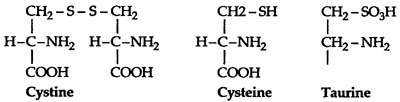
Taurine thus relates mainly to a biliary process, which is also evident from
its industrial role: it is synthesized mainly for the manufacture of detergents.
The compound acts as an emulsifier, which is also a characteristic of bile.
In the organism, taurine is bound to bile acids and excreted as
taurocholic add. The add was first found in ox bile, hence its name (tauros =
bull). It appears the manufacturers used this fact in creating the name Red
Bull; the trademark shows two red bulls head to head. Later, it was found
that humans excrete about three times more glycocholates than taurocho-
lates. Some carnivores - especially dogs - excrete only taurocholates, which
also predominate in other predators. "According to the German Federal
Department of Health, low concentrations of the amino add (sic) taurine,
which promotes numerous metabolic processes in human metabolism, have
been added to baby foods for years."(4) Clearly, neither the author passing on the information nor the Department knew that taurine is not an amino add
and had no idea which metabolic processes in infants are involved; otherwise
they would probably not have encouraged these in infancy considering the
modem problem of hyperactive children.
Nature and actions of bile acids
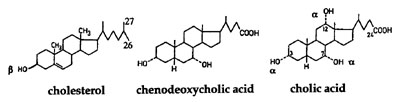
All bile acids derive from degradation of cholesterol, a slightly soluble
compound. In a number of steps, two primary bile acids are produced in the
liver - cholic add and chenodeoxycholic acid (highest proportion. In the
process, the double bond is hydrogenated, the OH group at position 3 isomerized
(alpha instead of beta), an alpha-OH added at position 7, the side
chain reduced and oxidized to the add (COOH). The resulting chenodeoxycholic
acid (cheno add in short) is found mainly in the bile of geese (chen,
chenos = goose), but also in human bile. It is freely soluble and also dissolves gallstones, having been used for this purpose since 1975. Its emulsifying power is greater than that of other bile acids (proprietary product
Chenofalk¨). Healthy bile will dissolve gallstones because it contains the
relevant bile adds. Thus human gallstones dissolved sometime after in vivo
implantation of a dog's gall bladder(5). The above-mentioned cholic add has a
third OH group at position 12.
Ursodeoxycholic acid is much the same. As the name indicates it was
found in the bile of bears and has been used for centuries in Chinese
medicine. The search for the active principle probably started with this.
Ursodeoxycholic acid differs from chenodeoxycholic add by having the OH
group at 7 in the isometric beta rather than alpha position. Its cholagogue properties make it particularly useful in treating cholestasis, e.g. in cases of cirrhosis (proprietary product Urofalk¨).
Lithocholic add (lithos = stone; 3-monohydroxycholanic acid), which is
only slightly soluble, is the product of microbial reduction of the two OH
groups at 7 and 12 of cholic add or the 7-OH of cheno acid (secondary bile
acids) in the intestine.
This indicates the role of the intestinal flora in gallstone development.
Bacterial metabolism is always reductive, whereas the biliary process is
oxidative. If unphysiological and perhaps even aggressive bacterial activity
predominates over bile production, degradation of primary bile acids
increases and lithocholic acid is produced. This is withdrawn from the
enterohepatic circulation of bile adds, resulting in reduced activity.
The many other bile acids differ mainly in their degree of oxidation. They
combine with glycocoll or taurine to form different conjugated bile acids.
Thus glycocholic acid is a conjugate of glycocoll (= glydne, aminoethanoic
add, NH2-CH2-COOH), the simplest amino add and one of the bile acids.
Taurocholic acid is a conjugate of taurine and cholic acid (generally) or
deoxycholic acid.
Taurine and glycine are eliminated in conjugated form via the liver and
bile and resorbed, thus stimulating bile formation. In view of the above, it
should be clear, however, that this is a matter of quality rather than quantity,
reflected in the different nature of individual bile acids and the choice of
taurine or glycine.
The function of the hepatobiliary system is to "make idea into reality,"(6)
with bile formation providing the necessary activity by transforming the
stream of substances produced in me liver. The significance of bile formation,
and especially bile acid production, thus lies not only in the physiological
function of fat emulsification to facilitate absorption but in providing a
physical basis for activity at the level of spirit and soul. The enterohepatic
circulation of bile acids plays a major, constitution-determining role in this.(6)
This is essentially the origin of the choleric temperament, with cholerics
clearly bile-determined, active individuals.
The bile-stimulating activity of bile acids also has a qualitative aspect.
Activities of spirit and soul can intervene powerfully yet gently, with due
regard for existing conditions, or they may be uncontrolled and aggressive.
Much can be learned from the fact that different animals have greatly
different biliary products, with taurocholic acid predominant in carnivores,
esp. dogs, i.e. in predators. Aggressiveness is a dominant characteristic of
these animals. As shown above, taurocholic acids should be in a lower
proportion than glycholic acids in humans.
In other words, taurine stimulates bile formation, leading to increased
activity, but qualitatively speaking this is more animal-like and aggressive.
The extent to which such massive stimulation is still controllable and, indeed,
in accord with human nature remains to be seen.
Earlier investigations have shown that human, porcine and bovine bile,
including Fel tauri depuratum, which appears in some pharmacopoeias,
have marked hypotensive properties. The action is less powerful in canine
bile. Even me sodium salts in isolated glychocholic and taurocholic acid still
have hypotensive activity, though the duration and intensity of action were
much greater in purified dried ox bile.(7) Cholic add is listed as a choleretic in the 1993 drugs list published by the German Federal Association of
Pharmaceutical Concerns (Rote Lisle), with products mentioned including
NovoMandrogallan (contains Fel tauri and cholic acid) and the tonic
Glutergen +H3, but the superior activity of dried bile (Fel tauri) with its
hypotensive action is no longer utilized (The same applies to Martifidale Extra Pharmacopoeia- Translator.) Not one of the many antihyper-
tensives listed indudes Fel tauri. m spite of the physiological data available
goose bile, for instance, has never been used to dissolve bile stones. The
isolated prindple is given preference.
It would be well worthwhile doing a Goethean study to determine the
quality of bile produced by different animals. This may also provide a basis
for differentiated clinical use. The relevant analyses have been done.(8)
Inositol, vitamins
Another declared ingredient of the new drinks is inositol, C6H6 (OH)6,. This
is glucose-like, sweet-tasting, and found practically everywhere in the
biological sphere, above all in muscle tissue (myo-inositol), brain, liver, lung, milk, etc., and in cereal grains mostly in combination with phosphoric acid as phytin.(9) The inositol phosphatide is found mainly in soy and in brain tissue.
Inositol has a specific relationship to phosphorus and phosphoric acid. As
previously shown,(2) phosphorus stimulates ego activity in metabolism,
especially in conjunction with sugar and sugar-like compounds such as
inositol, which may result in hyperkinetic syndrome.
Apart from caffeine, taurine and myo-inositol, glucurolactone is
specifically mentioned as an ingredient of the drinks. This is an intermediate
product between glucose and vitamin C. It is now known that humans are
not able to produce vitamin C from glucose themselves. Glucoronic acid
does, however, have an important detoxification function. It forms water-
soluble glucuronides that are eliminated mainly in the bile, ultimately again
stimulating biliary function.
Most of the B groups of vitamins have been added, which makes sense as
they are especially needed for energy-consuming activities (vitamin B1 =
"nerve vitamin"). This actually makes it possible to abuse the ether body by increasing external activity, temporarily compensating it to permit further "activity." Yet even the coca leaf chewing Indians knew that in the long run this depletes the body. Excessive caffeine consumption - whether in "natural form" as coffee, tea, etc. or added to soft drinks - leads to exhaustion at least of the nervous system with sleeplessness, as is well known. People who have extremely good livers, especially young people, are able to compensate for a long time, which is part of the nature of the thing but does not change the
principle.
The question is, why do young people in particular have such a need for
stimulant effects? As already stated, powerful conscious awareness is part of
human nature. It is generally known and "proven" that this can be stimulated
by caffeine. This, however, is where taurine appears on the scene,
effecting choleresis. The resulting need to be active is exactly what we see in
many young people. This is the "switched-off" generation which feels life
offers little that is of interest and needs its "kicks" which are gained through
exciting situations such as a football game, a thriller or, in the present case, a
medicinal impulse given to biliary function. With the "brilliant" combination
of stimuli given to the conscious mind and the will, people feel strong - in
fact, very strong. This results in enhanced self awareness of the kind also
achieved with drugs such as heroin. It is not real strength but an illusion, but
those concerned are unable to realize this. The same applies even to sugar
consumption, which has been fully discussed elsewhere.(10)
In reality, all external stimuli are liable to make people unfree and,
indeed, weak; they are then dependent and may ultimately become addicts -
the foundations for this are certainly laid. Genuine strength develops only
through inner activity and work.
It needs a true science of me human being to realize that the (desired)
stimulation of conscious awareness (more than wide awake) and will
(hyperactivity), which then go directly hand in hand, eliminates or at least
neglects the middle element of feeling and, therefore, the truly human aspect.
Real feeling coming from the heart that may also engender enthusiasm is
generally looked down upon. We are "cool" today, not showing - or indeed
developing - emotions. This allows a logical, intellectual thought that is not
controlled by any moral quality to enter directly into a will impulse and
action. Daily life provides sufficient examples of this.
Although problems arise with these stimulant effects, we certainly do not
have to do without them if they are used for particular occasions (a cup of
coffee or tea in the mornings or at conferences) and within limits; but
repeatedly consuming them in excess can lead to dependence which ultimately
means physical or mental and spiritual weakening of the individual.
References
1 Hess E. Rausch-, Schlaf und Genussgifte Stuttgart 1971.
2 Wolff 0. The hyperkinetic syndrome. English by M. Gardner. Journal of Anthroposophic Medicine 1993; 3:7-16.
3 Husemann/Wolff. Anthrvposophical Approach to Medicine. English by P. Luborski. New York: Anthroposophic Press 1982.
4 Hoeher K. "Red Bull" - gesundheitsgefaehidend? Aerztl Praxis 73; 10 Sept 1994, S. 7.
5 Johnstonetal.il957;73:336.
6 Husemaim/VifoUf.AnthivposophiwI Approach Chapter on the liber.
7 Daniel. Verhandl. d. dt Ges. f. inn. Med. 44. Kongr. Wiesbaden 1932, S. 413.
8 E.g.Hepatoiogyl993;18No.4.
9 Koslowsky & Wolff. Emaehrung, Entwicklung, Rachitis. Merkwstab 1990; 43:232 ff.
10 Merkblatfc Das Zuckerproblem; Die suesse Suchfc In preparation. Soziale Hygiene- Vereinerweitertes Heilwesen.
A general discussion has been published under the title "Red Bull" and "Hying Horse,"
Erfirischungsgetraenke der 3. Generation" in Eraehungskunst Heft 9, Sept 1994 Stuttgart.