pgs. 36-42.doc
(Previously unpublished manuscript from the papers of the late Dr. Ehrenfried E. Pfeiffer, which has been edited for publication. Originally printed in Mercury 1992; 12.)
In medieval chemical manuscripts descriptions of how to produce chemical
and therapeutical substances spoke of the "repetition" of one and the same
procedure, a process which might appear unnecessary to the chemist of
today because seemingly no new transformation resulted from it. This
procedure mainly concerned processes of dissolving and distillation. Yet the
old literature makes it clear that these processes, when repeated in definite
rhythms, have the effect of purifying the substance involved and intensifying
the intended process. The repetition of the distillation process is reported to
purify the substance more and more and, thus, make it receptive to "fixation"
of the world-spirit. When elaborating on the production of metal mirrors. Dr.
Steiner explained that a substance undergoing distillations is brought back to
its cosmic origin and rendered able to receive cosmic forces.
One can well imagine that a single distillation may not be sufficient when
one considers the strong relationship to the physical conditions, the permeation
with not only material impurities but also with earth processes - for
example, the raw technical production and manufacturing. The purely
chemical rectification requires several repetitions. In the old instructions - as
indicated many times by Rudolf Steiner - the distillation products are
reunited with the original substance so that no purification - in the sense of
"removal of impurities" - seems to take place. Thus the processes themselves
are influenced.
Can one verify the effects of such distillation processes through an
experimental test? One can study the effects on a human being of a remedy
in its various stages of preparation. Such experiments are time consuming
and difficult to interpret. Or one can study plants in their reaction to growth
and shape, as in growth tests with legumes (peas). This also is time
consuming and shows only a detail of all the possible effects of the remedy.
The most suitable, practical way seemed to be to use the method of
Sensitive Crystallization and to study the "biography" of the remedy with
single crystallization pictures. This provided an opportunity to observe both
an obvious effect and a specific influence.
Concerning the method and its possible applications, we refer you to the
book. Sensitive Crystallization Processes, A Demonstration of Formative Forces in
the Blood by E. Pfeiffer in which medical consequences of this method are
specifically represented.
Through the kindness of Weleda, Arlesheim we received an insight into
the production processes of remedy No. 20 (Kalium aceticum cum. stibio).
This remedy is especially suitable for studying the problems referred to
earlier.
In brief, the indications for the production are: "distilled wine vinegar is
poured onto Tartar (Potassium tartrate) and distilled off several times so that,
after the distillation, it tastes as sour as at the start. Then Antimony is finely
ground together with the above end product. Next, an alcoholic extract of
Crocus sativus is added to the powder and this again treated by distillations.
Further distillations with pure alcohol follow until the "spiritus" no longer
shows a red color. Then Coral is finely pulverized together with this
intermediate product, covered again with alcohol and distilled. This has to be
repeated several times until finally there results the finished remedy."
To investigate the effect of the formative forces which might accompany
the whole process, a small amount was taken each time from all the single
intermediate states, added in high dilution to a 5% solution of copper
chloride (CuCI2) and crystallized according to the established method. The
resulting crystalizations showed that, with the help of the obtained form,
pictures of each single stage of the whole process could be clearly fixed as to
its effect; especially the last stage in each case can be observed as a specific
and characteristic form-picture.
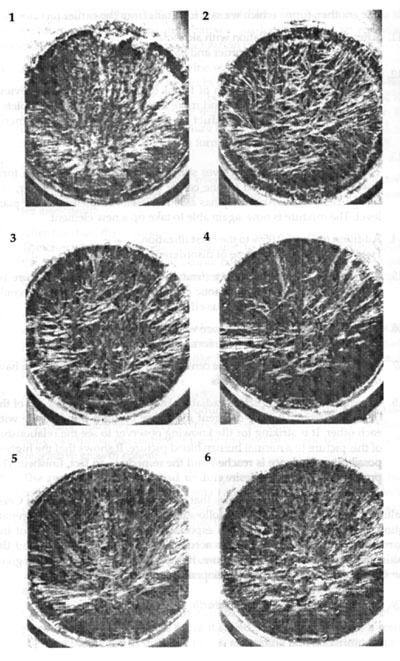
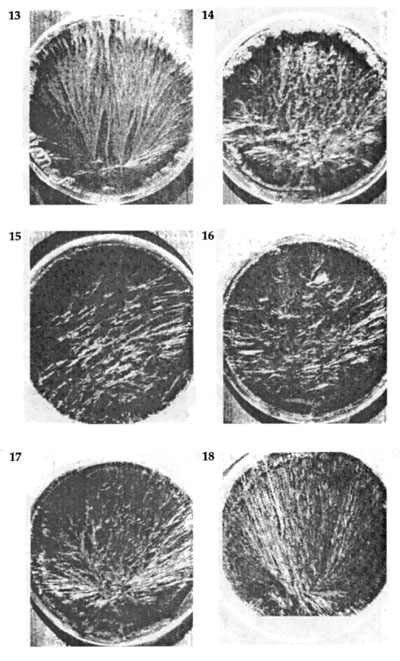
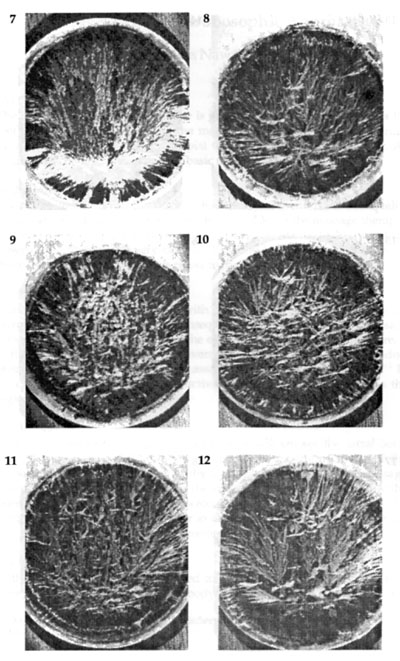
The single stages are shown in the accompanying crystallization pictures:
1. Distilled wine vinegar, 5 drops added to 10 cc of copper chloride solution
This picture shows hardly any activity of formative forces. It concerns a
chemical product without any specific characteristics. In its tendency the
wine vinegar may have something plant-like in the direction of flower
and fruit forms, but they cannot manifest properly. Observe especially
the center area of this picture for a later comparison.
2. 0.05% solution of the salt of tartar added to the CuCl2 solution.
Here appears quite a different character of forms: sharply contoured
needles, concentrated to small but not very clearly delineated centers
which are distributed over the surface. However, a unifying
centralization towards one center is missing. It is the typical picture of a
substance which has precipitated after fermentation. Such forms are
obtained with the crystallization of substances resulting from various
fermentation or putrefaction processes; that is, one can recognize a phase
of a certain natural process but without being able to see any specific,
individual characteristics of the substance in question.
Whoever is surprised by such conclusions is referred to the book
mentioned above on how far-reaching conclusions can be drawn from the
form pictures and also consider that we can look back on an empirical
material of many thousands of crystallization pictures.
3. After the first distillation with wine vinegar.
A strong change can be observed in this picture. The sharp tartarus-type
needles are still retained near the border; but towards the center of the
picture a new form reveals itself: this has a more plant-like character. We
can recognize a tendency in picture No. 1 - even if not quite distinct - is
apparent in the center. Here this form manifests itself more obviously.
4. After the second distillation.
The needles are more and more overwhelmed from the other, new form
principle and kind of "ennobled." The hard, sharp fermentation character
loses itself.
5. After the third distillation.
The character of the single needles, due to the tartarus, vanishes. Also,
the form of the wine vinegar cannot be found any more. Instead, a new
principle enters, a unifying element, which arranges the crystals more
and more towards one center.
6. After the fourth distillation.
As compared with the previous one, this picture shows no more improvement
in centralization. The single forms become slightly finer and
again approach the more plant-like forms. Judging from this picture, no
more distillation is necessary.
7. Addition of Antimony, 0.005 g to 5% CuCl2 solution.
A new form element is now introduced. Considered by itself, this shows
a striking character: a very distinct general center with fine, feathery,
wing-like forms, the picture of the pure effect of etheric forces out of the
vegetative growth sphere.
8. The preparation which had undergone the four distillations is now
triturated with Antimony and a small amount of the mixture added to the
crystallization. At first, there appears a complete chaotization of the forms,
a kind of regression. In spite of this, the centered character remains.
9. A further element is introduced: Crocus sativus, three drops added to the
crystallization. The resulting picture shows abundant chaotic plant forms
which, again, have as their single distinguishing characteristic a tendency
towards the plant-like.
10. Crocus sativus, extracted with alcohol, is added to the mixture of the
preparation gained at stage 8 and distilled for the first time. As a result,
we see a battlefield of different forms, struggling and superimposing on
one another, forms which we saw in details from the earlier pictures.
11. After the second distillation with alcohol.
The form picture starts to order and balance itself.
12. After the third distillation.
One could say a new creation of forms becomes visible. The previous
little centers disappear more and more and make room for a completely
new kind of form - the product of all the previous form elements
working together.
13. After the fourth distillation.
The new form character receives still more fixation and creates a form
now completely directed to one center point. From the character, one
recognizes that the Antimony has asserted itself completely on the plant
level. The mixture is now again able to take up a new element.
14. Addition of Coral 0.05% to the crystallization.
Here again the feathery type of disordered crystals.
15. The trituration of the substance (from picture 13) with Coral (picture 14)
reveals again a completely chaotic picture as a first reaction. One could
nearly think that all the previous efforts were in vain.
16. After distillation of above mixture with alcohol.
The chaos starts quickly to take form.
17. After the second distillation the center point is clearly revealed. We have
now very finely-formed crystals.
18. A completely unified picture radiating from one center results out of the
third distillation. All the different forces are brought into balance with
each other. It is striking for the knowing observer to see the relationship
of this picture to a normal human blood picture. It shows that the highest
possibility of balance is reached and the remedy is, in fact, finished. The
process has reached its desire end.
This experimental series shows that, with the help of the Sensitive Crystallization
method it is possible to follow up the separate stages in the preparation of a
compound remedy and especially observe the interaction of the
formative forces, their progressive accommodation to one another and the
ultimate harmonization. Furthermore, it is evident that such a process gives
an image of the whole path of development towards the normal.
Dr. Ehrenfried E. Pfeiffer and Erica Sabarth