pgs. 18-36.doc
(Original title: Angaben zu Pflanzeninhaltsstoffen bei Rudolf Steiner. Merkurstab 1994; 47:561-
80.
English by A. R. Meuss, FIL, MTA.)
Introduction and aims
From the very beginning of anthroposophically-oriented science, biologists
among Rudolf Steiner's pupils did work in plant morphology that resulted in
a number of important publications. New ideas were described on plant
development and aspects relating to the cultivation of food and medicinal
plants elaborated. Attempts were also made to gain new insights into the
actions and processing of medicinal plants.
It seems that this emphasis on morphology, with less attention paid to
plant constituents, was due more to the special interests and capabilities of
Rudolf Steiner's pupils than to anything he said. The list presented in this
paper shows that Rudolf Steiner referred to constituents of about 35 plant
species. Only a few of these were common substances such as sugars. Indeed,
rare substances like nicotine and esculin were often mentioned by name and
discussed. On many occasions Rudolf Steiner would explain the actions of a
medicinal plant from the occurrence of specific substances.
In the authors' view, Steiner's references to constituents can be as fruitful
for the development of anthroposophic medicine and pharmacy as his
statements on plant morphology. This means that the references must be
known and understood by modern scientists. The aim of the present paper is
to present a list of those references and discuss the terms used by Rudolf
Steiner in the hope that this will encourage others to work with Rudolf
Steiner's statements on plant constituents.
Interpretation and presentation criteria
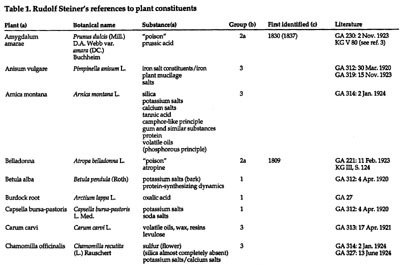
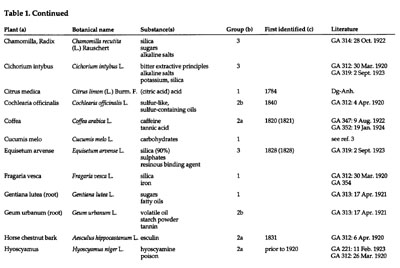
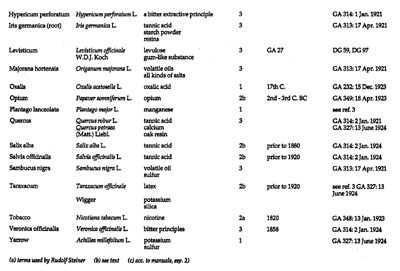
Table 1 lists references known to have been made by Rudolf Steiner to
constituents of 35 plants. Three of these were personal communications to
individuals who later put them in writing (marked "see ref. 3" in the table).
The authors felt it was right to include them as they show good agreement
with the other references.
In most cases the action, generally a medicinal action, of the plant was
shown to be at least partly due to the substance in question. The statements
relating to actions are important to interpret, but they should be considered
in context The original sources - or Krueger(3) - are therefore included. It has
to be stressed that the relationship between a particular constituent and a
specific action should not automatically lead to the assumption that the
constituent causes the action. The presence of a constituent may perhaps be
taken to indicate that higher forces are at work. Rudolf Steiner has shown
this, for instance, in the case of the alkaloids (atropine; GA 221,11 Feb. 1923).
These forces would then be the active principle. It must also be stressed that
individual constituents must, of course, be considered in conjunction with
other characteristics. Thus lemon is important not only because of citric add
but also for the "leathery skins" (GA 319, see also Pedersen(8)).
Rudolf Steiner's references may be considered from different points of
view. We know that Steiner sometimes referred to higher dynamics by the
name of the substance, e.g. silica, they have created. Thus he spoke of the
calcium content of oak, the silica content of the earth's crust or of common
horsetail. Reference might be made to "people who introduce too much
nicotine into their bodies" (GA 348), or a description given of formic acid
synthesis by isolating the oxalic acid from clover and heating this with
glycerol (GA 232). The working hypothesis on which the list is based was that
reference was made to the substance where quantities or concentrations were
given, but that in other cases different interpretations are possible. Where
specific physical substances such as esculin are mentioned, the authors felt
that knowledge of these must derive from experimental work or, in Steiner's
case, study of the relevant literature rather than spiritual scientific research. It
is likely that at least some of the remaining statements also derive from the
scientific literature.
Interpretation, therefore, depends on knowing the literature likely to
have been available to Rudolf Steiner. His private library includes only
Dinand's Taschenbuch der Heilmittel (pocket manual of medicines) and
Domblueth's Arzneimittel der heutigen Medizin (drugs used in modern
medicine) (1923), neither of which refers to constituents (personal
communication, W.F. Daems 1987). A search was therefore made for textbooks and
manuals using the same formulations as those given by Steiner (see literature
list B).
As it is generally thought that Rudolf Steiner only or mainly referred to
common substances, the main criterion for presenting the references was
whether they concerned only common substances or - perhaps in addition -
less common ones.
The former are known as "primary constituents." Being part of normal
plant metabolism they are found in all plants. If such a constituent has not yet
been found in a plant, it means that further investigations using improved
methods, are required.
The main groups of primary constituents are carbohydrates (e.g. monosaccharides
such as glucose and fructose and polysaccharides such as starch
and cellulose), proteins and nucleotides (including monomers such as amino
acids and purines), fats (e.g. triglycerides and phospholipids) and inorganic
matter (e.g. potassium, calcium, magnesium, iron, manganese and silica).
Plants only differ in the amount of these substances they contain, except that
some degree of individualization exists for nitrogen-containing polymers.
Less common substances, known as "secondary constituents," are only
found in some plants and may therefore be taken to indicate variations in
metabolism. A secondary constituent may also be seen as the product of a
deviation from archetypal plant biochemistry, analogous to the concept of
the archetypal plant used in plant morphology. Examples of secondary
constituents are glucosides, alkaloids, the constituents of volatile oils and
tannins.
Information supplied
Only primary constituents were mentioned for 10 plants (see Table 1). The
question to be considered in this case is why they were referred to in
connection with the medicinal actions of those particular plants. It may be
assumed that in the case of clover and lemon the reason was the high
concentration of the substance in question. With other plants such as
Cucumis, Capsella and Fragaria it has to be accepted that substances were
mentioned that do not play an unusual role in the plant concerned, at least
not from the point of view of materialistic modem science.
Birch may serve as an example, though it is also a special case, because
apart from the potassium salts Rudolf Steiner also mentioned dynamics or
processes. Birch bark contains potassium salts in concentrations that do not
go beyond the usual (0.05 - 0.10 - 0.17 - 0.29%(4); the caldum content is higher
than usual (0.28 - 0.50 - 0.65 - 1.28%(4)). These substances may perhaps be
considered in terms of seasonal variation or in conjunction with other constituents
and processes. The term "protein-producing powers" used in connection with
the leaves does, of course, dearly refer to the dynamics. The protein
content of the leaves is relatively high (11 -14 - 17 -19.8% of crude protein
calc. w. ref. to dried subst.(4)) but does not essentially differ from concentrations
found in other plants, not even in terms of seasonal variation.(9)
A second group consists of 12 plants where only defined (e.g. nicotine,
Group 2a, 6 speces) or at least identifiable (e.g. tannin. Group 2b, 6 speces)
secondary constituents were mentioned, sometimes in addition to primary
constituents. Table 1 shows that the occurrence of these substances was
already known and reported in the literature at the time when Rudolf Steiner
gave his lectures. In some cases reference is made to toxic effects (Amygdalae,
Hyoscyamus, Tabacum, less obviously so Papaver), which depend on the
concentration, in others to methods of obtaining the substance from the plant
(tannic add from Quercus, Salvia and Salix), with the substance rather than
the plant essentially responsible for the medicinal action (tannins and bitters,
GA 314). It may, therefore, be assumed that in this case the substance is
meant.
A question still to be investigated in pharmacy is the extent to which the
extract should be purified. Total extracts are generally used nowadays; esculin is, however, available in its pure form.
Six plants for which an exactly-defined single substance was mentioned
are of special interest. The substances are four powerful toxins, two of which
are used in conventional medicine, a less powerful stimulant (caffeine) and a
substance with a special relationship to light (esculin). The first five contain
nitrogen (alkaloids and caffeine, which is similar to an alkaloid). According
to Rudolf Steiner these are produced because the astral acts directly on the
physical, bypassing the etheric (GA 221, 11 Feb. 1923). This is an important
statement when we consider the ranking value of the substance, a subject we
will not discuss in the present context.(6)
With the remaining 13 plants, not all the terms used can be fully
correlated with specific constituents so that we have a wider range of
potential interpretations. Some of these terms are ambiguous or no longer
used today. Correct interpretation depends on knowledge of whether those
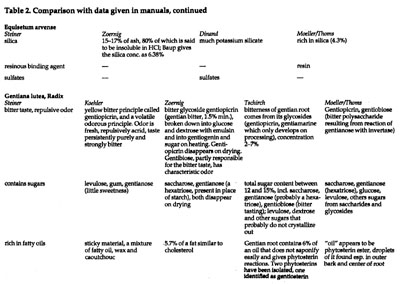
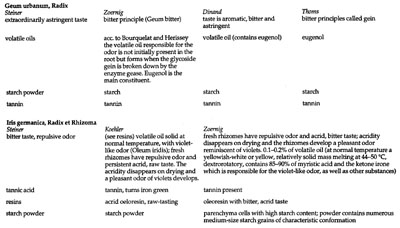
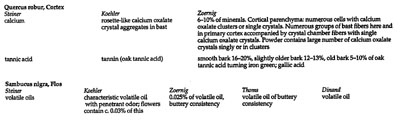
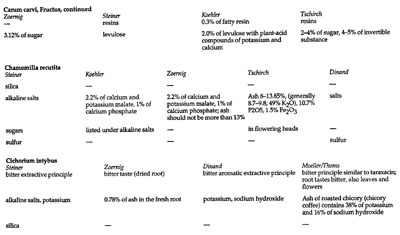
terms were used at the time and, if so, what they signified. We have compared Rudolf Steiner's references to these plants (and to
Geum and Gentium) with information given in such major manuals from the
early twentieth century as we have been able to track down (see Literature B),
including the main work on pharmacognosy (Tschirch). The most important
items of information given in the manuals relating to plants for which several
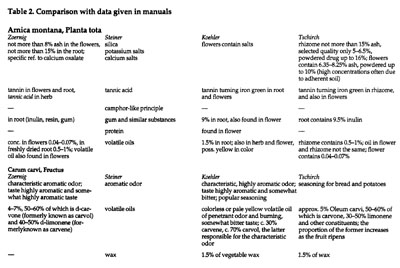
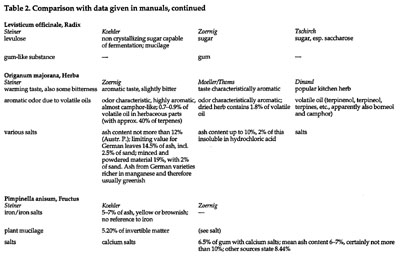
constituents were mentioned have been listed in Table 2. Rudolf Steiner often
used highly specific terms to describe odor and taste, characteristics that
relate to the constituents, and these instances have also been included.
In the case of Arnica, silica and "camphor-like principles" could not be
traced. The former, called the "basic substance" by Steiner is, of course,
present. The term "camphor-like" remains inexplicable, as it is not connected
with reference to the volatile oil. Rudolf Steiner refers to this substance as the
"actual sedative" so that we have to take the term to refer not to substance
but medicinal action. Arnica thus ought to have an action similar to camphor.
In the case of Carum carvi, agreement between statements by Steiner and
Koehler is complete.
Nothing has been found, even in the more recent literature (Voronkov et
al.(10)) on the silica content of chamomile. Bockemuehl(1) found 2.6-4.2% of
silicates in the root ash. To our knowledge, sulfur does not occur in elemental
form in the plant kingdom. We therefore consider Dinand's reference to this
to be an error; none of the other sources refers to it. A probable conclusion is
that Steiner either accepted Dinand's erroneous statement, or he was not
speaking of the substance in this case. The idea that this concerns a different
aspect of (he sulfurous is supported by the description of chamonule root in
GA314. This is preceded by a general discussion of silica, sugars and alkaline
salts as well as the "flower which contains sulfur." It should be possible,
according to Steiner, to produce sulfur from the latter which, of course, is
only feasible if "sulfur" is taken to be sulfurous substance-in our view in the
form of the volatile oil. This also agrees with the formulation used in die
lecture of 5 January 1924 (GA 316) where Steiner described the threefold
plant in terms of scent, leaf and root Discussing the "scented" aspect of (he
plant, he said, for instance: "And because the activity from which scent arises
exists in its most concentrated form in sulfur, we would be right to follow the
medical terminology of the past and call the spiritual extractive principle in
the plant through which scent arises - a principle that causes longing to arise
in the elemental spirits - the sulfur principle in the plant" He concluded with
the 6 meditations for physicians; the 1st and 4th are important in the present
context:
1 Spirits of healing,
you unite
with the blessed sulfur
of ethereal fragrance.
4 I seek to unite my soul's wisdom
with the fire
of that fragrance.
In this lecture, the term "sulfurous" is synonymous with "the spiritual
extract principle" in the plant, or the dynamics that result in scent production.
The interpretation is possible, therefore, that with reference to chamomile
the term "sulfur" referred to the scent substances and hence also to the
dynamics that produce them.
For Chicorium, again no reference to silica could be found. Later on, 13%
of silica was found in the root ash.(10)
In the case of the common horsetail, the term "sulfates" was only found
in Dinand. This is interesting in view of the fact that Equisetum species
cumulate sulfates and contain unusually high concentrations of these, Equisetum
arvense 4.3-17% of sulfates in the ash or 0.7-3.5% of dried matter.(5a,b) The
nature of the "resinous binding agent" is still open to question; Moeller/
Thorns do speak of resin, but no resins have so far been found in the plant.(5a)
Pectin, the only substance in Equisetum arvense known to have binding
properties, is present in fairly high concentrations(5) but cannot really be called
resinous. The concentration of silica given (90%, GA 327) could not be found
anywhere else.(5) It probably means 90% of the ash.
The details given for Gentiana lutea have been verified. Apart from the
difference between "sugar-containing" and "levulose," agreement with
Koehler is complete. Agreement between Steiner and both Zoemig and Dinand is complete
for Geum urbanum. Reference to the taste suggests that Dinand was the
source. Details given for Iris gennanica agree best with Zoernig and Tschirch.
Zoernig's description of Origanum majorana does not entirely agree with
the details given by Steiner; the words "all kinds of salts" - even adding
"especially in marjoram" are unlikely to be based on Zoernig. Moeller/
Thorns or Dinand may have been the source.
For Pimpinella anisum iron could not be confirmed, and mucilage (gum)
only within limits.
The information given on oak bark agrees best with Zoernig, who does
not give the calcium concentration, however. Steiner spoke of 77% of calcium
in oak (GA 327), but we think the term "calcium structure" indicates that the
action is partly explained not in terms of the physical substance but by the
way oak deals with calcium.
Sulfur has never been found in elder flowers (see under chamomile).
Discussion
Investigation has shown that Steiner cannot have taken all his information
from one of the manuals we checked. He must, therefore, either have used a
manual we have not been able to discover or several manuals and perhaps
papers published in journals. It would be difficult to check this out, especially
as there is also the possibility that some of Steiner's statements (camphor-
like?) have been wrongly reported.
The majority of terms investigated, some even at the level of word
combinations, e.g. unpleasant odor, could not be found in the works of
Zoernig or Koehler. The conclusion is, especially as the term "levulose" used
by Steiner apparently appears only in Koehler, that this book was available to
Steiner, possibly through Mr. Spiess or Dr. Schmiedel (a copy of it exists in
the library at Weleda Schwaebisch Gmuend). On the other hand, the fact that
both Steiner and Moeller/Thoms use the unusual term "resin" suggests that
this work was also available to Steiner. Reference to "sulfates" and the
erroneous reference to sulfur by Dinand make it seem possible that Steiner
had this manual available as well.
The term "levulose" still remains to be explained [the old German term
used literally means "mucilage sugar." (Translator)]. Where Steiner and
Koehler refer to this, the others speak of sugars {Carum, Levisticum) or specific
mono- and disaccharides {Gentiana). According to Moeller/Thoms/ it is
actually a synonym for "fructose." Where Steiner uses this term, therefore, it
means mono- and oligosaccharides.
As already mentioned, use of the terms "resin" and "resinous binding
agent" does not always agree with the specialist terminology in the field. It
has been fully discussed elsewhere that, for Steiner, the perceptibly sticky
nature of the substance was a dominant feature.(7)
Summing up, it may be said that all references listed under Group 2 and
the majority of those in Group 3 (Table 1) may be taken to refer to substances.
The exceptions and some of the substances have been discussed above.
The emphasis has been on constituents and the specialist literature in this
paper. For further work on the subject, with the aim of developing criteria for
the further development of anthroposophically-oriented medicine and
pharmacy, particular importance attaches to Rudolf Steiner's descriptions of
how higher principles, e.g. the astral, cause or influence the synthesis of
certain substances.
Peter A. Pedersen, Pharmacist Ulrich Meyer, Pharmacist
Albert Proebsti, Chemist Wala Heilmittel GmbH
Weleda AG Bosslerweg 2
Postfach 1309 D-73087 Eckwaelden/Bad BoU
D-73503 Schwaebisch Gmuend Germany
Germany
References
A) Works and statements by Rudolf Steiner
GA 27. Steiner R,, Wegman I. Fundamentals of Therapy Tr. E. Frommer, J. Josephson. London: Rudolf Steiner Press 1983.
GA 221. Earthly Knowledge and Heavenly Wisdom (GA 221). February 1923. Tr. not known. New York: Anthroposophic Press 1990.
GA 230. Man as Symphony of the Creative Word. Tr. J. Compton-Bumett, rev. K. Kiniger, A.Meuss. London: Rudolf Steiner Press 1991.
GA 232. Mystery Knowledge and Mystery Centres. Tr. E. Goddard, D. Osmond. Domach. London: Rudolf Steiner Press 1973.
GA 312. Spiritual Science and Medicine. Tr. not known. London: Rudolf Steiner Press 1975.
GA 313. The Spiritual-Scientific Aspect of Therapy. Tr. R. Mansell. Long Beach CA: Rudolf Steiner Research Foundation 1990.
GA 314. Fundamentals of Anthroposophical Medicine. Stuttgart, 26, 27 (2 lectures) and 28 Oct.1922. Tr. A. Wulsin. Spring Valley NY: Mercury 1986.
GA 316. Eight Lectures to Doctors. Domach, 2-9 Jan. 1924. Tr. not known. MS translation R % at Rudolf Steiner House Library, London.
Easter Course for Medical Students. Lecture of 22 April 1924. Tr. R. Mansell. Long Beach, California: Rudolf Steiner Research Foundation 1984.
GA 319. Principles of the Methods of Healing in Anthroposophical Therapy. Penmaenmawr, 28 Aug. 1923. Tr. unknown. MS translation R 98, Rudolf Steiner House Library, London. Anthroposophische Menschenerkenntnis und Medizin. Den Haag, 15 Nov. 1923. Not translated. What Can the Art of Healing Gain through Spiritual Science? Amhem, 17,21 & 24 July 1924. Tr. G. Kamow. Spring Valley: Mercury 1986.
Anthr. Therapy, Lectures to Doctors. London, 2 & 3 Sept. 1923. Tr. R. ManseU. Long Beach, CA.: Rudolf Steiner Research Foundation 1984. An Outline of Medical Research. Report of 2 lectures. Tr. not known. 28 & 29 August 1924. London: Rudolf Steiner Press 1939.
GA 327. Agriculture. Lecture of 11 June 1924. Tr. G. Adams. London: Bio-Dynamic Agriculture Association 1977.
GA 347. The Human Being in Body, Soul and Spirit; Our Relationship to the Earth. Tr. J. Reuter and S. Seiler. New York Anthroposophic Press & London: Rudolf Steiner Press 1989.
GA 348. Health and Illness, vols. I and H. Tr. M. St Goar. New York: Anthroposophic Press 1981 & 1983.
GA 349. Vom Leben des Menschen und der Erde. Ueber das Wesen des Christentums. 13 lectures, Domach 1923.1. Auflage. Domach: Rudolf Steiner Verlag 1961.
GA 352. Natur und Mensch in geisteswissenschaftlicher Betrachtung. 10 lectures, Domach 1924.2. Auflage. Domach: Rudolf Steiner Verlag 1967.
GA 354. The Evolution of Earth and Man. 14 Lectures, Domach 1924. Tr. G. Hahn. London: Rudolf Steiner Press 1987.
KG III. Hilma Walter. Abnormitaeten der geistig-seelischen Entwicklung in ihren Krankheitserscheinungen und deren Behandlungsmoeglichkeiten. Wegleitung zum Verstaendnis einer Sammlung von Krankengeschichten mit Hinweisen wn Dr. Rudolf Steiner. Arlesheim: Natura 1955.
KG V. Hilma Walter. Die Pflanzenwelt. Versuch eine Pflanzensystematik als Verstaendigungs-grundlagefuer die Therapie. Krankengeschichten und Berichte mit Hinweisen von Rudolf Steiner. Arlesheim: Natura 1971.
Dg. Krankeitsfaelle und andere medizinische Fragen, besprochen mit Rudolf Steiner;
bearbeitet und gesammelt von Dr. Friedrich Husemann im Klinisch-Therapeutischen
Institute in Stuttgart, herausgegeben von Dr. A. G. Degenaar. Manuskriptdruck. Stuttgart
1939.
B) Handbooks published in the early 20th century
Dinand AP. Handbuch der Heilpflanzenkunde 1. Auflage. Esslingen/Muenchen: J. F. Schreiber 1921.
Dragendorff G. Die Heilpflanzen der verschiedenen Voelker und Zeiten. Stuttgart: Ferdinant Enke 1898.
Moeller J, Thorns H. Real-Emyklopaedie der gesamten Pharmazie. 1. Auflage. Berlin/Wien: Urban & Schwarzenberg 1904-1914.
Pabst G. Koehler's Medizinal-Planzen-Atlas. Berlin-Lichterfelde: Hugo Bermuehler 1898.
Thoms H. Handbuch der praktischen und wissenschaftlichen Pharmazie Band V. 1. Haelfte. Berlin/Wien: Urbahn & Schwarzenberg 1929.
Tschirch A. Handbuch der Pharmakognosie Band n. Leipzig: Chr. Herm. Tuachnitz 1912-1917.
Zoemig H. Arzneidrogen. Leipzig: Dr. Wemer Klinkhardt 1909 (L Teil) und 1911 (H. Teil).
Further literature
1 Bockemuehl J. Vorlaeufiger Bericht ueber Versuchsarbeiten mit Kamille in Zusammenarbeit mit der Weleda Arlesheim. Unpublished. Forschunglslaboratorium am Goetheanum, 27 Aug. 1974.
2 Karrer W. Konstitution und Vorkommen der organischen Planzenstojfe (exklusive Alkaloide). Basel: Birkaeuser 1958.
3 Krueger H. Heilmittelangaben Rudolf Steiners. Domach: Medizinische Sektion der Freien Hochschule fuer Geisteswissenschaft am Goetheanum 969-1979 (unpublished).
4 Pedersen PA. Phytochemie und Pharmakologie der Birke - Betula alba L. Eine Uebersicht der Literatur bis 1975 - herausg. 1976 (unpublished).
5 a) Pedersen PA. Equisetum arvense L. Eine Uebersicht der chemischen und pharma-kologischen Untersuchungen. 1978 (unpublished).
b) Strueh H-J. Equisetum und Kiesel. Tycho de Brake Jahrbuch 1989.
6 Pedersen PA. Die Stofflichkeit der Ranunculaceen als Ausdruck der Umkreiskraefte.
Unveroeff. Manuskript. September 1983.
7 Pedersen PA. Was sind Bindemittel und welche Bedeutung haben sie bei der Herstellung von Heilmittel-Kompositionen? Vortrag bei der Jahresinformationstagung fuer anthroposophische Aerzte am June 17,1987 in Schwaebisch Gmuend (unpublished).
8 Pedersen PA. Pharmazeutische Betrachtungen zu Gencydo. Merkurstab 1990; 43:98-107.
9 Rysin LP, Antyukhina V. Chemical composition of grass-undershrub plants in pine forests of Moscow district. Lesovedenie 1977:36-4:7.
10 Voronkov MG, Zeichan GI, Lukevitz E. Silizium und Leben. Biochemie, Toxikologie und Phannakologie der Verbindungm des Siliziums. Hrsg. K. Ruehlrnann. Dresden/Berlin: Akademie Verlag
1975.