IntroductionThe following concise presentation will be comprehensible
only to those familiar with the basis of an anthroposophically extended
medicine. Nevertheless we will try to use only such concepts as can be
understood from the text itself.
Cardiodoron consists of an extract of Primula off. flos 2,5
g, Onopordon acanth. flos 2,5 g and Hyoscyamus niger herba D 2 10,0 g/100 g.
According to general experience (Weckenmann 1981) and systematic testing it is
indicated in the case of vasolability and orthostatic hypotension. Figures 1-3
illustrate this by means of pulse, pulse-respiration quotient (Q P/R) and
orthostasis quotient. For a better understanding of these parameters we will
explain them for orthostatic lability: in terms of pulse reaction a tachycardic
and a bradycardic form can be recognized. This may serve as a first indication
that the pathological orthostatic phenomenon is not accompanied by a uniform
vegetative tone. On the contrary an increase in vagotonia even to the point of
asympathicotonia as well as an increase in sympathicotonia can accompany
orthostatic insufficiency (Bradbury et al 1925, Reindell et al 1955, Parr 1957,
Thulesius 1976, Osten 1977). This is supported by the fact that periods of
orthostatic lability are found to occur in a diurnal rhythm, the times of
maximum lability occurring at about 3 a. m. and from 12 a. m. to 2 p. m.
respectively (Ashkoff et al 1966). At night a narrowing of blood pressure
amplitude is predominant, during daytime tachycardia. The former indicates
predominating vagotonia, the latter predominating sympathicotonia. (Blood
levels of noradrenalin do not correlate with the severity of the pathological
orthostatic phenomenon but do correlate with pulse frequency, from Vendsalve
1960 according to Thulesius 1976).
It may at first glance seem surprising that a
sympathico-ergotropic reaction could be unfavorable for orthostasis. This will,
however, be understood if we take trophotropia and ergotropia to be opposite
extremes of a polar organization in the sense in which Rudolf Steiner develops
these in his first medical course (1920). This polarity is the basis for
specific physiological functions on the one hand but on the other hand it
provides a natural disposition to illness, if the extremes are not kept in
balance. Those processes and organic structures which mediate between the two
sides and maintain an equilibrium between them are in this sense the source of
health (Weckenmann 1980 a). We will call them the "middle organization".
The pathological orthostatic phenomenon can be induced from
polar extremes — resulting in a bradycardic and a tachycardic type. Both types
of orthostatic reaction have in common, that the mediating functions are not
sufficiently effective.
According to Steiner the respective rates of pulse and
respiration to each other as expressed in the pulse-respiration quotient (Q
P/R) indicate the polar organization and how it can be harmonized by the
rhythmical central organization represented in the heart and the lung. Steiner
indicates that the healthy relation of heartbeat and respiration centers around
a quotient of four heartbeats to one respiratory cycle of breathing in and out
(Q P/R = 4/1 = 4). If heartbeat slows down or respiration increases out of proportion
the Q P/R will become smaller — if pulse-rate increases or respiration slows
down Q P/R will increase.
Hildebrandt (1960, 1976, 1977) demonstrates that a low Q P/R
at rest indicates trophotropism and that an increased Q P/R indicates
ergotropism. We understand trophotropism to be a preponderation of the
biological functions of growth, regeneration and anabolism that predominate
naturally during infancy and childhood but also during sleep at night — and we
understand ergotropism to be the preponderation of those functions that are the
basis of reactions to external stimuli observed in their fullest sense only
during periods of waking which are periods of predominating metabolic
katabolism.
From a study of the phenomenon of orthostatic collapse — taking
it to be a tachycardic form of orthostatic lability — Steiner demonstrates
that an increase in Q P/R indicates the strong katabolic effect of the nervous
system on metabolism and conversely that a decrease of Q P/R indicates a weak
effect due to a "loosened" connection between the two. (See
Bibliographical Index no. 348).
The tachycardic form of orthostatic lability is determined
by a hyperactivity from the side of the nervous system, associated with fear
while cerebral circulation diminishes, in a sense "not healing" the
overactive nervous functions. After such a collapse, the patient is usually
temporarily unconscious and the relation of pulse and respiration is reversed
—Q P/R falling below 4 just as in case of bradycardic orthostatic lability from
the very beginning.
In bradycardic orthostatic lability the opposite of the
above is true. The nervous system is not overstimulated and forced into a
state of high activity but it is dulled and, figuratively speaking, sinks into
metabolism, being absorbed by it and thereby not leaving forces for conscious
awareness. It is a state similar to that which is passed through during
embryonic growth and to a lesser extent during infancy and in the sleeping
phases of life. In such a situation or rather at times when Q P/R tends. in
this direction orthostatic can not react sufficiently to the stimulus of the
altered and upright position. Some patients show this kind of orthostatic
reaction — it is related to the bradycardic form that may occur physiological
at night and corresponds to the vagovasal syncope.
Cardiodoron seems to be effective in both types of
disturbances, if actual orthostatic lability is present (Weckenmann 1981 a). It
is not yet clear whether or not it is also effective in the case of
trophotropic and ergotropic hypertension. Inquiries with colleagues indicate
that the results are generally better with hypotonic patients than with
hypertonic patients.
The purpose of the following study was to determine whether
individual case studies would yield fine points that are lost in systematic
collections and to find out to what extent individual case studies would agree
with the results from more generalized studies.
Methods
The patients described here necessarily underwent a certain pre-selection since on the
one hand my previous knowledge of them — whether right or wrong — entered in,
and on the other hand only certain patients came to me. Hence this group is not
a random sample, but speaks for itself. Thus this study is intended to let the
reader experience how observations — judgments — decisions — treatments —
renewed observations — etc. interweave in each unique encounter of patient and
doctor. This gives the report a personal style, which I do not wish to avoid.
It will be less important for the reader to discover precisely when
Cardiodoron is indicated than for him to follow the course presented here,
which may help him think over his own way of proceeding in similar situations.
Thus the study does not intent to evoke imitation, but to stimulate the
reader's own presence of mind for future patient - doctor encounters.
Furthermore, observations of individuals can also lead us to
recognize the "type". The type, as it is meant here, need not be
identical with a statistical average. It comes to the observer intuitively after evaluation of a particular case.
If individual cases are to be evaluable in this sense, we
require above all an accurate description of the symptoms and their modalities,
as well as of the observations made during examination (see also Hahnemann).
Then in the subsequent consultations one must ask for the symptoms again, check
for new ones, and revue the pathological observations. For that purpose in my
outpatient records I write down all symptoms and observations under each another
in a column, and the days directly next to one another. I use symbols to mark
the change in symptoms and findings (Fig. 5).
The patients are asked to speak freely for themselves. For
me, questions serve to clarify what has been said or to stimulate further
speaking. I ask either quite open questions, not intended to lead, or yes-or-no
type questions. As a matter of routine I ask only after appetite, weight, bowel
movement and so on. In the following cases the investigations and observations
of the course of the disease are unsystematic since they are oriented solely
around the therapeutic requirements. I will use diagnostic concepts only for
the sake of making myself understood.
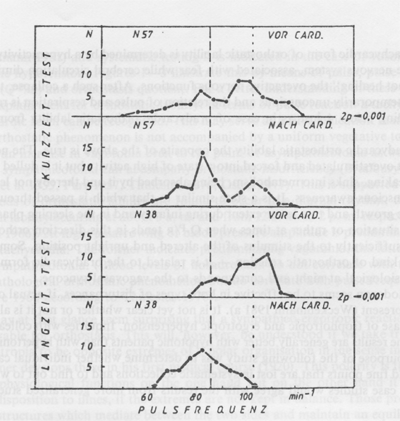
Fig. 1
Average pulse rates of
orthostatically labile patients standing upright — before and after
Cardiodoron. In long term testing (Langzeit-Test) two tests were done before
giving Cardiodoron and two tests 40 days and 80 days after therapy with 5 x 20
drops Cardiodoron respectively. Averages were made of the results before and after
Cardiodoron.
In short term testing
(Kurzzeit-Test) one test was done before giving Cardiodoron and one test an
hour after an injection of I ml Cardiodoron 5 % i. m.
It is obvious that the
double peak in frequency distribution still remains after therapy. The
difference was calculated by the Wilcoxon test.
It can be tested relatively quickly whether a remedy lives
up to expectations or not, so long as an effort is made to give single remedies. Single-remedy
prescription is much easier to carry out in homeopathic - anthroposophic therapy
than in allopathic, since homeopathic remedies have a greater sphere of
efficacy than allopathic ones. The reason for this is that the therapeutic
range of a homeopathic substance includes all the so called side effects — allopathically
speaking — as its chief effect. If it
takes effect after a number of unsuccessful therapeutic attempts have been made
and if it continues to work for an number of months afterwards, then the
likelihood of a placebo effect is small.
In order to provide for good conditions, I chose only such
patients who had had Cardiodoron alone or with whom Cardiodoron had been added
to another therapy of long standing (which was also continued).
Cardiodoron was always administered orally, usually 3 x 20
drops/day.
In the following reports I do not mention all findings,
since this is tiring and disturbs clarity. I will however be glad to reply to
inquiries.
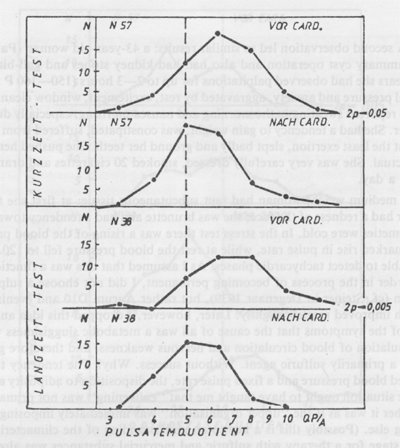
Fig. 2
The frequency
distribution of pulse — respiration quotient (Q P/A) of orthostatically labile
patients standing upright before and after Cardiodoron given as described in
legend to Fig. 1. The statistical calculations were done according to the
T-Test.
Case histories
[1] At the beginning I would like to present a case of
misjudgment. A 45-year-old leptosome, blonde woman (Patient no. 1) consulted
me. She complained of an inability to walk more than a few hundred meters, and
of tiredness. I observed a strong tendency to blush and a tachycardia with
intermittent atrial flutter. The respiration was slow and she had a round back
and pectus excavatum. The patient spoke hastily and restlessly, and kept
squinting as if in pain. The cause of the atrial flutter was a mitral
insufficiency stage 2-3, which had brought about atrial dilation and
subendocardial damage. The patient had already been treated with Digitoxin and
Verapamil; she refused an operation and asked me if I could do anything else
to help her. Since there appeared to me to be an ergotropic hypocirculation,
hyperventilation and instable weakness, and since the behavior of the atrium
also seemed to fit this picture, I gave Cardiodoron — without success.
This example teaches us that though Cardiodoron affects
functional disorders, it will do so only so long as they are 'on the way' to
becoming organic deformations, but not when they stem from an already existing
organic deformation. The atrium itself was not primarily pathological, and
reacted quite normally to the organically caused congestion — namely with
fluttering. If I wanted to stop this without improving mitral insufficiency, I
would have to suppress the normal reaction of the atrium, i. e. to poison it
permanently, and this lies outside the scope of regulatory therapy.
[2] A second observation led to similar results: a
43-year-old woman (Pat. no. 2) had had a mammary cyst operation and also had
had kidney stones and gall-bladder colics. For 4.5 years she had observed
palpitations for up to 2-3 hours (150-160 P min. -1) with substernal pressure
and anxiety, aggravated by rest, excitement, window cleaning and washing. She
reported sweating in the morning and nausea on rising, especially during change
of weather. She had a tendency to gain weight, was constipated, suffered from
hemmorroids, sweated at the least exertion, slept badly and ground her teeth.
She pushed herself and was over-punctual. She was very carefully dressed,
smoked 20 cigarettes and drank 2-3 cups of coffee a day.
This medium weight woman had taut subcutaneous tissue: at
first she tended to be pale, later had a redness of the face; she was brunette
and had a tendency towards eczema. The extremeties were cold. In the stress
test there was a rising of the blood pressure without any marked rise in pulse
rate, while at rest the blood pressure fell to 120/80 mm Hg. I was unable to
detect tachycardic phases. As I assumed that this was a functional circulatory
disorder in the process of becoming permanent, I did not choose a sulphur
therapy or Scleron (cf. Steiner in Degenaar 1939), but rather Aurum D10 and
evenings Digitalis D3, which improved matters slightly. Later, however, I
dropped this idea and decided in the face of the symptoms that the cause of all
was a metabolic sluggishness with insufficient stimulation of blood
circulation and nervous weakness, and therefore gave Cardiodoron — a primarily
sulfuric agent. Without success. Why? The tendency to react with an elevated
blood pressure and a fixed pulse rate, the disposition to adiposity and the
preclimacteric situation ought to have taught me that "enlivening"
was not primarily the problem; rather it was as if the "upper organization"
was immediately imposing its form on everything else. (Possibly this is a key
to an understanding of the climacteric situation.) Thus the stage for a therapy
with sulfuric and mercurial substances was already passed: in other words, such
a therapy could at best work as temporary "counter measure". Thus the
high blood pressure at this stage appears to me typologically as a connecting
link between the unstable circulatory weakness in the young adult and the
deformation of arterioclerosis in the old. Unpublished studies on orthostatic
reactions have shown that with increasing bradycardia and hypertension the orthostatic
lability yields in favor of regulatory rigidity.
Here the question arises how to interpret tachycardic phases
in this patient. After all, the pathological tachycardia is not related to an
exertion of the organism as a whole but seems to appear autonomously. Phenomena
such as atrial fibrillation, ventrical tachycardia, and others become more
frequent with age. Although in their outer aspect they are mostly
high-frequency disturbances, according to present day views they arise out of
"retardations" of the spread of the action potential, for example,
which permits the occurrence of reentry mechanisms. Since in old age many
processes, especially of the heart, slow down, the danger of developing
autonomous accelerations (secondary tachyarrhythmias) is greater than in
youth, when primary tachyarrhythmias are present more often. One might with all
due caution compare the secondary tachyarrhythmias in some ways with
degeneration in cancer. Cardiodoron appears to me to be a remedy only for
primary tachyarrhythmia. To be sure, it must remain open whether this patient
had a primary or secondary tachyarrhythmia.
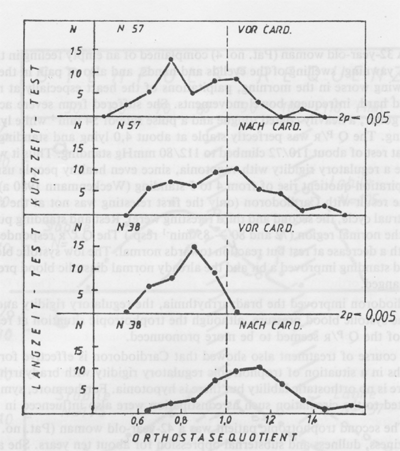
Fig. 3
The frequency
distribution of the orthostatic quotient of orthostatically labile patients
before and after Cardiodoron in short term testing and long term testing. The
orthostatic Quotient (OQ) is a measure for the stability while standing up and
is calculated according to the formula
OQ = X Bloodpressure-amplitude standing
+ 52,5
X Pulse-rate standing
(Weckenmann 1981). Values of < I are an indication of orthostatic
lability. The differences between the results before and after Cardiodoron were
calculated with the T- Test.
[3] A 27-year-old patient came with a similar complaint.
This man (Pat. no. 3), however, complained of shooting pains in the left
chest, ever since childhood, aggravated by excitement, exertional dyspnea,
axillary perspiration, trembling in both arms and numbness of the limbs.
This fair-skinned patient was vasomotorically flushed,
shrugged his shoulders, pulled up his chest in a strange manner, and had loud,
excited heart sounds.
His circulation I evaluated as having a juvenile lability: Q
P/R of 8 with tachycardia of 100 P min-' at rest, labile T in the ECG with
improvement under stress. On the other hand there were signs of incipient
rigidity: blood pressure at rest of 155/90 mm Hg. hypertensive reactions under
stress (100 Watts for 6 min. sitting) to 210/90 mm Hg, and pulse frequency of
only 156 min -1.
I decided on Cardiodoron, giving emphasis to signs of
juvenile disturbance. The shooting pains in the chest, exertional dyspnea,
tachycardia and Q P/R — elevation improved. Whenever he improved, the patient
stopped Cardiodoron, then asked for it again. This indicates that it only
helped temporarily and that it is not the basic remedy. In a following consultation
I should give more importance to the signs of rigidity.
I will now present four cases of patients with
experimentally proven trophotropism. All four are leptosome, thin, pale — but
not from anemia — shy and quiet. No excitement was to be seen in them.
[4] A 32-year-old woman (Pat. no. 4) complained of an empty
feeling in the head with dizziness, yawning, swelling of the eyelids and hands,
and also of pain in the nape of the neck growing worse in the morning,
palpitations of the heart especially at night in bed, chills, and hard,
infrequent bowel movements. She suffered from severe acne, and had a diffuse
goiter, a heavily coated tongue and a pulse rate of 54 min -1 while lying and
only 64 standing. The Q P/R was perfectly stable at about 4,0 lying and
standing. The blood pressure at rest of about 110/72 climbed to 112/80 mmHg
standing. Thus it was necessary to assume a regulatory rigidity with vagotonia,
since even healthy people usually show a pulse-respiration-quotient rise of
from 4 to 5 standing (Weckenmann 1980 a). Fig. 6 illustrates the result with
Cardiodoron (only the first retesting was not at the same time of her menstrual
cycle, the second and third retesting were). Rest and standing pulse-rate rose
towards the normal region (72 and 80 — 85 min -1 resp.) The Q P/R responded to
Cardiodoron with a decrease at rest but reaction towards normal. The low
systolic blood pressure at rest and standing improved a bit and the already
normal diastolic blood pressure remained unchanged.
Cardiodoron improved the bradyarrhythmia, the regulatory
rigidity and also, to an extent, the systolic blood pressure, although the
trophotropic situation at rest, messured in terms of the Q P/R seemed to be
more pronounced.
This course of treatment also showed that Cardiodoron is
effective for a period of 2.5 months in a situation of trophotropic regulatory
rigidity with bradyarrhythmia even when there is no orthostatic lability but
there is hypotonia. Furthermore, symptoms clearly unrelated to the circulation
such as constipation were also influenced in the process.
[5] The second trophotropic patient was a 42-year-old woman
(Pat. no. 5) suffering from dizziness, dullness and substernal oppression for
about ten years. She also suffered from anxiety, perspiration of the head,
tremor and attacks of dyspnea for one year. This leptosome patient had a
delicate, pale face which presented a certain contrast to the slight
accumulation of fat on her legs. The standing test, particularly the last
minutes of it, showed the typical signs of orthostatic lability with a pulse
rate of 84 P min -1, ca. 11 breaths per minute, a Q P/R around 8 and BP at
110/85 mm Hg. This time the decision for Cardiodoron was easy. The patient
took 30 drops every morning. After 30 days the dizziness and the perspiration
of the head were better, and all the other symptoms had disappeared. The blood
pressure amplitude had not improved, but the "rhythmic ordering" had:
84 P min -1, 14-15 Resp. min -1 and Q P/R around 5.5 i.e. near normal. It can
be seen that the improvement of rhythmic ordering alone can be accompanied by
well-being although hypotonia remains the same.
[6] The third trophotropic patient was a 33-year-old man
(Pat. no. 6). He complained of shortness of breath, which always set in on the
day after any physical activity; he also complained of anxiety with tachycardia
before entering a room with unknown people. The patient was thin, prematurely
old with a red face, partially gray beard, and had strikingly unshaply thorax
and abdomen. The Q P/R lying was 20 (!) and 9,9 standing; bradypnea was
extreme, improving under stress. The strong relative bradypnea with tachycardia
induced by anxiety prompted me to give Cardiodoron. After 4 months of treatment
the complaints had almost completely disappeared, even in situations where the
patient — as he said earlier — would have suffered definite difficulties. This
result could be maintained for more than a year with a regime of 30 drops of
Cardiodoron in the evening.
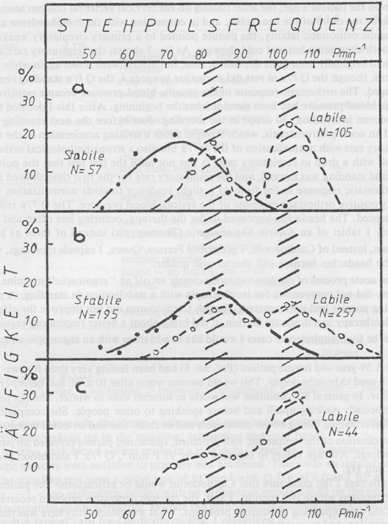
Fig.4
Frequency distribution
in percent of pulse rates of orthostatically labile patients while standing
(three random samples).
a) Weckenmann 1975,
b) Patients of the
Carl-Unger-Klinik 1966-1975 (unpublished),
c) Weckenmann 1973.
[7] The fourth
trophotropic patient was a 34-year-old woman (Pat. no. 7) with a 12 year
history of migraine-like pains in the nape of the neck and back of the head
with simultaneous vomiting, which were independent of time of day, weather or
menses. For 4 years she had also had a lymphoedema on her right leg, which had
appeared without apparent cause. The patient had a tendency to chills and had
cold extremities.
The x-rays showed a slight spondylosis in the lower and mid
cervical vertebral column with irregular lordosis and leftsided scoliosis. The
standing test presented the typical picture of a bradycardic orthostatic
lability with an orthostasis quotient of 0,84 and a Q P/R of 6,7 standing.
Given the patient's age, the local finding on the cervical
vertebral column seemed too small to be the cause of the headaches; and in
connection with the lymphoedema and the bradycardic orthostatic lability, the
picture pointed to a primary circulatory weakness. I began with alternating hot
and cold showers. As fig. 7 shows, the respiratory rate at rest, which had
originally been quite depressed, rose, but always went down again while standing.
Thus, though the Q P/R at rest did normalize towards 4, the Q P/R standing
remained unchanged. The orthostatic response of the systolic blood pressure
became positive. The diastolic blood pressure had been normal from the
beginning. After this I decided to give Cardiodoron in addition, 30 drops in
the morning. Just before the next standing check she had an acute
gastroenteritis, which brought about a striking acceleration of the resting
respiratory rate with normalization of the Q P/R but also a strong pathological
orthostatic response with a drop in respiratory rate. It was not until the last
test that the pulse rate at rest and standing was normal, and the respiratory
rate for the first time showed a positive orthostatic response in the form of
a slight tendency towards normalization with a strongly positive orthostatic
response of the systolic blood pressure. The Q P/R remained uninfluenced. The
headaches improved under the therapy, occuring less often and requiring only 1
tablet of an Aspirin like analgetic (Thomapyrin) instead of three as before.
Then, instead of Cardiodoron, I prescribed Ferrum/Quarz, 1
capsule mornings, whereupon the headaches became still shorter and milder.
The acute process of the gastroenteritis clearly set off an
"ergotropic" stimulus. This, however, did not compensate for
trophotropia with a stabilisation in standing. A proper mediating process had
not occurred. Though Cardiodoron did not improve the effects of the
hydrotherapy in a dramatic fashion, it did bring about a better respiratory
regulation.
To the four trophotropic cases I would like to add three
with an ergotropic autonomic quality.
[8] A 39-year-old female patient (Pat. no. 8) had been
feeling very tired for two years. She felt a need to breathe deeply. This would
become worse after 10 a. m. and before changes of weather. In general her
condition was worse in summer than in winter. She felt palpitations,
especially walking uphill and before speaking to other people. She complained
of abdominal cramping during bowel-movements and of chills. She had an
exited-depressed air.
Examination of the leptosome, well-groomed, suntanned
patient revealed no pathological findings. Average values in standing were: 95
P min -1, Q P/R 7 and blood pressure 119/95 mm Hg.
In this case I felt quite sure that Cardiodoron would be
efficacious. The patient lost all her symptoms within two months. Later, the
reactive depressive problem recurred but without the accompanying circulatory
problems. What was noteworthy here was the typical aggravation during summer
and warm front phases, which always favor hypotonic circulatory disturbances.
Nevertheless Cardiodoron improved the situation during the summer months from
June till August, though the patient had no holidays.
[9] The next patient a woman of 30 (Pat. no. 9), had already
had a tachycardic orthostatic lability which had reacted to Cardiodoron. Now
she came again at the age of 35, this time complaining less of orthostatic
symptoms than of inner vibration and the need to breathe deeply. She did not
feel the tachycardia very strongly at all. It was striking in this patient's
case that several unsuccessful attempts at therapy preceded Cardiodoron, under
which there was a rapid improvement. No relapse came until three years later,
although the patient took no medicine in the meantime.
[10] The third patient (Pat. no. 10) was 45-years-old when
she came to me. She complained of migraine with nausea and vomiting,
aggravated before menses and from overwork, of upset stomach, flatulence, outbreaks
of perspiration, rotary vertigo on standing up, difficulty waking up in the
morning, exhaustion and cold hands.
The slim, dark-blond patient spoke in a strikingly clipped
and fast manner; her throat and nape muscles were sensitive to pressure and
hardened. There was an osteochondrosis C3-6, the standing test gave a pulse
rate of 91 min -1 with Q P/R of 6.0 and BP at 115/84 mm Hg. — i.e. an
orthostatic lability with an orthostasis quotient 0,82 on the border between
tachycardia and bradycardia. Despite the pathologic-anatomical alterations,
this seemed such a typical case for Cardiodoron that I prescribed it.
After two months the perspiration outbreaks had disappeared.
The improvement of flatulence symptoms was striking, although the therapy
consisted only of a "circulatory remedy". Here we touch on the
question of the so called secondary symptoms — say so called, because there
really is no such thing. A symptom can be less prominent or troublesome, but it
is just as characteristic. The remarkable thing is how such symptoms can also
disappear under Cardiodoron if the total picture is correct.
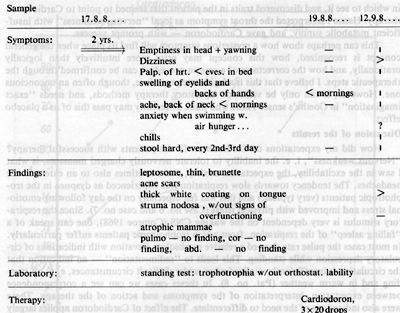
Fig. 5
Sample Outpatient Record.
Symbols: ? can't judge; — unchanged; > improved; | disappeared; <aggravated; —> Year duration of symptoms.
Another example of this was given to me by a woman who came
to me at the age of 40 (Pat. no. 11) with a 10-year history of unclassifiable
pain in the joints. A treatment with vegetarian diet, Folio Betulae, mustard
plasters, abdominal compress, Equisetum D15 / Formica 1310, Betonica D3 / Rosmary D3 brought good
improvement.
Then, however, the patient suddenly complained of nausea
while swallowing. I found no objective alterations: the symptom was a riddle at
first. I tried to find a greater context in which to see it, and discovered
traits in the patient that seemed to point to Cardiodoron therapy. Hence I
interpreted the throat symptom as local "nervous weakness" with insufficient
metabolic supply, and gave Cardiodoron — with prompt success.
This can perhaps show how a mysterious symptom will find its
place when the general concept is recognized, how this concept may arise more
intuitively than logically or rationally, and how the correctness of a certain
procedure can be confirmed through the therapeutic steps. I believe that this
is a legitimate procedure, though often an unconscious one. However, it can
only be valid for regulatory therapy methods, and needs "exact imagination"
in Goethe's sense. Those who think differently may pass this of as a placebo
effect.
Discussion of the results
How did my expectations of Cardiodoron fit the patients with
successful therapy? "Nervous weakness", i.e. the inability to
tolerate nervously charged moments, is what I saw in the excitability, the
expectation anxiety, and sometimes also to an extent in the headaches. The
tendency towards slow respiration was experienced as dyspnea in the trophotropic
patients (very typical!) and this was felt especially on the day following
emotional stress and improved with physical stress (Case no. 6 and case no.
7). Since the respiratory stimulus is very dependent on the waking CNS (Comroe
1968), one can speak of a "falling asleep" of the respiration, from
which trophotropic patients suffer particularly. In most cases the pulse rate
showed a relative or absolute elevation with indications of circulatory
depression while standing. This leads to "sedimentation" — an
indication that the circulation is insufficiently vitalized when under
difficult circumstances, e. g. on standing and in warm weather (Pat. no. 8).
In theses cases we can see a correspondence between expectation, interpretation
of the symptoms and action of the therapy. There were also indications of the
need to differentiate. The effect of Cardiodoron applies largely to primary
functional disturbances and not to secondary ones caused by anatomical deformations
(Case no. 1). Therefore, prescription of Cardiodoron in advanced age should be
carefully considered. However, premature aging in relatively young adults does
not seem to be a contra indication (Case no. 6).
It can be seen that hypertension becoming stable and
incipient signs of bradycardic rhythmic disturbances with retardation of the
spread of the action potential, even when this leads secondarily to
tachycardia, cannot be brought to a long-term cure with a sulphur therapy such
as Cardiodoron (Case no. 2). On the other hand cases of rigid regulatory patterns
with hypotonia but without orthostatic lability are clearly still treatable
with it. This finding, however, should be subject to further testing (Case no.
4).
The frequency of the leptosome build among our Cardiodoron
patients is striking. This is explained by the observation that leptosomes tend
more often to heightened pulserespiration-quotient than do pyknotics.
(Weckenmann and Schreiber, publication in preparation). If a raised Q P/R
ratio proves to be an indication for Cardiodoron, then it would be sensible to
associate the leptosome body type with this indication.
Disconnected symptoms which are at first hard to classify
can disappear with Cardiodoron if the patient's functional system and
constitution speak in favor of a Cardiodoron therapy (Case no. 11).
Relapses years later will respond again to Cardiodoron when
the symptoms indicate it (Case no. 9).
Experiments have shown that a single daily dose of
Cardiodoron can be efficacious.
The preponderance of the female sex found here, however, does not seem a
probable indication to me, since though women also predominate in larger groups of
orthostatically labile patients, they are also more often ill than men. Thus the ratio of women
to men in our clinic was 1,8/1,0 and that of the surrounding
population 1,1/1,0 (Statistisches Landesuntersuchungsamt Stuttgart).
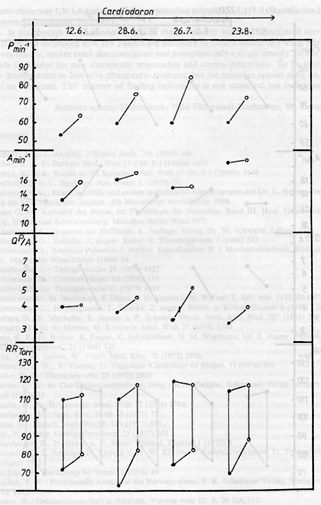
Fig. 6
Behavior of average
values of pulse and respiratory rate, Q P/R and blood pressure lying • and standing
0 for patient no. (4) before and (after) during Cardiodoron.
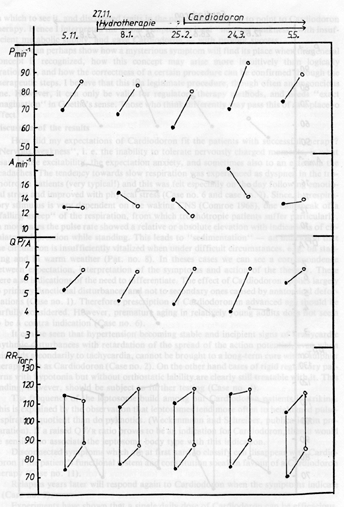
Fig. 7
Behavior of the
average values of pulse and respiratory rate lying • and standing 0 for patient
no. (7) before and during hydrotherapy and Cardiodoron.
Is my concept of Cardiodoron and of the patient for whom it
is indicated correct? — It seemed surprising how few patients are necessary to
obtain indications when one observes exactly, makes exact documentation and
prescribes only a single remedy. In this way guide lines arise for new
therapeutic approaches and contra-indications. To be sure, we are dealing more
or less with therapeutic attempts; but the mistakes appear early on and can be
corrected. This manner of finding indications is not statistical but
individual.
Authors address:
Filderklinik
7024 Filderstadt-Bonlanden
W. Germany
References
Aschoff, J. u. J. Aschoff: Pflugers Arch. 306 (1969) 146
Barbey, K. u. P. Barbey: Med. Welt 17 ( N. F.) (1966a) 1693
Barbey, K. u. K. Brecht u. W. Kutscha: Med. Welt 17 (N. F.)
(1966b) 1648
Bradbury, S. u. C. Eggleton: Am. Heart J. (1925) 73
Degenaar, A. G.: Krankheitsfalle und andere medizinische Fragen
beraten mit Dr. R. Steiner. Gesammelt im Klin.-therapeut. Institut. Als
Manuskript vervielfaltigt 1939.
Gauer O. H.: Kreislauf des Blutes. In: Physiologic des
Menschen. Band III. Hrsg. Gauer-Kramer-Jung, Urban und Schwarzenberg,
Munchen-Berlin-Wien 1972
Hahnemann, S.: Organon der Heilkunst. 6. Auflage, Verlag Dr.
W. Schwabe, Leipzig 1921 Hildebrandt, G.: Zeitschr. f. angew. Bader- u.
Klimaheilkunde 7 (1960) 533
Hildebrandt, G.: Arterielle Pulsation u. rhythm.
Koordination. B. J. Hochschulskripten, Bibliograph. Inst. Mannheim-Wien-Zurich
(1969) 34
Hildebrandt, G.: Therapiewoche 25 (1975) 4122
Hildebrandt, G.: Chronobiologia III (1976) 113
Hildebrandt, G.: Therapiewoche 27 (1977) 1911
Hildebrandt, G., H. Breithaupt, S. Dohre, J. Stratmann u. M.
Werner: Z. Arb. wiss. 31 (3NF) (1977) 98 Hildebrandt, G., H. Jungmann, L.
Steinke: Z. angew. Bader- u. Klimaheilkunde 6 (1959) 126 Herberg D., K.
Mechelke, E. Nusser u. P. Schenck: Dtsch. Arch. Klin. Med. 207 (1961) 268
Jarmatz, H., H. de Marees, G. Kunitsch: Med. Welt 27 (1976) 1789
Klein, K. E., H. Bruner, R. Finger, K. Schalkhauser, H. M.
Wegmann: Int. Z. angew. Physiol. einschli. Arbeitsphysiol. 23 (1966) 125
Lang, E., W. Jansen, W. Pfaff: Med. Klin. 70 (1975) 1976
Lohmann, F. W., R. Gotzen, U. Ungewiss: Cardiology 61
(Suppl. 1) (1976) 309
Lubke, K. O.: Therapiewoche 22 (1972) 2935
Marees, H. de: in: Das Orthostasesyndrom, Hrsg.: H. J.
Dengler, Schattauer Verlag Suttgart-New
York (1974) 25
Marees, H. de, H. Jarmatz: Med. Welt 27 (1976) 1784
Matthiolius, H.: Beitr. Erw. Heilk. 3 (1970) 77
Osten, H.: Munch. med. Wschf. 119 (1977) 897
Parr, F.: Archie Kreislaufforschung 25 (1957) 101
Pauschinger, P., P. Huber u. P. Matis: Phlebol. Proktol 1
(1972) 3
Reindell, H., E. Schildge, H. Klepzig u. H. W. Kirchhoff:
Kreislaufregulation. G. Thieme Verlag, Stuttgart 1955
Rieckert, H.: Cardiology 61 Suppl. 1 (1976) 69
Rhohen, J. W.: Funktionelle Anatomic des Nervensystems. F.
K. Schattauer Verlag, Stuttgart-New York 1975
Steiner, R.: Geisteswissenschaft u. Medizin. Vortrag vom 22.
3. 20 GA 312
Steiner, R.: Physiol.-Therapeutisches auf Grundlage der
Geisteswissenschaft (1920-1924) GA 314 Steiner, R.: Was kann die Heilkunst
dutch eine geisteswissenschaftliche Betrachtung gewinnen? Arnheim, Vortrag vom
24. 7. 24 GA 319
Steiner, R.: Ober Gesundheit und Krankheit. Grundlagen einer
geisteswissenschaftlichen Sinneslehre. Vortrag vom 13. 1. 23 u. 30. 12. 22 GA
348
Thulesius, O.: Cardiology, 61 (Suppl. 1) (1976) 180
Vendsalu, A.: Acta med. scand. 49 suppl. (1960) 173
Weckenmann, M.: Med. Welt 12 (1970) 515
Weckenmann, M.: Arztl. Praxis 25 (1973) 1453
Weckenmann, M.: Weleda Korrespondenzblatter f. Arzte 98
(1980)
Weckenmann, M.: Basic Res. Cardiol 70 (1975) 339
Weckenmann, M.: Beitr. Erw. Heilk. 34 (1981a) 41
Weckenmann, M.: Blutdruck und rhythm. Parameter als
abhangige Grosen im Grenzbereich zwischen orthostatischer Stabilitat u.
Labilitat in. Veroffentl. Basic. Res. Cadiol. (1981) b
Weckenmann, M.: Die rhythmische Ordnung v. Puls und Atmung
im Stehen bei orthostat. Stabilen u. Labilen. In Verb ffentlichu ng Basic. Res.
Cardiol (1981) c
Weckenmann, M.: Die Ergebnisse einer Umfrage fiber die
Anwendung und Wirkung von Cardiodoron. Vorlaufige Mitteilung (1981 d)
(Veroffentl. vorbereitet)
Weckenmann, M., K. Schreiber: Die Beziehung zwischen Ruhe-Pulsatemquotienten
und Alter, Geschlecht und Konstitution bei intern. Patienten (1979)
Veroffentl. vorbereitet
West, J. B.: Ventilation/Blood Flow and Gas Exchange Oxford:
Blackwell Scientific Publications Ltd, 1965