Hyoscyamus niger, henbane, stinking nightshade
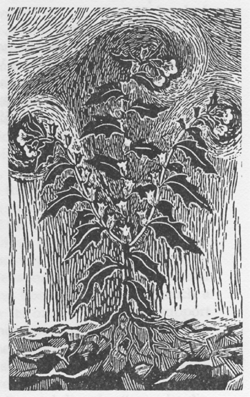 There are a dozen species of Hyoscyamus. Like gypsies, they
have settled here and there throughout Europe, North Africa, and Asia. The most
important and characteristic among them is the henbane, a very strange
variation indeed on the basic type, and yet entirely a solanaceous plant.
Shaggy and defiant, something belonging to the forces of darkness rises up in
the midst of summer light and warmth, absorbing from those elements forces
which nevertheless cannot liberate, cannot resolve, the crouching, cramped
form. Into softly swelling form it puts something that is rigid and bony. To
the untutored eye, it is immediately obvious that this must be a very poisonous
plant. It has a threatening look, witch-like and yet somehow beautiful, elegant
in a bizarre way. One can understand why in older times, in ancient Egypt, men
would grow pale when they saw it, for the image of the plant would not merely
strike the eye, but touch men deep down, in their very blood (this is how
Rudolf Steiner put it).
There are a dozen species of Hyoscyamus. Like gypsies, they
have settled here and there throughout Europe, North Africa, and Asia. The most
important and characteristic among them is the henbane, a very strange
variation indeed on the basic type, and yet entirely a solanaceous plant.
Shaggy and defiant, something belonging to the forces of darkness rises up in
the midst of summer light and warmth, absorbing from those elements forces
which nevertheless cannot liberate, cannot resolve, the crouching, cramped
form. Into softly swelling form it puts something that is rigid and bony. To
the untutored eye, it is immediately obvious that this must be a very poisonous
plant. It has a threatening look, witch-like and yet somehow beautiful, elegant
in a bizarre way. One can understand why in older times, in ancient Egypt, men
would grow pale when they saw it, for the image of the plant would not merely
strike the eye, but touch men deep down, in their very blood (this is how
Rudolf Steiner put it).
The plant is an annual, living on waste-land and in dust-dry
ditches. One year, the plant collector will find it among the stony rubble in a
river bed, the next, miles away among the broken ruins of an old castle; there
are always just a few plants, inconstant like gypsies. The henbane does not
show gratitude for loving care, and in the herb garden it will grow in a place
of its own choosing rather than one assigned to it. --Fairly late in the year,
and not until the soil is broody with summer warmth, the small grey seed
germinates. Small cotyledons are followed by the first long-stemmed leaves
which are soft and full of sap, spreading out over the ground. Then the shaggy,
wild-looking herb comes up rapidly, the main shoot holding the leaf stems
shackled to it, allowing only the lamina with its ear-shaped lobes to unfold,
slowly and hesitantly, until finally the leaves spread outward, incised and
with pointed ends, reminding of bats' wings. A leaf form like that might be
expected in a thistle, with its hardening tendencies, but hardly in a herb as
tender as this. Glandular hairs grow in thick confusion, covering every part of
the plant. --A strong stem rises up, promising tall growth.
But this upward growth soon ceases. Foliage piles up and
congests, and further growth seems not just held up, but indeed crippled.
Suspecting a fungus or an animal pest, one steps closer to discover what it is
that has so effectively put a stop to the growth of the shoot--and behold, it
is the first blossom. Yet the herb may be only two weeks old! Now the side
shoots curve away sideways, growth is diverted into them, and is at first very
much compressed. The side shoots form rolled-up spirals which in spite of their
dusty green color are in fact already inflorescences. Thus early and deeply is
the flowering process embedded, impressed into a leaf element which is only
just developing. In "normal" plants a tendency to spiral brings about
the rhythmical sequence of leaves around the shoot, so that the leaf shoot may
find full expression before it goes on to form the flower. In the henbane, this
spiral tendency is taken hold of by the flowering process from the beginning,
and deformed.
In his Astronomy Course, Rudolf Steiner pointed out
how certain planetary rhythms are imprinted upon the leaf spirals of the
plant. In the henbane, however, such planetary influences as have been taken
up have not been properly transformed; it is this which makes the plant so
poisonous. The henbane does indeed show distortion of the spiral tendency.
The side shoots now begin to unroll from their spiral coils,
starting from the inside. From the growing point which is shrouded in darkness
there emerges bud after bud; always one leaf and one flower, with leaf, shoot
and flower stem strangely intergrown. Each bud travels along a spiral line:
first it points inwards and upwards, like the hour-hand of a clock at 2
o'clock; it wanders on, always pointing outward from the center of the spiral, down to the 6 o'clock position; it then rises
up on the outside, reaching the horizontal in the 9 o'clock position. There the
flower opens, a gloomy, violet throat from which dark veins branch outwards
into the sulphur-yellow marginal zone of the calyx, an impressive image of darkness
acting into light. The attendant leaf has its plane in the vertical, however,
a most unusual sight in the plant world. The structure continues to turn until
it has reached the 12 o'clock position and the flower stands vertically and
the leaf horizontally, as is "proper" for a plant. But by that time
the flower has faded and the leaf is beginning to wither. The turning movement
ceases for the first pair of leaf and flower, and the next pair starts along
the same root, as do all that follow. This succession produces a linear shoot
standing obliquely outwards, with the spiral like a crosier at the end as it
continues to unroll. The staff shows the rhythmical sequence, like a spinal
column, stiffly bearing the upward-pointing, prickly-tipped, drying capsules
and slowly withering leaves. All the "staffs" together form three to
seven rays of a funnel, open at the top and with its point at the place where
the first branching took place and the first flower unfolded down below. Into
the center of the funnel drop the seeds discharged from the dry capsules. What
an "egocentric" gesture, compared to the outward-reaching, giving
gesture of a fruit tree or bush.
If one looks down on the plant from above it will be seen
that the leaf-and-flower pairs emerging from the spiral center, point to the
right, then to the left in rhythmical alternation. Like all horizontal flowers,
the flower shows bilateral symmetry. The calyx does not drop off when the
flower withers, but forms a sphere enveloping the ripening fruit and opening
into a five-pointed funnel at the top. The fruit is green at first, and similar
to that of Belladonna. But it then turns into a dry capsule with a little lid
which finally opens, and discharges the seed. And still new flowers with their
leaves burst forth from the spiral, pointed left and right in turn, emerging
from darkness into the light of day, on and on until the first frost puts an
end to it.
The flower has an aromatic, musty, scent; the herb and stems
are also scented and one notices this particularly if one strips off the shaggy
glandular hairs with one's hand. The scent is similar to that brought into the
house by long-haired dogs when they are wet.
The active principles of the plant (which can be explained
only if one sees them as the result of activity, as produced by the henbane
process) are: l-hyoscyamine, d,l-hyoscyamine (atropine), l-scopolamine,
d,l-scopolamine; the latter alkaloids predominantly in the seed. Also choline,
some volatile oil, bitter principles, and tannin. In terms of chemical
analysis, this means great similarity to the deadly nightshade. But at the same
time the henbane is quite different, as a medicinal plant, from Belladonna.
If one considers that "active principles" are
preceded by the "active forces" which produce them and which have
created the plant form as their image, their living image, one will find more
significant information on the medicinal action in the signature and language
of the plant than in what the chemist has to tell. The results of chemical
analysis are not without significance, but they are only part of the total
information provided by the plant.
In the henbane, the focal point of the whole structure is
obviously the spiral interweaving of leaf and flower, rather than the thick
tap-root. This root offers itself up, wholly to the flowering process, it dies
off when flower and fruit are formed. (The deadly nightshade on the other hand
withdraws its vital powers into the root in autumn, it has a much stronger root
life.) The focal point of the medicinal action will therefore lie in regions
where the processes of metabolism and limbs meet with processes of the rhythmic
system; in these regions the action of the astral element upon the physical and
etheric principles will be influenced. Depending on the dose, an astral body
which is not coming in strongly enough will be stimulated to act more strongly,
or an astral body which is pressing in too strongly, and is held as in a spasm,
will be pushed out. The form-giving impulses of the rhythmic region, of the
"middle man", interact with the metabolic organization to give rise
to the muscle organization in the limbs of man. The astral organization,
providing the impulses for movement, needs to act particularly upon this muscle
organization, as on a tool, building up as well as breaking down. It is here
that the henbane has a particular sphere of action, because of its
"astrality-filled synthesis of the rhythmical leaf process and the flower
process". Suitable remedies prepared from the henbane will effect
spasmolysis, better nutrition, and anabolism in this region. Nutrition of heart
muscle and of the musculature of the limbs is promoted when suitable
preparations of henbane are combined with other indicated remedies.
According to Rudolf Steiner, Hyoscyamus stimulates the solar
plexus: the astral body (and ego organization) act upon it more strongly.
Steiner put it like this: "If we use Hyoscyamus to transmit the astral
principle, we transmit . . . that which lives in the mantle of warmth around the
earth and forms the outer part of the atmosphere; we transmit this to the solar
plexus of man . . ." In the introductory chapters, it was described how
spheres and processes of being which for the plant lie outside, at the near or
distant periphery, are interiorized in man, as internal processes, internal
organs. The astral spheres belonging to the henbane have a special relation to
the regions of warmth mantling the earth. (A "mantle of warmth"
forming the outer limit, at a very great height, of the atmosphere,
was predicted by Rudolf Steiner in the early twenties. Years later, this was
confirmed by meteorologists.) The solar plexus, and the associated autonomic
system with its interplay of sympathetic and parasympathetic, enables part of
the astral body to act on the etheric and physical functions; this part of the
astral body is the one which must work unconsciously. Indeed, the very role of
this nervous system is to keep the astral body unconscious in this region, to
extinguish the powers of consciousness. If spirit and soul qualities do become
free in this region, the results — as described earlier for Mandragora — are a
somnambulant pictorial consciousness, visions, and hallucinations. Because of
these effects, the henbane was used for evil purposes in the Middle Ages, in
form of an ointment. The herb, once dedicated to Apollo, was finally restored
to its rightful place through homeopathy. In that field, it is used for a wide
range of muscular spasms, states of excitement, epileptic seizures, and also
disorders which indicate that the brain no longer forms the healthy physical
base, the "mirroring unit", for daytime conscious awareness, so that
there is confusion of ideas, and manic (and also depressive) states. According
to Rudolf Steiner, "mental" disorders always have physical causes. In the
medicine based on anthroposophical spiritual science, Hyoscyamus also plans an
important role in the treatment of twilight states based on a state where
"the brain is not properly maintained in its structure", so that its
astral organization does not come in to act firmly enough in the physical
brain. If a remedy prepared from henbane is introduced into the human organism,
metabolic activity has to make intensive efforts to overcome the constitution
of this very poisonous plant. This gives rise to a particularly intensive
power-form in the etheric body of the metabolic region, a form that is hard to
dissolve, much harder than that arising through a food plant (which resolves in
about 24 hours). As a counter process to this activity in the lower
organization there arises in the upper organization a better cohesion between
the organizing forces of the brain and the astral organization. While at the
lower pole a plant element is being overcome which had astral forces impressed
into it too deeply, the upper pole can properly draw close to itself an astral
element which had loosened its connections.
Datura stramonium, thorn-apple, stramony, apple Peru,
Jamestown weed
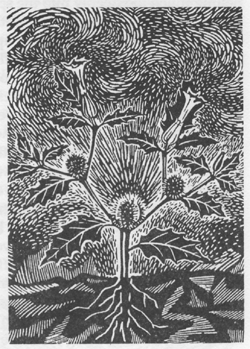 Most relatives of the Stramonium genus grow in Central and
South America. They have hanging flowers and berries, and may reach the height
of small trees, though with rather soft stems. Our thorn-apple — with flowers
and capsule fruits firmly upright — lives in Central and Southern Europe, North
Africa and Western Asia.
Most relatives of the Stramonium genus grow in Central and
South America. They have hanging flowers and berries, and may reach the height
of small trees, though with rather soft stems. Our thorn-apple — with flowers
and capsule fruits firmly upright — lives in Central and Southern Europe, North
Africa and Western Asia.
If one has a feeling for how the growth of a plant from seed
is an exhalation into the physical, then the thorn-apple is the image of
"exhalation tightened in spasm". A strong shoot grows upwards, with
soft leaves of a faded blue-green spreading all round, though their stems do
not get away from the main shoot, they are fused with it. A spindly, branching
root pushes downwards.
The leaf is basically ovoid, with triangular points and
lappets giving it a thistle-like appearance. This seems somehow in
contradiction to the soft consistency of the leaf. Growth, intended for a plant
of man's height, again ends suddenly and prematurely, just as in the deadly
nightshade and the henbane. The first flower causes a standstill. Before it,
the stem branches, and each side shoot in turn is brought to a stop by a
flower, and forks. The bract leaves belonging to the flowers are taken along,
to the left and the right, by the forked shoots, their stems fused with them,
and only the laminae allowed to unfold at the next fork, to become the bract of
what in fact is the next higher flower. The plane of the next fork is rotated
by 90° in relation to the preceding gone, so that the plant as it grows reaches
out all round into space, resembling a funnel standing on its point, this point
being the first fork. What we have before us is a branching structure similar
to the bronchial tree. None of the other Solanaceae bring out the principle of
pseudo-dichotomous branching as clearly as this. The final, uppermost shoot
ends in a fan of leaves, and from the green-yellow plane there rises, boldly
and rather bizarre, the topmost flower, and with it the others from lateral
peaks grown to the same height. By this time, the lowermost flower has already
developed into a prickly seed capsule.
In the thorn-apple, the whole flowering process is
premature, funnelling much too deeply into the sphere of the leaf. Each
individual flower shows even more clearly the pattern of deep invagination. The
calyx widens a little first, then closes up tightly; from the narrow funnel
thus produced the slim throat of the flower breaks forth, a trumpet shape of
beaten metal. This compression of etheric swelling forces through astral
flowering forces causes water to exude from the fluid organization of the
plant, and this fills the space between calyx and corona in the bud. Such a
"water" calyx is a great rarity in the plant world. The flower
terminates in five sharp points. These are initially twisted in a spiral; as the
flower opens, the spiral unfolds, in arcs which always, no matter what the
position of the flower on the plant, sweep from east to south, west, and
north, following the course of the sun in the sky. Yet this actually happens at
night, when the sun is below the horizon. In the morning, the gleaming white
flower closes up, in a movement going in the opposite direction. Thus the
gestures of the flower affirm the movement of the sun at night, but deny it by
day. Here the thorn-apple is showing a new variant of the left-motif of the
Solanaceae. It is not only that the flowers open at night; the whole plant
seems to freshen up, it stands up straight, with leaves raised. The scent
coming from the plant at night is of an evocative sweetness, like a cunningly composed
perfume rather than a plant scent, and attracts night-flying moths with
probosces long enough to fit the deep funnel of the flower. In the morning the
flower closes up, with its anti-sun gesture, and drops down from the
horizontal; the leaves, too, are lowered, and the whole plant seems to sag.
Once the flower is pollinated, calyx and corona drop off as though cut off with
a knife. The fruit grows into a prickly ball, and finally the browny black
seeds are shaken from the opening capsule by the wind. --The leaves have a
repulsively sweetish, animal-like smell. Like the henbane; the thorn-apple
loves rubble and wasteland.
Chemical analysis has demonstrated the presence of l-hyoscyamine, and small quantities of atropine and l-scopolamine in the plant,
so that in this respect it is similar to the other Solanaceae we have
discussed. However, in its more subtle aspects, the medicinal action differs
from that of the deadly nightshade and the henbane. The leaves of the
thorn-apple help to free the astral body of the asthmatic when its grip is too
tightly clenched in the process of exhalation. Stramonium poisoning unleashes
the forces of the will, at the same time separating them from the guiding,
purposive ego sphere, from the faculty of cognition. Senseless actions are
performed and continued with manic insistence. Consciousness is taken over by
hallucinatory, visionary states, which may also be filled with erotic images
arising from the lower, metabolic region, etc.
Rudolf Steiner gave a new indication: the unripe fruit of
the thorn-apple suitably prepared may be used as a remedy for biliary colic
with gall stones. The rationale of this is apparent if one considers the
spamolytic properties of the plant (and of the other Solanaceae we have
discussed), and also notes how the interplay between swelling tendencies and
the form-giving principle which goes on all through the plant, culminates in
the fruit, a prickly, radiant sphere. This fruit is very much formed out and
hardened; when it has rotted away, a delicate fibrous skeleton is left behind.
This form, like a spiked club, is also impressed upon the crystal druses of
calcium oxalate which are secreted from the living sap, a reflection of
centrifugal processes. These dynamics, of something inner being pushed
outwards, are activated in the remedy. The "prickles" are in fact
mainly vessels belonging to the fluid organization. In this case, something
which normally is rounded, forming drops and spheres, is radiated outwards.
Scopolia carniolica, scopola, Japanese Belladonna
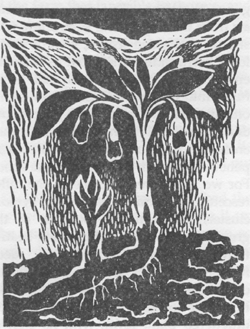 This small plant from the mountain forests of the upper
Sava in Yugoslavia and the eastern Carpathians, is somewhere between
Belladonna and Hyoscyamus in appearance. It is a spring plant, flowering in
April and May. In this and certain other respects it is like Mandragora, and in
Romania used to take the place of the latter as a magic herb (known as mantraguna)
in popular use. The rhyzome is perennial (like those of Belladonna and
Mandragora), more than a hand's length, and the thickness of a thumb. From it,
the somewhat fleshy stem, still bearing some tower scale leaves, rises to a
height of two spans. It ends in a thick shock of petiolate leaves, with the flowers
hanging on long stems from the axils; these are tubular bells, earth-brown in
colour, and faintly browny green inside, hiding in the shade of the thick, wide
umbrella of leaves. This shock of leaves is, of course, nothing but the leafshoot-flower
structure of the deadly nightshade, with the small leaf and the large one, and between them the flower, budding upwards,
but moving downwards into the shelter of darkness as it opens (with Scopolia,
the flower is more pendant). Imagine the Belladonna funnel of leaves and
flowers pushed together to form a rosette, and there you have Scopolia
carniolica; indeed, the whole structure might be called a 'little Belladonna",
were it not for the fruit which develops in quite a different direction,
forming a dry capsule similar to that of the henbane.
This small plant from the mountain forests of the upper
Sava in Yugoslavia and the eastern Carpathians, is somewhere between
Belladonna and Hyoscyamus in appearance. It is a spring plant, flowering in
April and May. In this and certain other respects it is like Mandragora, and in
Romania used to take the place of the latter as a magic herb (known as mantraguna)
in popular use. The rhyzome is perennial (like those of Belladonna and
Mandragora), more than a hand's length, and the thickness of a thumb. From it,
the somewhat fleshy stem, still bearing some tower scale leaves, rises to a
height of two spans. It ends in a thick shock of petiolate leaves, with the flowers
hanging on long stems from the axils; these are tubular bells, earth-brown in
colour, and faintly browny green inside, hiding in the shade of the thick, wide
umbrella of leaves. This shock of leaves is, of course, nothing but the leafshoot-flower
structure of the deadly nightshade, with the small leaf and the large one, and between them the flower, budding upwards,
but moving downwards into the shelter of darkness as it opens (with Scopolia,
the flower is more pendant). Imagine the Belladonna funnel of leaves and
flowers pushed together to form a rosette, and there you have Scopolia
carniolica; indeed, the whole structure might be called a 'little Belladonna",
were it not for the fruit which develops in quite a different direction,
forming a dry capsule similar to that of the henbane.
The underside of the plant bears a dark tinge (violet or
bluish). This is obviously in every respect a member of the nightshade family.
Its action combines those of Mandragora and Belladonna. As a
"narcotic", it has played a role similar to that of the mandrake root;
as a remedy it has been used to treat gout, rheumatism, and also paralysis
agitans, the shaking palsy.
Nicotiana tabacum tobacco
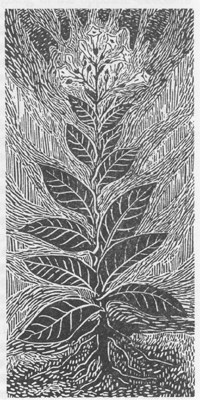 The Solanaceae theme comes up in quite a different key when
we consider the genus Nicotiana. This comprises annuals from the tropics and
subtropics, with strong, undivided leaves, some a metre long, surrounding the
shoot as it strives energetically upwards. With their stems fused into the
shoot, these leaves follow one another rhythmically in great abundance,
gradually contracting until they enter the floral region as small bracts,
penetrating right to the top of the shoot. For we have already come to the
inflorescence (a terminal panicle or cymose cluster), the aim and purpose of
the growing process. With many beautifully colored, well-formed, deep
funnel-shaped blossoms, the inflorescence stands out clearly against the
luxuriant foliage, and we see a free, unfettered plant form, with no sign of
spasm. Quite obviously, the incoming flowering impulse has not led to the
deformation of the rhythmic system which we have seen in the other Solanaceae.
The Solanaceae theme comes up in quite a different key when
we consider the genus Nicotiana. This comprises annuals from the tropics and
subtropics, with strong, undivided leaves, some a metre long, surrounding the
shoot as it strives energetically upwards. With their stems fused into the
shoot, these leaves follow one another rhythmically in great abundance,
gradually contracting until they enter the floral region as small bracts,
penetrating right to the top of the shoot. For we have already come to the
inflorescence (a terminal panicle or cymose cluster), the aim and purpose of
the growing process. With many beautifully colored, well-formed, deep
funnel-shaped blossoms, the inflorescence stands out clearly against the
luxuriant foliage, and we see a free, unfettered plant form, with no sign of
spasm. Quite obviously, the incoming flowering impulse has not led to the
deformation of the rhythmic system which we have seen in the other Solanaceae.
Our esthetic sense permits us to call the tobacco species
beautiful; some have won a place in our gardens as ornamental plants,
particularly the graceful, sweet-scented nightflowering species with their
white flowers resembling narcissi, and slim horizontal trumpet shapes reminding
of Datura.
However, in this genus, too, astral impulses normal to the
floral region have strayed beyond their limits of space and time, and permeated
the whole plant from the root upwards. This is apparent from the strongly
aromatic and resinous scent of leaf and stem, and from the fact that these
plants develop one of the most powerful poisons in the plant kingdom, nicotine,
and related substances. But just as the form of the Nicotiana species is of a
different type to that of the deadly nightshade, the henbane, the thorn-apple,
etc., so the alkaloid nicotine is quite different from substances such as
hyoscyamine, atropine and scopolamine. Its chief characteristic is that it is
a fluid, very volatile, like a volatile oil; it is all the time subtly exhaled
into the atmosphere from the leaves. A fine poisonous mist floats above any
tobacco field, with its aromatic, musty scent. The plant creates an air-form
for itself, beyond the form that is visible to the eye, and this air-form is
filled with its specific nature. In the tobacco plant as in the other
Solanaceae, the astral is impressed into the physical too early and too deeply,
drawing part of the plant processes into the element of astrality, into the
sphere of the air; it does not, however, deform the rhythmic system in
Nicotiana. An astral principle, something cosmic, is caught up in the plant
like the genie in the bottle; but — in contrast to the Solanaceae we discussed
earlier — here the stopper is taken out, the incarcerated becomes free, surrounds
the plant as a vaporous form and no longer makes its impression upon the form
of the plant (i.e., upon that which is formed out of solid and fluid elements).
In one of his lectures (January 13, 1923), Rudolf Steiner
described the action of tobacco poison. It affects chiefly the circulation,
speeding it up and making the heart beat faster. The respiratory rate does not
increase, so that the healthy ratio of pulse to breath which is so very
important for man (72 pulse beats to 18 breaths on average, i.e., 4:1), is
upset. The blood receives inadequate amounts of oxygen, resulting in a dyspnoea
which the subject is not aware of, and in connection with this an anxiety which
also goes unnoticed. The heart beats fast; its healthy relation to other organs
such as the kidney, is dislocated. The rhythm of life becomes too fast, and so
does thinking activity. Man wears himself out too quickly, damaging the heart
through unconscious anxiety states. According to Steiner, nicotine addiction
is in the final instance due to the fact that for the last three or four
centuries man has not been sufficiently active in his spirit. Present-day aims
do not lead to a true interest in life; the sense organs are stimulated, and so is the rational mind that is connected with
them, but the blood is not stirred. Tobacco poison is given the task of rousing
the blood.
Nicotine does not, however, have any visionary or
hallucinatory "narcotic" effects. Modern scientists are completely
mystified by the fact that smokers cannot do without tobacco, that tobacco has
conquered the whole of the world as no other substance has done, and has become
a poison to which all mankind is addicted. The Red Indians used it chiefly in
their cults. People whose psyche had been suitably prepared were given tobacco
water to drink and this brought them to a state close to death; by loosening
the spiritual members of man's being this made it possible for those people to
see the spheres of the spiritual world which open to man after death. It was
then possible to get in touch with the spirits of ancestors, etc. Tobacco was
an "initiation poison". It could only have this effect in races where
the constitution of the members of man's being was very specific, where the
force "holding together" the physical, the spiritual and the psychic
aspects was of a very specific type. At the same time it was necessary to make
the soul "transparent" for spiritual actions, so that it would not
allow any of its subjective spiritual and psychic contents to color its
perceptions when in such a state. Those states are not what smokers all over
the world are after today. They merely want relief from the discomfort of
emptiness, and from the consequences, extending right into the very blood, of
the non-spiritual life which developed when man turned exclusively to the
material world. Occupation with this world led to three things: firstly the
investigation of its physical forces and laws; secondly, discovery and conquest
of the physical earth; and thirdly, atrophy and desolation of the psychic and
spiritual aspects of man's nature. In this "move to the West", which
in the final instance is a taking hold of the forces of death, tobacco was
discovered and appropriated; a poison which for a time obligingly hides with
its smoke the consequences of the path taken by mankind. Man will overcome the
need for tobacco when he consciously grasps his own spirituality.
The actions of the tobacco plant on man, and its medicinal
potential, derive from the specific processes which have been outlined above.
Part of the astrality which has taken hold of the whole plant is driven out
again by the strong forces of the rhythmic organization so that it forms an
airy principle around the plant, in the form of a vaporous sphere. The poison
of tobacco has been made volatile. Remedies prepared from tobacco leaves
influence the action of the astral body on the rhythmic organization of man;
the blood process is accelerated, the process of exhalation is intensified,
and the musculature of the blood vessels and of the respiratory apparatus in
influenced. Asthma and vasospasm are thus among the indications. "Tobacco
regulates the activity of the astral body" is a general indication given by Rudolf Steiner. In the digestive system, the
astral body is helped to permeate the air organization. Tobacco may be used to
treat the severe flatulence and even inhibition of intestinal action which
result when the astral body is not properly incorporated in this region.
--According to Rudolf Steiner, tobacco as a remedy not only regulates astral
activity, but even compensates for "atrophied" astral activity, for
"deformations" of the astral body which might become transferred to
the etheric and finally also to the physical processes in the human
organization.
Tobacco thus is a powerful remedy. Its effectiveness is,
however, impaired by the considerable use and abuse of tobacco by smokers.
Habituation leads to a dulling of response. At this point I should like to
conclude the discussion of Tabacum the main object of this book being to
describe the essential nature of the plant. Details as to medicinal uses may be
found in the anthroposophical medical literature.
There is a further statement by Rudolf Steiner on the action
of nicotine which is little known and which I should like to quote (a lecture
given in Munich, on January 8, 1909). In reply to a question as to the action
of nicotine, the reply was: "I cannot give you an opinion on this, I shall
only base myself on that which I have stated here from the standpoint of spiritual science. --With regard to nicotine, this may on occasion be a highly
dangerous stimulant, and we must be aware that something which is highly
dangerous for one person need not be so for another. All one can say is that
the action of nicotine upon the organism is such that it splits up the activity
of the organism, that it splits up a certain group of activities, those
performed by the astral body in serving the physical body. Part of the
activities normally performed by the whole astral body are then performed by
only part of it, so that the astral body is, in a sense, partly relieved. This
may be harmless, but it may also have serious consequences, depending on the individual
case."
Solanum dulcamara, bitter-sweet, woody nightshade, felonwort
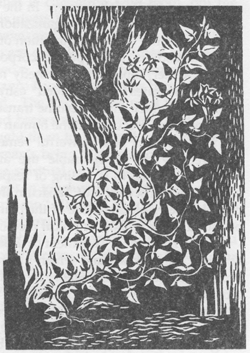 From among the shade-giving herbs by the forest brooks, from
the shrubs on the river bank, rises the slim semi-shrub of the bitter-sweet,
rapidly striving upwards from a creeping ground axis. It lets itself be borne
upwards by stronger shrubs, its own powers of getting upright being rather
poor. What it lacks in the vertical it makes up for with increased branching
power. With the main axis failing to impose the law of above and below, there
results a chaotic confusion of branches growing on and on, developing
independently of each other. Each side shoot goes on gaily, as though it were a
wholly independent plant. Thus borne up into the light, not rising by its own
power, the plant develops a rich foliage, though this, too, very much lacks the proper order which
would make it a harmonious whole. The bitter-sweet does not make an ornamental
plant, for it holds too much confusion. The same principle which lets the slim
branches shoot into length, but not grow upright, also shapes the leaves. Lower
down on the shoot, these are still slightly rounded, but higher up they form a
narrow triangle on a heart-shaped base, finally sharpening into arrow points as
they approach the inflorescence. The leaf form is not rigidly laid down, there
is an inward curve here, a rounding-out there, two or three little ears
emerging, or even division into a twin pair of leaves. The foliage is fresh and green, though there is a note of darkness in it;
in the autumn it turns a blackish violet. This same color is shown all the time
by the young leaf stems, the veins, calyces and flower stems, and indeed flows
from the very ground, up into the shoots and branches.
From among the shade-giving herbs by the forest brooks, from
the shrubs on the river bank, rises the slim semi-shrub of the bitter-sweet,
rapidly striving upwards from a creeping ground axis. It lets itself be borne
upwards by stronger shrubs, its own powers of getting upright being rather
poor. What it lacks in the vertical it makes up for with increased branching
power. With the main axis failing to impose the law of above and below, there
results a chaotic confusion of branches growing on and on, developing
independently of each other. Each side shoot goes on gaily, as though it were a
wholly independent plant. Thus borne up into the light, not rising by its own
power, the plant develops a rich foliage, though this, too, very much lacks the proper order which
would make it a harmonious whole. The bitter-sweet does not make an ornamental
plant, for it holds too much confusion. The same principle which lets the slim
branches shoot into length, but not grow upright, also shapes the leaves. Lower
down on the shoot, these are still slightly rounded, but higher up they form a
narrow triangle on a heart-shaped base, finally sharpening into arrow points as
they approach the inflorescence. The leaf form is not rigidly laid down, there
is an inward curve here, a rounding-out there, two or three little ears
emerging, or even division into a twin pair of leaves. The foliage is fresh and green, though there is a note of darkness in it;
in the autumn it turns a blackish violet. This same color is shown all the time
by the young leaf stems, the veins, calyces and flower stems, and indeed flows
from the very ground, up into the shoots and branches.
The furled cluster of beautiful flowers develops clearly and
distinctly separate from the leaf region (reminding of the spiral of flowers in
the henbane, but free from leaves; flowering time is in midsummer). True to the
character which has already emerged, the cluster of flowers turns downward and
becomes pendant. The flower resembles that of the tomato in form; it is a small
work of art in color and shape, and indeed seems wholly made of color. The
anthers, an active, bright yellow, thrust forward, while the violet petals are
reflexed; between those two colors, green holds the balance, with five
small-scale leaves surrounding the corolla. The backward flexion of the petals
reminds somewhat of the flower of the cyclamen, and the scent, too, is similar.
The interplay between light and dark in the Solanaceae is given a charming
variation here, and although it occurs throughout the plant, this interplay is
particularly obvious in the flower. In keeping with the elongated twigs, and
the narrow shape of the leaf, the scarlet, pendant berry is oval in shape,
looking like a tiny tomato that has been greatly elongated. Its taste is watery
and sweet, then burning, and it contains many small seeds.
This plant surely cannot be very poisonous, even if it is a
nightshade. With its cheerful green, the beautiful harmony of colors in the
flower between restless violet and bright yellow, and the strong scarlet of the
berry, it appears friendly, and indeed pleasing. Shy and yet importunate, it
presents itself — but still, there is the blackish-violet hue giving a touch of
darkness to the plant, though not as threateningly as in the deadly nightshade,
the henbane, the thorn-apple, etc. The flowers are open, they do not hide their
inner parts the way those relatives we have just mentioned do, they are not
deeply invaginated. As in all other species of the genus Solanum (and this is
one of the largest in the plant kingdom), the "spastic principle" is
relaxed, almost completely cancelled out. The vegetative part of the plant, the
green leaf and shoot, is left more free to develop, and the flowers have their
own development, clearly separate from the rest. This indicates that the astral
lets the etheric have its rights, and does not press into the plant form
prematurely or to any excessive degree. It fits in with this that Solanum
species do not form alkaloids like hyoscyamine, nicotine, etc., but a peculiar
class of substances known as "glyco-alkaloids", compounds somewhere
between the glycosides and the alkaloids. The chief among these are
solanin–found in the fruit–and solacein and solanein in the stem and leaf.
The plant also contains mucins and tannins (about 10 per
cent) and the ash contains a high proportion of silicic acid, about 18 per
cent.
The high silicic acid content relates the bitter-sweet to
the sphere of the senses, the ectoderm and its invaginations. Inflammations of
the skin, with itching, heat, urticaria, and weeping eczema are indications on
the one hand, catarrhal inflammation of the mucosa of the respiratory passages
and bronchi on the other, particularly if linked with a clenching of the astral
body in these organic regions. These are the spheres where a plant which
combines being a silicic acid plant with the Solanaceae pattern of
astralization may be effective. It may also be helpful in cases of whooping
cough. On the other hand the action extends to catarrhal conditions of the
mucosa of the intestines and bladder. Rudolf Steiner suggested that the flowers
of the, bitter-sweet might be used together with flowering money-wort (Creeping
Jenny) to treat eczematous conditions. A very subdued Belladonna note is added
to those main actions.
Solanum lycopersicum, tomato
Here we have another of the Solanaceae which lacks the
proper power to come upright. Heavily it pushes its way upwards along the stake
provided, quite different from the elegant manner in which beans or hops wind
upwards. The tomato is greatly overburdened with sheer matter, the trend
towards substance overrides the trend towards form. The plant is hypercharged with tendencies towards swelling growth. The
leaves are very herbaceous, and yet there is something undefined in their
shape. The river of proliferating, burgeoning life may be said to break its
dams all the time, letting a leaf debouch here, a lappet there. The stems are
tumid, and swollen at the joints. Yet the floral structures develop clearly
apart from the herbaceous parts of the plant; there is no evidence here of the
spastic compaction seen in the highly poisonous Solanaceae. The coiled floral
shoot does faintly recall the spirals of the henbane. The leaves also show a
tendency to curl on occasion. The flower is small, pale yellow, and opens into
a flat disk; the anthers emerge into the open, as in the bitter-sweet. The
calyx normally has five points, but quite often there are six, or seven. Again
the given order is not adhered to. Similarly, strict formative laws are
exceeded by the fruit in its exuberant growth; it may be the shape of an apple,
a pear or an egg, smooth or ribbed, and finger-like forms may proliferate from
it.
As in the other Solanaceae we have discussed, the herb of
the tomato has a strong scent. This is musty and aromatic, like parsley but
also like petrol, and at the same time reminding of meat-broth. So again we
have processes normally confined to the floral region entering into the region
below the flower. Cosmic elements become excessively earthly.
An egotistical trait comes out in the tomato in its habit of
being compatible with itself, preferring to grow in its own dung. It shares
this habit with tobacco. Immature, "wild" compost is what it likes
best.
The proliferating forces hidden in the wild tomato plant
make it possible to develop from it the cultured forms, with their abundance
of fruit. As a food, it should be used with circumspection; if there is a
tendency towards proliferative and hardening disease, with the form-giving
forces "running wild", tomatoes should be avoided, e.g., in cancer,
gout rheumatism. On the other hand tomatoes agree well with the liver, which
is a proliferative plastic organ. Rudolf Steiner recommended an extract of the
fruit in high potency for the treament of osteomyelitis.
Capsicum annuum, paprika
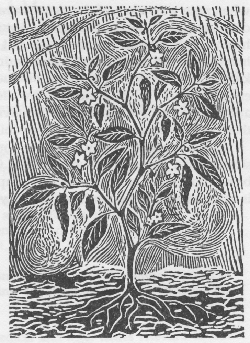 Difficulty in coming upright, proliferation of the herb, and
a strong flowering process, pendant flowers and elongated fruits — these are
also features of the paprika plant. The abundant foliage is a glossy dark
green, and the leaves are happiest in the hot sun. The light-colored, shallow
flowers shelter from the light, nodding, and the fruits, their color ranging
from yellow to red and purple and even almost black, are half hidden in the
shade of the leaves. These fruits are not just swelling like those of the tomato; they are bloated, blown up, not juicy
but downright airy fruits. They have taken hold of the airy element and made it
part of themselves. More than that, they also incorporate the fire-qualities
of high summer, qualities of vital importance to a child of the tropics. The
forces of astralization which have by now become familiar to us in our study of
the Solanaceae, take hold of the etheric, vegetative element with air and
fire. It is not surprising, then, to find a specific substance containing
nitrogen in this plant. This substance, capsaicin, makes the fruit hot to the
taste and gives it its vesicant properties, producing blisters similar to burns. It will energetically fire metabolism, and produce
inflammation. Being one of the Solanaceae, Capsicum also acts on the astral body in muscular rheumatism, when it is gripping the
muscle as in spasm; Capsicum annuum will relax this grip and thereby relieve
pain.
Difficulty in coming upright, proliferation of the herb, and
a strong flowering process, pendant flowers and elongated fruits — these are
also features of the paprika plant. The abundant foliage is a glossy dark
green, and the leaves are happiest in the hot sun. The light-colored, shallow
flowers shelter from the light, nodding, and the fruits, their color ranging
from yellow to red and purple and even almost black, are half hidden in the
shade of the leaves. These fruits are not just swelling like those of the tomato; they are bloated, blown up, not juicy
but downright airy fruits. They have taken hold of the airy element and made it
part of themselves. More than that, they also incorporate the fire-qualities
of high summer, qualities of vital importance to a child of the tropics. The
forces of astralization which have by now become familiar to us in our study of
the Solanaceae, take hold of the etheric, vegetative element with air and
fire. It is not surprising, then, to find a specific substance containing
nitrogen in this plant. This substance, capsaicin, makes the fruit hot to the
taste and gives it its vesicant properties, producing blisters similar to burns. It will energetically fire metabolism, and produce
inflammation. Being one of the Solanaceae, Capsicum also acts on the astral body in muscular rheumatism, when it is gripping the
muscle as in spasm; Capsicum annuum will relax this grip and thereby relieve
pain.
The fruit contains much vitamin C and provitamin A
(carotene), so that it is of particular dietary value if eaten raw.
Physalis alkekengi, winter cherry, ground cherry, bladder
herb
This member of the Solanaceae family is again one whose form
is liberated, "free from spasm". From the perennial root-stock rise
the shoots, a meter high, with elongated, pointed leaves of a cheerful green
growing on free stems. Higher up, the flowers arise, from the leaf axils. They
are similar to potato flowers, wide open, and immediately turn downwards,
developing into red berries the size of small cherries. The structure most
characteristic of the winter cherry is the calyx, however, which turns a fiery
red, moving out around the fruit in a wide-reaching gesture and closing up in
front, thus forming an aerial balloon around it. This is a gesture of wanting
to take hold of the airy region, an organizing sphere normally closed to the
plant, and to attempt something of an air organization.
Plants with air-filled calyces of this type — we find them in
many familes — became important in medicine during the Middle Ages, at a time when note was taken of the signature rerum. They were used
to treat conditions of the kidney and bladder. According to Rudolf Steiner,
the kidney has not only eliminating functions, but also a highly constructive
task: to incorporate the astral body in the air organization of man. The life
of the kidney and bladder is particularly influenced by the nature of the air
in the environment. The Solanaceae have each in its own way the property of
attracting astral processes from the environment and holding them. From these
aspects arise the medicinal possibilities of the winter cherry.
Physalis contains only a low proportion of alkaloids, but
the fruit has a strong bitter principle, much vitamin C, and a carotinoid. The
plant is barely poisonous and a relative, the Cape gooseberry (Physalis peruviana),
is eaten as a fruit, though it cannot deny kinship with the tomato.
* Translation from the German of the third part of the ninth
chapter in the author's Heilpflanzenkunde (Botany of Medicinal Plants), Vol. 1
published with the kind permission of the author and of the publisher,
Philosophisch-Anthroposophischer Verlag am Goetheanum/Dornach, Switzerland,
whose permission should be sought for reproduction. Translator: R.E.K. Meuss,
F.I.L., illustrations by Walter Roggenkamp. Reprinted with permission from
B.H.J., January 1976.