THE MOST IMPORTANT MEDICINAL PLANTS AMONG THE SOLANACEAE
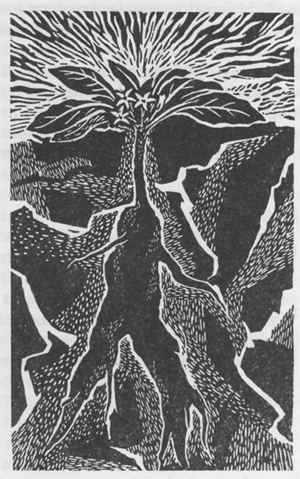 Mandragora officinarum, the mandrake
For the peoples living around the Mediterranean, Mandragora,
the mandrake of the Middle Ages, is undoubtedly one of the oldest and most
efficacious medicinal plants. The records go back over almost three thousand
years, and the ancients had very sound and detailed knowledge as to the actions
of this plant, despite the fact that they did not have the facilities of modern
chemical analysis to identify the active principles and test them accurately
in animal experiments. In fact, the modern age and the development of
present-day methods of investigation may be said to have caused the gradual
disappearance of this plant from the materia medics. By the beginning of the
last century it had ceased to play any proper role in medicine, and merely figured obscurely on the dark stage
of superstition and decadent occult practices. Then, towards the end of the
nineteenth century, chemical analysis revealed the presence of a
number of highly active alkaloids in the Mandragora root; serious attention
began to be paid at that time, not to the mandrake, but to a close relative,
Scopolia. A mixture of morphine and scopolamine, one of the Scopolia alkaloids,
has since been used to induce twilight sleep, to relieve pain during childbirth,
etc. The mandrake itself may be said to be waiting still for its resurrection as
a medicinal plant.
It was quite a different form of consciousness which made
use of Mandragora as a therapeutic agent, a consciousness very much alive to
the essential nature of the plant, rather than to the physical substance
through which such a plant demonstrates its existence to our sense organs. The
ancients saw in every tree a wood-nymph, and in every plant elemental beings
that were spiritual in nature. In poisonous plants they saw evil spirits. And
so they surrounded the mandrake with mystic rites and cults, for they saw it in
a context quite different from what modern man is generally able to perceive.
Istereng — luminous root — was its Persian name, because a flame-red light and bright rays were felt to be
emanating from it in the evening, something also experienced by peoples in the
Mediterranean regions. Merdomgie — like unto man — was another name, and this
strikes the same note as the expression used by the Pythagoreans, Anthropomorphon;
or Ebrewi ssanam, face of an idol. Then again the plant was called the
dog-drawn, Segken, and this motif we find recurring again and again later on,
in the directions to let the root be drawn from the ground by a dog, as it was
said to emit a piercing cry on coming free from the ground, a cry which brought
death to any who heard it. Sacrificing an animal to appease the demon who is
driven from his home when a plant is dug up or a tree is felled, is a custom
not confined to those times and to Mediterranean regions. The unlawful damaging
of trees, particularly in holy places, was atoned for by cutting off the arm,
or even with death. Sacrifices are still made by primitive peoples today when a
tree is felled or a field harvested. The Chinese, we are told, still believe
that from the falling tree a threatening figure in the form of a blue bull
emerges. Animal and plant are experienced in a context which obviously still
exists, or did exist, for that level of consciousness. A Javanese approaching a
Sarcolobus narcoticus tree to obtain the bark he needs to prepare his arrow
poison, will do so on all fours, as if he himself were a poisonous animal; he
bites into the bark and then scrapes it off with great care. Quite recently
information has come to light on "hunting-magic" plants. Among
primitive tribes in South America, and also elsewhere, the hunters rub the
juice of such plants into their skin, or their weapons, in the belief that its
magic will attract the animals they seek to hunt. There is also the belief,
held all over the world, that the spirits of the dead are for a time
intimately bound up with plant life, and go to dwell in trees, for example.
When Mandragora was taken from its natural sphere, into
areas of human use, this was accordingly done with due ritual, a ritual wholly
appropriate to the type of consciousness we have touched upon. The root was dug
in the evening, after bowing to the sinking sun and paying homage to the
infernal gods, the chthonic deities. With an iron sword not previously used for
any other purpose, three magic circles were drawn around the plant. Then the
root was exposed, all the way down except for the very last bit, with the face
averted to avoid noxic vapours. The body also had to be properly protected,
with oil, lest it swell up in those vapors. In later periods — and we know of
this from Dioscorides, for instance — it was the custom to tie a dog to the root
and let the animal pull it free from the ground. Then the old magical and
mythological consciousness vanished for mankind in the course of the
centuries, and weirder and more and more superstitious customs became
established, but we shall not go into these here.
From the sixteenth century onwards, Mandragora was
increasingly forgotten, and the sceptical atmosphere of the Age of
Enlightenment finally extinguished the last glimmer of the old knowledge. Yet
at the turn of the present century, when scientists began the systematic
investigation of the traditional medicinal plants by means of chemical
analysis, it was found that behind the mystery of the mandrake there lay after
all a tangible reality. Alkaloids were found in the plant, some of them known
already from other poisonous Solanaceae (the family to which Mandragora
belongs), and one apparently specific to Mandragora. Yet while such details are
undoubtedly of interest, they do not bring us one whit nearer to the true
essential nature of this medicinal plant, just as knowing the amount of cash in
the safe would tell us little of the nature of a great trading empire.
Details like these make up the picture which modern consciousness
has of Mandragora. It has to be admitted that it is abstract and rather then
compared to the one painted by the old form of consciousness, which was in rich
tones and included the whole of the human being in the experience. Yes, of
course, the new one is scientific and exact, whereas the old one does seem
fantastic to us. But scientific accuracy does not get us anywhere near the true
nature of the creative plant-whole which actively produces out of itself such
remarkable active principles as hyoscyamine, mandragorine, etc. These
substances are secondary, the other aspect is primary.
However, modern consciousness must not stop at this point.
It is apparent in this very consciousness, particularly if one compares it with older forms of consciousness, that it is undergoing a major
transformation and, driven by inner necessity, is seeking to extend its
boundaries. For a consciousness thus expanding, one starting point towards an
exact science is Goethe's teaching on metamorphosis; the continuation and extension
of this is the inward purpose of the modern science of the spirit which was
founded by Rudolf Steiner. 1
The mandrake is a typical member of the nightshade family,
but it is a very particular variant of it. We shall probably come closest to
grasping its specific nature if we consider it against the background of the
Solanaceae type. Then the essential nature of this medicinal plant will stand
out clearly.
The plant develops a mighty root, growing straight down into
the ground to a depth of up to 60 cm. It is a tap root, thick, relatively soft,
a plastic structure which lower down frequently divides into two or more
branches, each continuing downwards on its own, and swelling into thickness.
When it is dug up, the whole structure of head, trunk and legs does vaguely
resemble the human form. In spring, a shock of elongated leaves, undivided but
slightly sinuate, unfolds from the root. A luxuriant rosette develops, but no
stem, no leafy shoot rises above it. All the substance formed in the leaves is
claimed by the root, all power of growth is drawn down and held fast down
below. Spring has barely reached its zenith, and we now expect the plant really
to come up, when the leaves begin to yellow around the edges, curl up, and
there is no further growth for this year. That is how the young plant develops
from seed, sending forth leaves which get longer with each spring, until
finally they reach a length of something over a foot. At the same time the root
increases in length and thickness. Mandragora will permit only the forces of
the sun in very early spring to act upon it and build it up; among the
Solanaceae it is more or less what the crocus is among the Iridaceae, or the
winter aconite among the Ranunculaceae. The majority of Solanaceae are summer
plants. The henbane will start into growth only when the soil has become really
warm; and the deadly nightshade, the thorn-apple, tobacco, tomato and potato,
all need the full powers of high summer. Mandragora drops out of this rhythm
completely; with its appearance in spring, it leads the annual procession of
nightshade plants, or else, in form of its variant Mandragora autumnalis, it
comes at the end of the line, in late autumn, like the autumn crocus among the
Liliaceae, or the cyclamen among the Primulaceae.
A number of years must pass; each spring makes the root grow
bigger and more rich in substance, until finally the plant is ready to flower.
Then for the first time an abundance of greenish-white flowers spring up in
March (Mandragora officinarum) to April, at the center of the rosettes of
leaves. Each on a separate stalk, 2 or 3 inches high, and just over an inch in length, bell-shaped, though the upper half divides into five
pointed petals. The flower is held in a calyx about half its length, gamosepalous
and five-cleft to the middle. The leaves rise considerably above the flowers,
and the whole inflorescence, drawn together as in a small umbel, seems to disappear
among the rich, swelling foliage. More than in any other of the Solanaceae, the
inflorescence has moved down, penetrated into the root region, forcing the
leaves down to the ground. One might try and visualize a Belladonna, say,
transformed into a Mandragora, by imagining its strange inflorescence one floor
lower down, and the foliage moved down until it reaches the surface of the
soil, with the root, as it strives downward into tremendous length and
circumference, giving full expression to this downward movement.
From the flower, the berry develops rapidly, round, slightly
pointed at the top, yellow, juicy and the size of a plum. The scent of the
berries is peculiar and slightly narcotic, though not unpleasant, and the
fruits contain a number of small seeds.
The main part of Mandragora is its root, however, with its
fleshy body that has taken up so much from the flowering process coming up
close to it. The root, too, gives off a peculiarly sweet, narcotic scent,
particularly if it is cut up; it is not surprising that in earlier times both
berry and root were used as a hypnotic which acted simply through its smell. An
extract of the root gives a browny-yellow essence showing faint violet phosphorescence
in transmitted light. It contains methylaesculin, which is closely related to
the iridescent substance found in the horse chestnut to aesculin. As already
mentioned, at the turn of the century the root and essence were the subject of
chemical analysis. A mixture of nightshade alkaloids was found, including the
hyoscyamine of the henbane; scopolamine and atropine, both closely related to
hyoscyamine; norhyoscyamine, also known as hyoscine; and an alkaloid specific
to Mandragora, mandragorine, though not much is known about this so far.
Four of the five Mandragora species belong to the
Mediterranean region, one to the Himalayas. They are particularly at home along
the coasts of the Mediterranean, in Greece, Crete, Syria, North Africa, Sicily,
and Spain. They extend eastwards beyond this through Palestine and into
Mesopotamia. In all these countries, spring brings plenty of rain, for a brief
period of abundant vegetation; this is followed by a long, hot, dry summer.
Mandragora opens out in moderate sunlight, but withdraws into the darkness of
earth when the sun comes into full force. In this way the plant has its own
variation on the theme generally followed by the Solanaceae in their attitude
to the light of the sun.
If we review the actions of Mandragora as they have been
known empirically through thousands of years, the following keynotes tend to
recur:
1. Hippocrates wrote that very small doses of Mandragora
would soothe fear and cure deep depressions. Slightly larger doses cause the
pupils to enlarge, an action characteristic for many of the Solanaceae. The eye
becomes a "night eye", behaving in bright daylight as though it were
in the darkness of night. Sense impressions are felt to be excessively strong,
and restlessness and over-excitement develop. The blood wells up into the head,
as happens in lesser degree when sleeping. Larger doses tend to sedate, and
finally induce a deep sleep. The ancients thought this hypnotic effect could be
produced by merely sniffing the fruit or the root, or preparations made from
them. Even stronger doses induce anaesthesia. External application of
Mandragora can cause analgesia and even loss of sensation, whilst high doses
taken internally will finally lead to total anaesthesia and death-like sleep;
this enabled the ancients to do extensive surgery and cauterizations on the
body and limbs, and may be seen as a precursor of modern anaesthesia. If the
dosage is increased further, fatal poisoning results.
Apart from these physical effects, note must be taken also
of actions on the psyche. These tend to take the form of visions,
hallucinations, and even delirium.
We can see from all this how the supersensible bearer of
sentient life, the soul principle, is step by step forced out of the physical
organs of sensation, depending on the size of the dose, and how the Mandragora
action takes it place. Above, an attempt was made to describe the abnormal pattern
of life dynamics which contributes to the development of the poisonous
substances found in the mandrake root. In the sphere of the life-bearing,
ensouled organism, this pattern provokes an abnormal pattern of dynamics that
is its polar opposite, and this in turn calls upon the whole human being to
counteract it.
2. If the human soul principle, the astral body, acts too
strongly upon certain organic regions which should be subject to its normal
activity only, this gives rise to certain symptoms of spasm, or cramp.
Mandragora has spasmolytic action in these cases, and its action will be
stronger than that of belladonna or Hyoscyamus. Because of this, colics,
persistent tenesmus in conjunction with hemorrhoids, and also asthma, hayfever
and whooping cough have at various times been among the indications for this
medicinal plant.
3. Mandragora is an ancient aphrodisiac; it was said to
promote conception, particularly if the fruit was used. Mandragoritis was one
of the names given to Venus. The Arabs called the fruits devil's apples,
because of the exciting dreams said to follow their consumption, but also
genies' eggs, because they ensured conception. Similar properties have been
claimed for other nightshade plants, for instance certain species of thorn
apple. The abnormal degree to which the vegetative sphere of the plant is
penetrated by intensive flowering processes comes to expression here, and those
flowering processes do in a certain sense correspond to the sexual sphere in
man. An added factor is that Mandragora immerses its flowering process so
deeply in the elemental forces of spring, forces which find expression in the
sprouting growth and development of the whole plant world at that season.
4. One finds repeated mention in the old literature that the
mandrake leaf – a part of the plant free from the alkaloids which cause the
root, the flower, fruit and seed to be so poisonous – is excellent for the
treatment of wounds and inflammation. Thus the analgesic action was seen in conjunction
with an anti-inflammatory action.
5. The actions which have led to the inclusion of Mandragora
in the materia medica of anthroposophical medicine lie in a sphere, however,
which is quite different from those mentioned above. This is the field of
remedies for certain forms of rheumatism, and particularly for gout.
Here we refer to what is said about gout in chapter 11 of
the book Fundamentals of Therapy, An Extension of the Art of Healing through
Spiritual Knowledge by Rudolf Steiner and Its Wegman. 1 This chapter bears the
title "The configuration of the human body and gout". It describes a
function of the eliminating processes which until now has been given little
attention. This concerns particularly the processes of production of uric acid
and it distribution throughout the organism. The whole of the human
organization, with all the members which contribute to its being, is actively
taking part in the production, distribution and elimination of characteristic
substances of this type; moreover, this is done in an individuality not only
in the shape of his features, or the proportional relations of his limbs, but
also in the way in which a substance like uric acid is produced, deposited,
and eliminated. In this chapter of the book, Rudolf Steiner sets forth that
catabolic and not anabolic processes provide the material substrate for
conscious experience, and that a particularly remarkable catabolic process is
the production of uric acid. This process is brought about by those members of
man's being which develop consciousness, the ego and the astral body. The ego
specifically governs the extremely subtle excretion of uric acid in the brain,
the astral body governs the more substantial secretion throughout the whole body,
and the elimination of uric acid in the urine. For man to be the conscious
being he is, his organs must be impregnated to the right degree with inorganic
matter. The bodily economics must be right in the healthy organism to provide
for the distribution of uric acid to the various regions. The proper
distribution of uric acid deposits is a very major factor in human health. It
indicates whether the right relation exists, in any organ or organ system,
between ego organization and astral body. The whole of the individual human being
is always involved in every process in his body – his life organization (ether
body) his soul being (astral body), and his individuality of spirit (ego).
"Let us assume that in some organ, where ego activity
ought to predominate over astral activity, the latter begins to have the upper
hand . . . The organ will then receive an excess of uric acid, and this cannot be
dealt with by the ego organization . . . the uric acid is deposited not outside,
but within the organism itself. If it accrues in areas of the organism where
the ego is not able to be sufficiently active, then inorganic matter is
present, that is, matter belonging to the ego organization only, but
relinquished by it to astral activity . . . Here we are dealing with gout . . . The
cartilage of a joint or a section of connective tissue may be getting too much
uric acid, resulting in an excess of inorganic matter in them, so that in these
parts of the body ego activity falls behind in relation to astral activity. The
whole of the human form is the product of ego activity; the irregularity we
have described must therefore lead to deformation of the organs. The human
organism strives to leave its form."
To grasp this aspect of the Mandragora action, let us
remember that this plant pushes its flowering process down to the root process,
and in doing so takes excessive astral impulses down to the tip of the root, in
the production of alkaloids. In the root region, plants are predominantly
engaged in activities relating to the mineral and salt processes of the soil.
They conquer the mineral element, enliven it, and arrange it in its multiplicity,
according to the formative laws of the species. In the root of the mandrake,
domination of inorganic mineral nature comes face to face with excessive
"astralization". The Mandragora process, as we see it in the root, is
therefore well suited to counteract excessive activity of the human astral body
where the production and distribution of uric acid is concerned and restore the
ego organization to its position as a power able to guide and to prevail within
this totality of organized catabolism, this "uric acid organization"
within this organism, that is so important for the development of conscious
awareness.
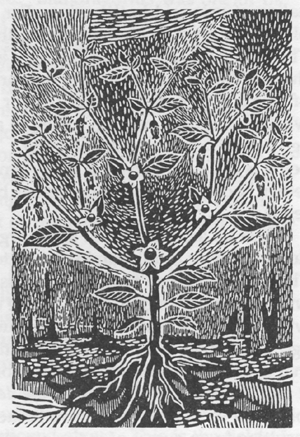
Atropa belladonna, deadly nightshade, banewort
One of the few Solanaceae that may be said to be truly at
home in our parts is the deadly nightshade. It is highly typical of the
family, a perennial growing in mountain forests, where it mysteriously makes
itself part of these places where nature is so elemental, part as something
dangerous, something demonic. The twilight border zone, where the light of day
meets the humid darkness of the forest, is the area where the deadly nightshade
likes to place itself. It may be at the edge of the forest, in a small clearing, or an area where all trees have been felled, providing the soil contains dark
humus, and there are sufficient forces of shade. If the sun comes through more
strongly and there is not sufficient darkness to hold the sun forces in
balance, the plant will soon disappear.
Not only the habitat, the whole form of the plant expresses
the battle between forces of light and of darkness. One major organ, the strong
root stock which develops several heads as it grows older, is for ever hidden
away in darkness. From it, spring energetically calls forth the shoot with its
large petiolate foliage leaves, oval in shape with a pointed apex and margin
entire, taking them up into the upper region – until autumn, when the nether
region demands the return of their essential principle down to the root. The
shoot grows strongly and rapidly, one would expect to see it develop to more
than a man's height, or even into a tree. Yet how soon an end is put to this
vitality of growth. There, it has stopped – what has inhibited it? A flower has
stepped into its path, an unsurmountable obstacle. Having got going, the
powerful current of growth cannot stop at the height it has reached, which is
about a meter; it breaks apart into lateral rays, usually three, not unlike the
water of a fountain will be deflected to go up at an angle when a fist has come
down to stop it gushing straight upwards. But from this point onwards the whole
plant has become something other. Something which has announced itself so early
and so clearly with that first flower, has now taken hold of all further growth
and development, lateral deflection having brought no escape. The plant structure now is one of three rays forming a funnel opening
out wide at the top, and this has become one whole inflorescence, though we also
see rich herbage. In the process of developing to full power its abundant
foliage, the plant was literally assaulted by the flowering process.
The lateral shoots forming the funnel have thus become a
strange mixture of intermingling leaf and flower elements. The following
trinity may be observed, rhythmically repeating itself all the way up the
branch: a small leaf which, being a bract, intimately belongs to the flower,
and from its axil the bud rising on a stem; beside them on the other side, a
large leaf, wanting to appear as a bract subtending that flower, though in fact
it is a bract belonging to the flower below, one floor lower down; its stem has
fused with the shoot and been taken one floor up with it. The large leaf thus
belongs more to the shoot, and owes its size to the stronger etheric forces of
the shoot; the small leaf belongs more to the flower, and the astral forces of
this have obviously reduced its growth. The flower buds are all on the inside
of the funnel formed by the plant, and face upwards. This needs to be
emphasized, for the proper appreciation of what is to follow. As it opens up,
the flower makes a strong movement, seeking shade, rotating downward and
outward and creeping under the large leaf beside it – as under a parasol. It flees
the light and in doing so, falls subject to gravity. A deeply invaginated
throat opens up, its colors revealing a struggle between a weak, fading yellow
and a gloomy brown-violet. The "earth bee", the heavy bumble bee,
gathers the nectar. Then the many-seeded "cherry" swells,
black-violet, like the eye of an animal, and as it does so, leaves the shade of
the parasol and rises up again into the lighter twilight. The dark hues
apparent even on the stem, in shades of black, violet and brown, lending their tinge
to branches and flowers, reach their final peak in the shiny black berry. Thus
the whole plant is sensitive to the interplay of light and darkness. The leaves
show it; they are real shade leaves, finely structured, though structure
changes when more light washes around them. The seeds however need light to
germinate, they only come up reluctantly if in deep shade.
The characteristic nature of Belladonna lies, however, not
only in the interaction of light and shade, but also in the interweaving of
water and air. The roots, the growing shoot, suck up water greedily from the
moist humus of the forest, and exhale it into the atmosphere. This intensive
"aerification" of the fluid element becomes apparent if we pick a
branch of the plant. Within a very short time it will hang down limply, for no
more fluid follows up, to make up for the losses due to evaporation.
Drying-out, withering forces from the astral element, the air, are constantly
striving to get hold of the plant, but all the time this is made good, as
water, the element of the etheric, pulses afresh through the plant. A powerful
life process generally counterbalances the effects of excessive
"astralization". We have seen this already in the way in which flower
and leaf processes blend; the flower succeeds in prematurely irrupting into the
plant form, but it must suffer the leaf element to continue unchanged by its
side, right to the tip of the shoot. It is also evident in the vitality shown
by the petals of the calyx, for these survive long after the flower, forming a
wide green dish with the black violet berry at the center. Vitalization and
devitalization are thus constantly contending for supremacy. The plant flowers
in June and July, and the berry ripens during the autumn.
Atropa belladonna is poisonous to man in all its parts.
Birds, rabbits – animals in whom, in a sense, the nervous and sensory processes
are preponderant – feed on it with impunity. The chemist will find in it the
typical Solanaceae alkaloids (l-hyoscyamine, atropine, l-scopolamine,
apoatropine, belladonnine) and in addition a substance called
a-methyl-aesculetin; this shows blue fluorescence and is closely related to the
iridescent substance found in the horse chestnut (aesculin). The ash contains
silicic acid and magnesium in appreciable quantities and also a trace of
copper. The first two relate to the hidden longing for light in this plant, for
both silicic acid and magnesium are connected with light processes, serving
them, and are "light elements".
Belladonna is one of the "great" remedies. Its
actions, for all their multiplicity, arise from the processes we have described
which make up its specific nature. The action is directed at the mode of
coordination of the members of man's being; it applies generally, and also in specific
organ spheres. As we have become aware of the special relation of the deadly
nightshade process to light and darkness, it will come as no surprise that the
eye holds a special place among those specific organ spheres. The encounter
between light and darkness, the world of night and that of day, is not limited,
however, to one organ, the eye, "created in the light and for the
light". As the transition from sleeping to waking consciousness, it concerns
also the human being as a whole. In the 19th lecture in Spiritual Science and
Medicine, 2 a description is given of how certain plants resist the immediate
forces of earth and then reserve many of their form-giving forces for the
development of flower and fruit (and Belladonna does this most noticeably).
Rudolf Steiner then continues:
"As the plant resists those forces of earth it becomes
exposed to forces from outside the earth when the final stage of seed-formation,
of fruiting, is reached; it then becomes a plant which desires to look out upon
the world in the same way as higher beings, beings from a sphere above that of
the plant kingdom, look out upon the world. The desire to perceive is revealed.
The plant is not organized for perception, however; it remains a plant though
it desires to develop something of the nature found in the
human eye. (Italics by W. Pelikan.) Yet it is unable to develop an eye, because
its body is that of a plant, not of a human being or animal. And so it becomes
a banewort, a deadly nightshade (German Tollkirsche; toll = mad, Kirsche =
cherry). I have attempted to give you a clear and rather vivid picture of the
process which occurs as the deadly nightshade comes into being. It becomes a
deadly nightshade, and as it does so, and has in its roots already the forces
which will finally cause it to produce its black berries, the plant is related
to everything which in the human body tends to impel towards the development of
form and shape, to impel towards something which can actually only take place
in the sphere of the senses, i.e. to lift man out of the sphere of his
organization into the sphere of his senses. The process which occurs when small
amounts of Belladonna are given in potentized form is indeed highly
interesting. It is terribly like the process of waking from sleep, when one is
not yet quite perceiving with the senses, and sensory perception is still
potentized, within, to fill our consciousness with dreams. At that moment one
always gets a sort of Belladonna action in man. Belladonna poisoning occurs
because the very process which normally goes on when human beings wake up,
when their waking is permeated with dreams, is now evoked in them by the poison
of Belladonna, but in this case becomes a continuous state and is not taken
over by (daytime) consciousness. The phenomena of the transitional state thus
become lasting. This is what is so interesting, that here one can see how the
processes evoked by the phenomena of poisoning are processes which, if they
have the right timing, actually pertain to the whole human organization . . .
waking from sleep in man has something in it of becoming Belladonna, but toned
down . . . limited to the moment of waking."
If the moment of waking were to become a permanent state,
Rudolf Steiner concludes, it would be fatal – like Belladonna poisoning.
Thus Belladonna may be said to bring the "night-time
man" close to the day-time man, though night-time man is everywhere projecting
into day-time man. Their eyes are open, but in broad daylight they look as
though they had opened to total darkness. Lower man, blood man, is forcing his
way up from the subconscious, unconscious depths into nerve-man, into the
region of the head. For in its senses the organism is awake; in its metabolism
it is asleep, always, even during the day. The blood pushes upwards, the head
grows hot, the face red. Under the influence of Belladonna poison, the blood principle erupts into the nerve
principle. The blood vessels in the eye become engorged, epistaxis occurs, the
salivary glands and tonsils become enlarged, and the tongue grows red and
swollen. Hypersensitivity to external cold develops. A similar state is seen
with many diseases involving acute temperatures and the initial stage of
inflammation, and the homeopathic school has come to regard Belladonna as a
major remedy for these initial stages. Other conditions are migraine,
congestive headaches, and also the treatment of sequelae of influenza (Raeff's
Bulgarian cure). Here we see the effect on the head of the powerful root action
of Belladonna.
A plant in which astral activities are forced in to such
abnormal degree will obviously act on conditions in the human organism where
certain organic regions are subject to abnormal action on the part of the
astral body, so that cramps or spasms result. Belladonna has accordingly been
used to treat whooping cough, asthma, gastric and intestinal spasms, the
spastic component of biliary and renal colic, spasms in the uterine region, and
even paralysis, e.g. of the sphincter vesicae.
In the sphere of the nerves and senses, "day-time
man" is able to live fully in conscious activity of the spirit; in the
system of metabolism and limbs, man is unconscious, he is active in a state of
consciousness dimmed down to sleep; this activity is very much of the spirit,
but it is unconscious; "night-time man" lives in it. Spiritual
qualities, in remaining unconscious, are shackled, one might say, to organ
activity and the preparation of physical substance. With the poison of
Belladonna, part of this spiritual principle is driven out of the physical and
liberated. Normally such a liberation of the spiritual principle from its
organic base and support should take place only in the brain, the nervous and
sense organs. If it rises unfettered from the depth of the metabolic organs,
abnormal soul contents will be experienced in form of visions and the like. At
the same time a mad, pathological urge to move takes hold of the muscular
system. The role of Belladonna in the treatment of "mental disorders"
may be discerned from this.
We must remember, however, how we discerned the intense
struggle between etheric and astral principle going on in every part of the
deadly nightshade. Particular note should also be taken that the plant remains
soft and resists hardening at all stages of growth. In autumn, the whole
handsome structure withers away to almost nothing. One aspect of the Belladonna
action, therefore, is that given in suitable dosage it stimulates the life
processes (the activity of the ether-body) and combats processes of hardening
and mineralization such as might occur in the organization as a whole, or in an
organic region (especially the eye), due to premature aging.
It would however, go far beyond the scope of this book to
enter thus deeply into purely medical aspects. Anyone interested in specific
details and in the many possibilities of medicinal action, is strongly advised
to consult the detailed and comprehensive studies in Dr. Simonis' Die unbekannte Heilpflanze. 3
*Translation from the German of the second part of the
ninth chapter in the author's Heilpflanzenkunde (Botany of Medicinal Plants),
Vol. 1; published with the kind permission of the author and of the
publishers, Philosophisch-Anthroposophischer Verlag am Goetheanum/Dornach,
Switzerland, whose permission should be sought for reproduction. Translator:
R.E.K. Meuss, F.I.L., illustrations by Walter Roggenkamp. Reprinted with
permission from B.H.J., October 1975.
REFERENCES
1 Steiner, Rudolf & Wegman, Ita, (1925) Grundlegendes
fuer eine Erweiterung der Heilkunst Hach geisteswissenschaftlichen
Erkenntnissen. Arlesheim/Switzerland: Natura Verlag.
2 Steiner, Rudolf (1920) Geis teswissenschaft and Medizin.
4th edn. 1961-- Dornach/Switzerland: Rudolf Steiner Verlag.
3 Simonis, Werner-Christian (1955) Die unbekannte
Heilpflanze. Frankfurt a.M.: Vittorio Klostermann.