pgs. 80-85.doc
(Original title: Krankengeschichte mit ausfuehrlicher DarsteUung der Heileurythmiebehandlung. Der Merkwstab 1994; 47:487-91. English of clinical report by A. R. Meuss, FIL, MTA, eurythmist's report by J. Collis, MIL. Also published in Circular Letter of the Medical Section at the Goetheanum No. 7.1994.)
Clinical report
A woman aged 29, who from her 18th year suffered from continuous bouts of
deep, painful ulcerations on both legs. A diagnosis of ulcerative dermatitis
had been made (a deep ulcerative vasculitis formerly called "pyoderma
gangrenosum").
The first enteric symptoms developed in her 20th year, taking the form of
watery diarrhea with intestinal bleeding. Crohn's disease involving the
colon, with rectovaginal fistulas, was diagnosed some years later. Systemic
cortisone therapy had been given almost continuously from her 18th year,
currently Ultralan 10 mg. Azathioprine was given at intervals, but the ulcers
did not heal.
When first admitted in 1992 (five weeks at the Filderklinik) the presenting
picture was as follows. Patient aged 29, with relatively narrow face,
its features well developed; generally adipose, looking somewhat ungainly,
with excess fat mainly in the pelvic and hip region and on thighs. The whole
person had fallen into gravity. Lower legs bilaterally showed extensive,
sharply defined ulcerations, some as deep craters, weeping, with greasy
coating and offensive odor. The surrounding skin was indurated, reddened,
and looked partly devitalized. The ulcers developed from deep,
subcutaneous nodules that opened to the surface with purulent discharges,
leaving deep craters. Healed ulcers left soft tissue defects and hard scar
tissue. Healing took weeks if not months; some skin areas had been open for
more than 10 years. As regards her Crohn's disease, the rectovaginal fistulas
were a problem; the 3-5 doughy stools were not a primary concern.
Patient appeared depressed, disheartened and despairing and had little
hope of real improvement. Anything below the diaphragm, i.e. abdomen and
legs, felt alien to her, as if not her own.
Attempt to consider the human aspect
In the lower part, the dominant tendency was one of falling into gravity. The
watery element appeared to lack organization and vitality. The warmth
organization did not come in strongly enough. Intervention from the upper
human being was catabolic and destructive (Crohn's disease, painful leg
ulcers). The creation of boundaries against the outside world through the
skin and against the internal outside world (intestine) was disrupted.
The mental picture was dominated by heaviness and dullness.
Treatment
The aim was to vitalize and strengthen the life organization, and stimulate
the structuring, form-giving powers of the upper human being, reducing
excessive catabolic forces; stimulate the forces that set outer boundaries;
bring light into the inner life and develop prospects for the future.
Medical treatment included Mercurius viv. comp. alternating with
Cuprum sulph. comp.; Cichorium pi. tota 1x, Stibium 6x or Dyscrasite 6x;
Platinum chlor./Pancreas comp.; Quartz 30x or Equisetum 30x; Abnobaviscum
Quercus lOx, twice weekly s.c. Wecesin Ointment (wound healing oint-
ment) proved excellent for local application to the legs.
Additional and essential parts of the treatment were whole body rubs
with Equisetum Oil, a vegetarian diet, painting, later modeling, individual
eurythmy therapy and biographical conversation.
Cortisone could be discontinued altogether during her 5-week stay.
Intestinal functions became normal, two thirds of the ulcers healed, with the
pain disappearing completely. The patient came out of her depression, was
able to face the future with new-found courage and make plans again. She
was soon able to resume work.
Nine months later family stress caused an aggravation of the skin
condition, with new ulcers, increased diarrhea, and migratory joint pain.
Admission for another 3 weeks resulted in rapid, thorough improvement.
This time the ulcers healed almost completely. With continued outpatient
treatment (Dr. Paolo Bavastro, Filderklinik) the situation stabilized extremely
well, and 6 months later the skin on her legs was wholly intact for the first
time in 12 years.
The biographical background and evolution have been deliberately
omitted from this report.
Eurythmy therapist’s report
First treatment period. Status
During the early sessions the patient could only move a little and this while
lying down. Her legs were tightly bandaged (vasculitis), and she lay there,
passive and heavy, moving only when necessary.
I sensed that she felt almost no connection with her body which she
experienced merely as a heavy mass weighing her down.
She was non-committal but showed some expectancy, observing what
was going on with wide open eyes. There was no rejection in her attitude.
She sensed that "something"was being done for her and was gradually
persuaded to come to the eurythmy room, where we practiced at first sitting
down but later standing up.
It soon became obvious that her arm movements were subject to the
same leaden heaviness as her massive, clumsy legs. The more she managed
to attain to the vertical position the more apparent this became.
To bring about a change in this was the aim of our first series of sessions
comprising 15 treatments of approximately 30 minutes.
The eurythmy therapy exercises
Lying down with her legs heavily bandaged:
Contraction - expansion .......with the feet
A-U.........................with the legs
M ............................with the feet
B .............................with the feet
Since the patient was able to sit or walk but not stand, we began by doing
the consonant exercises sitting down; later we stood.
To make her feet more sensitive she was first given a copper cylinder to
move rhythmically backwards and forwards with the soles of her feet.
Then came the following exercises:
D with the feet, sitting down .... .and walking
B with the feet, sitting down .... .and walking
B with the legs, sitting down .... .and walking
R with the legs, sitting down .... .and walking
M with the feet, sitting down
M with the legs, sitting down .... .and walking
Becoming able to differentiate the foot and leg region of her body was an
important experience for the patient.
A further stage of the treatment involved making the consonant gestures
with the arms:
D with the arms, sitting down ... .and walking
B with the arms, sitting down ... -and walking
R with the arms, sitting down ... .and walking
M with the arms, sitting down ... .and walking
Further observations
At this stage, since the patient's legs were ulcerated and suppurating and
therefore firmly bandaged, and also because she was so weak, it was not
possible to work towards polarizing the upper and lower body by means of
the classic jumping exercises for the metabolic system.
We therefore concentrated on bringing about differentiations within
gravity. The patient had a lot of unformed ether forces that would let her
down abruptly as her arms and legs became exhausted after short bouts of
work. When this happened she collapsed in on herself like wet clay.
It took some time before she was able to maintain a flow of movement in
a longer sequence without constantly letting her physical body drop away
from the etheric stream.
Although she was alert to what went on around her, she was dreamy
and dull as far as her physical body was concerned. She required guidance
and support without which she could not master the exercises described.
Aim
During her first hospital stay we aimed to put some lightness into her heavy
body so far as the circumstances would allow.
We continued with this during the second period.
The cycle of exercises was completed with the big U-exercise.
Vowels
In order to choose the vowel exercises we have to observe and take into
account the person as a whole.(1)
We are given further assistance by the colored sketch Rudolf Steiner
made for the U.(2) Tones of blue and violet predominate and surround the
yellow veil. We gain an image of a sunlit path of light surrounded by dark
waters. This may even reflect the brightness we need within the darkness of
our heavy bodies.
Summary
The patient became more able to cope with her otherwise heavy and dumpy
body. She became more aware of the movements of the etheric and was
better able to give them some form.
Her legs were markedly improved, and this enabled her to begin
transforming overbearing heaviness into lightness.
Second treatment period. Status
Approximately 9 months later she was back in hospital. She had not attended
eurythmy therapy sessions as an outpatient, as intended, which meant that
the foundations laid had been dormant for almost a year.
This time she stayed for 3 weeks and had six 30-minute eurythmy
therapy sessions.
Nevertheless there was a definite improvement. The problem with her
legs had stabilized and no longer dominated the situation to the same extent.
Diagnosis
She now had various pains in her joints and a painful rectovaginal fistula that
made prolonged sitting impossible.
This time, therefore, we had to work while standing or walking, only
occasionally sitting down.
The eurythmy therapy exercises
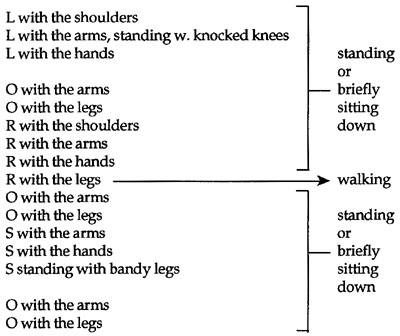
As the patient's joints were swollen we put together and practiced a program
of alternating consonant and vowel exercises from the eurythmy therapy
repertoire.(3)
Vowels
The big 0-exercise provided the intensification of the vowel aspect.(1)
The colored sketch of 02 shows warmth and brightness in the periphery
(dress and veil) while coolness is shown as the character in arm and leg joints:
cooling for the inflamed parts.
0 as mediator.
0 between consonants, i.e. between the movements for the metabolic
system and arm or leg movements, mediating between upper and lower
polarities.
0 was frequently repeated between the different consonants:
LOROSO.(4)
Or: The 0 that "reveals the human being as soul" pushes its way into the
metabolic process.(1)
Conclusion
To begin with the patient found it immensely difficult to bring form into her
ponderous and heavy body and raise it into etheric levity, but during the
course of the year (a total of 21 treatments) she succeeded astonishingly well
in doing this. She became alert and dynamic, both inwardly and outwardly,
clearly gaining in structure. She learnt to balance heaviness and lightness to
such a degree that the symptoms in her joints improved, leaving no residual
stiffness.
She was discharged from hospital as a healed individual capable of
finding her way back into working life.
Gisela Brauner-Gulow
Eurythmy Therapist
Filderklinik
D-70794 Filderstadt
Germany
Renate Schweigert
formerly at the Filderklinik
now at the Klinik Oeschelbronn
D-75223 Niefem
Germany
References
1 Steiner R. Curative Eurythmy (GA 315). Tr. K. Krohn. London; Rudolf Steiner Press 1983, 2nd lecture.
2 Steiner R. Entwuerfe zu den Eurythmiefiguren (Designs for the eurythmy figures) (GA K 26), Domach: Rudolf-Steiner-Nachlassverwaltung 1984.
3 Steiner R. Curative Eurythmy, op. cit, 8th lecture.
4 Kirchner-Bockholt, M. Fundamental Principles of Curative Eurythmy. Tr. rev. M. Beaumont & E. Lloyd. London: Temple Lodge Press 1992.