(Original title: "Zahnbildung,Zahnverfall, Zahnwechsel, Zahn- und Kieferfehlstellung/' fromPersephone 2. English by A. R.Meuss,FIL,MTA)
Hermann Hoffmeister
(4 July 1911 -10 February 1992)
In my experience, the 'function regulators' designed by Professor Fraenkl in Zwickau (Germany) are the best appliances for effecting functional changes.
With distoclusionantero-mesioclusion, or prognathism, structural reversal), the mandible is made to
move in an anterior direction to avoid a wire arch or tongue shield. These
appliances are attached to cheek shields positioned in the atrium or "cheek
pouches." Small additional pads positioned behind the
lower lip help to block external pressure from the muscles of the
cheeks and lower lip. Internal pressure from the tongue muscles is thus
given dominance and can help to widen and round out a narrow dental
arch. The special advantage of the regulator is that there are no
impediments inside the mouth apart from a few wires and perhaps a
tongue shield. Speech is possible, and it is important to speak while
wearing it, speech being the primary oral function. To achieve a
different position for the teeth and jaws it is necessary to wear the regulator
while the mouth is functioning, i.e. speaking. We do most of our talking
during the day and little at night, and this means that the regulator is
intended mainly for daytime use. Once one has gotten used to it, it is helpful
to wear it at night as well. The treatment can be supported by doing lip
exercises, asking the patient to pull the upper Up down and bite it. This is
particularly effective with the head tilted back. Many children do, however, find this exercise difficult.
(always referring to the movable mandible; with
It would be nice if such exercises were all that is required to correct a
distoclusion, but experience has proved otherwise. The same applies to
eurythmy therapy. I have found that years
of experimentation with this meant orthodontic treatment was not
initiated at the right time, causing more space to be lost in the
dentition as the gaps left by prematurely lost deciduous teeth were not
kept open. Eurythmy therapy will, however, be useful as a baseline
treatment. Even if money is no object, it is important to remember that
any additional treatment may demand too much of a child's time and
energies, causing him to lose interest and not comply where it is most
important, and that is to wear the appliance - usually for years. I
usually tell
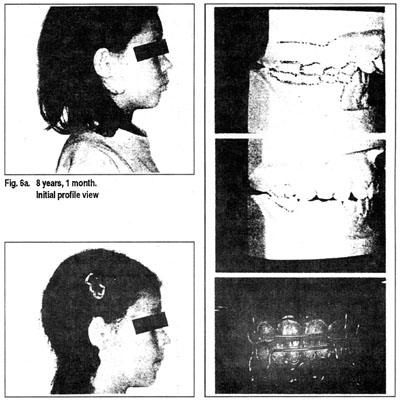
them that in orthodontics the saying is: "The end is always the hardest" be-
cause person's patience tends to wear thin.
If there is lack of space, no matter where and in which direction, there are
essentially two possible solutions: either we manage to stimulate growth and
enable the dental arches to develop fully or stretch and expand them so that
room is found for all the teeth, or we must redistribute the available space, i.e.
dispense with some teeth. The latter is unpopular with orthodontists and
their patients and is a method chosen only after careful investigation and thought. It is good to remember Wilhelm Balters' words, saying that with a vault it does not matter if it consists of 12 or 14 stones but only that it is a
good arch.
I can understand people's concern over the probable relationship of
certain teeth to specific organs, but so far I have seen no evidence of this. We
are dealing with extremely hard facts in the case of teeth. They cannot be
compressed to fit a gap that is too narrow. Sadly, the need to remove teeth is
often people's own fault, having failed to save a full denture of deciduous
teeth (with fillings). The size of teeth and that of the jaws are inherited
separately, and conditions may be so unbalanced that it is impossible to
accommodate all the teeth. The opposite may also be the case: large arches
and small teeth, resulting in gaps.
I have never actually regretted having removed teeth, but I have often
been sorry I did not make my demand more urgent. The premolars are
usually removed first, which provides space for the front and lateral teeth. In
the upper jaw the premolars tend to have two roots and be among the most
susceptible to disease. One often sees crowns, gaps and bridges in that area.
The lower premolars are more resistant. Sometimes the second lower
premolars are also removed. Unfortunately their posterior neighbors, the first
molars (six-year molars) are sometimes so bad that they cannot be kept alive
in the long run. There is no good orthodontic reason for their extraction,
which can only be an emergency measure to deal with caries and usually has
serious consequences, as neighboring teeth are apt to tilt. As one of the most
renowned orthodontists has said, planned removal of teeth requires the
greatest expertise in the field.
A word on the removal of wisdom tooth buds (germectomy), which is being done more and more frequently. It has to be advised if the X-ray shows
that the wisdom teeth are very badly positioned and cannot possibly emerge
and find a space. This includes situations where they are tilted forward at an
angle, with the teeth generally packed tightly together, so that they will cause
even more serious overlapping once they emerge. Removal is easiest at the
time when the roots are just beginning to develop. Once they are fully
developed and curved like a postillion's horn, which is common with
wisdom teeth, extraction is difficult and time-consuming even for an
experienced orthodontist, and the wound heals less easily. Unfortunately,
full dentures rarely include well-positioned wisdom teeth. One would
obviously only extract these after careful investigation and assessment of
their potential value, remembering the words of the above-quoted
orthodontist: "Where would I be in my old age without my wisdom teeth"
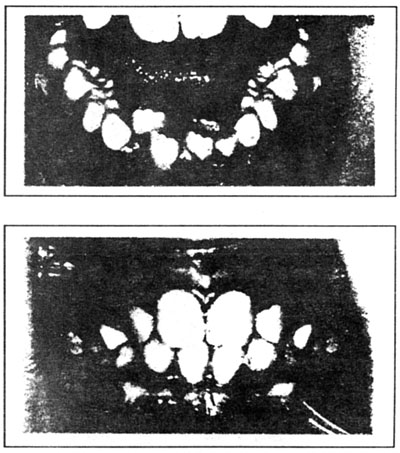
(as bridge piers)? Teeth that have failed to erupt should not be left in situ,
however. Their enamel is part of the skin organ and/ therefore, belongs on the
outside. Teeth retained in the jaw can act as foci of pathologicpremolars and
wisdom teeth are quite often missing.
disorder.
Nature actually shows us that fewer teeth can be adequate, for
Removal of the first premolars sometimes involves long-term planning,
starting with the removal of all deciduous canines. The incisors will then
usually erupt spontaneously and be well positioned. Later the first deciduous
molars are removed and then their successors. The process is known as
extraction-guided eruption of permanent dentures. I felt it was important to
know that Rudolf Hotz, the main protagonist of the method, also used it with
two of his three children.
Another, equally acceptable reason for extractions of this type is that in
earlier times, when the food was coarser, containing particles of ground
millstone, for instance, not only the occlusal surfaces of the teeth were worn
down, but also contact areas between teeth, so that a row of teeth would be
reduced by about the width of one tooth and could be accommodated more
easily in a jaw that had grown smaller. The extractions are done to make up
for the absence of this kind of wear and tear.
To return to prognathism. In both deciduous and permanent dentures it is normal for the upper teeth to lie anterior to and partly enclose the lower
teeth. If the opposite is the case, we speak of prognathism. It is important to
diagnose this early as it will become more serious unless treated. Treatment
should start not later than the changing of the incisors, taking care that the
permanent incisors are in the correct position. It is, however, better to start at
nursery school age. A regulator of reverse construction functioning like the
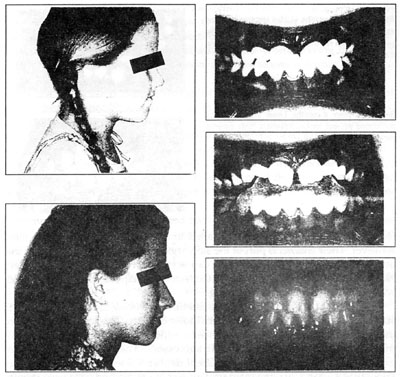
one used for teeth displaced by sucking is often fitted. Marked prognathism
can be very disfiguring and is the most frequent indication for orthodontic
interventions. The surgical procedure is to split the ascending rami of the
mandible longitudinally to change their relative positions. In most cases,
preoperative and postoperative orthodontic
treatment is also needed to adjust the dental arches to each other. The
procedure is difficult, protracted and expensive, but it harmonizes the
facial features as well as improving mastication. Prognathism also presents
extremely difficult problems at the later stage when the upper front
teeth need to be replaced, which is another reason for early
prevention. Early treatment gives lasting results, except in a few
cases where a new growth phase of the lower jaw occurs in puberty -
something which cannot be predicted. I have treated a girl with severe prognathism whose front teeth were reversed, and in her case there was no recurrence. Her brother had only a mild degree of prognathism that appeared
to have been overcome by the age of twelve. During puberty his lower jaw
grew inexorably forward, so that surgical intervention became necessary at
school-leaving age, fortunately with a positive outcome.
Crossbite is a form of malocclusion where the mandibular teeth are
unilaterally or bilaterally outside the maxillary teeth, one arch crossing the
other. It needs to be treated as early as possible, especially if unilateral and,
therefore, asymmetric, which may also be due to a displacement of the whole
mandible. Treatment will prevent the malocclusion becoming fixed, and with
the deciduous teeth this is relatively easy to achieve. Individual teeth hooked
over the other arch on the inside or outside should also be corrected as early
as possible. Working in collaboration with the MichaelshofHoefle, we found that
overcoming the problem of caught-up teeth may also help to resolve an inner
situation in which a young person is caught up. It is also desirable to have the
centers of the jaws properly aligned, again also in relation to curative education.
All these treatments should be given as early as possible, as they are
much easier then.
Curative Education
Institution, under the medical supervision of Dr.
Crowding of frontal teeth generally means waiting until all incisors have
erupted, so that their exact size and therefore need for space can be
established. On the other hand, it has proved effective to start earlier in cases
where it is perfectly obvious that there will be problems. The "interceptive"
method, using an appliance, will generally be indicated, but it needs to be
interrupted as soon as possible in order not to overstrain the child's patience.
Unfortunately, the appliance can only be removed if there is no danger of
losing space in the lateral arch due to caries or even early loss of deciduous
teeth, again demonstrating the importance of deciduous dentures that are
healthy or at least well preserved by means of fillings.
If the crowding is moderate, it will always be best to avoid extractions if
possible; if it is severe, it is definitely advisable to develop the dental arches
as far as possible because it is not always sufficient to remove just one tooth
from each half-jaw. Unfortunately, X-rays do not provide accurate infor-
mation on the size of teeth lying within the jaw, and this is why orthodontists
prefer to wait at least until the first lateral tooth has erupted before deciding
for or against extraction.
It is also important to consider the background to crowding, something
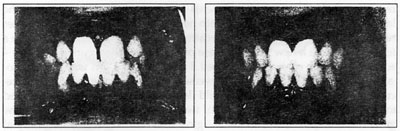
of which Wilhelm Balters has frequently spoken. The German term for it,
Enge (closing in of walls), relates to anxiety and angina, which are typical
signs of our times. People are constricted and coerced in so many ways that
local measures will hardly suffice, and crowding will often develop where
none has been before. It is comforting to know that crowding of the lower
front teeth, which, of course, are particularly caries-resistant and tend to be
retained longest, means no particular danger of caries or periodontopathy.
Compared to the crowding of upper teeth, that of lower teeth is also less of an
esthetic problem. It does, of course, have a distinct hereditary element.
Some functional orthodontic appliances have already been discussed
with reference to malpositioning due to sucking. Others will be discussed
below, starting with some that are removable. Active plates are attached to
the teeth with wire clips. The active components are either sprung wires or
devices with built-in male screw elements. This makes it possible to apply
pressure or traction to specific teeth or parts of the dental arch, single or
groups of teeth, and the relevant maxillary processes supporting them may
be slowly moved as the bone is restructured. Functional appliances are thus
intended to change form by changing function; the opposite is the case with
active appliances. We change the form and hope function will also change. In
either case, changes in form need time to stabilize. This is achieved by means
of retention, using passive appliances to support the changes achieved. This
does, of course, predispose closure of the mouth, as mentioned earlier.
Active plates will achieve quite remarkable changes, especially in the
upper dental arch. The lower arch is less responsive but fortunately requires
only minor correction as a rule. The lower canines in particular are known to
resist change once erupted. If the intention is to widen this area, functional
stimuli need to be set very early and for a long period, preferably using a
functional regulator. Appliances which are half-way between active and
functional are also available, e.g. the double propulsion plate with guide
wires that engage in grooves and thus take the mandible forward each time
the mouth is closed. The Crozat appliance is half-way between the fixed wire
appliances, which will be discussed below, and active plates. It consists of a
wire frame attached to the teeth with flexible wires welded onto it and acts
only via the teeth and not, like the plates, via the alveolar ridges as well. It
takes up little room in the mouth, which means that it presents the same
problems with mutual support of movements as the fixed wire appliances.
Other repositioning maneuvers are difficult if not impossible with removable
appliances. This applies particularly to parallel repositioning of teeth
within an arch, i.e. without tilting or rotation; extensive changes in the angle
of the axis, e.g. moving the crown inwards and the root outwards (torque).
Fixed appliances are used for the purpose. These are also known as multi-
band appliances because the devices for holding the brackets were originally
attached to the teeth with bands. Today the brackets are attached directly to
the teeth in visible areas, using a caustic fusion process. This is less obvious
than the metal bands, especially if plastic or ceramic brackets are used.
The action is based on the thin, highly elastic, light wires, which some-
times are also angular (edgewise arch) or twist and flex. They are fitted into
the brackets and usually terminate in a small tubule on bands attached to
molars. Spiral springs and elastic (rubber) rings are further energy sources in
this type of precision engineering which will also deal with many of the
problems that can be solved by using removable appliances.
Orthodontists are increasingly giving preference to these "fixed"
methods, mainly because they can be sure that the appliance will be in the mouth. This is not to say,
however, that fixed appliances require less compliance than removable
ones. Patients have to be highly conscientious with dental care, for
about 3 minutes after every meal because the brackets, wires and
ligatures will retain food residues which may cause disastrous plaque
and caries. Prevention consists in impregnating the teeth concerned
with fluoride, a local protection against caries that has proved effective in this situation.
As a short-term measure against caries, which after all is incurable
and in the long run generally worsens, fluoride impregnation is certainly
acceptable, even if its general use is regarded with skepticism. The complex
orthodontic appliances affixed to the teeth make not only dental care but also
eating, and especially mastication, more difficult. As a result the risk of caries
is greatly increased.
To achieve certain goals it will frequently be necessary to support the
appliance with headgear. This makes it possible to move upper lateral teeth
posteriorly. For the opposite situation a "face mask" supported by the chin is
available. A head-chin cap with elastic rubber to pull back the mandible is
much simpler. It is mainly used for the early treatment of prognathism.
A very simple aid is the angled glide plane to align one or several
wrongly interlocking teeth. It is usually cemented onto the lower front teeth
for a period.
There are, of course, endless variations of the above appliances. What
matters is that one knows "how to play the instrument," that is, the potential
and limits of the different methods, which generally presupposes training as
an orthodontist. It has no doubt become obvious that my personal preference
is for the functional method, using a regulator. This does not use force but
offers a possibility of change and addresses one of the main causes, which is
wrong positioning and tensioning of muscles in the mouth (tongue) and around the mouth (above all lip, cheek and masticatory muscles).
Having described malpositioning and methods for its treatment, let us
consider the key question of the issue: when is orthodontic treatment
indicated? Daily experience and a look in the mirror show that we shall
manage even if our teeth are not the most beautiful. Still the desire for
balance, beauty and efficient function of teeth is perfectly natural and also
common. On one hand, we hear again and again from parents and caregivers
that when they were young, the war, the post-war period or simply lack of
money - insurance companies were not paying what they do today - prevented
orthodontic treatment, and they are surprised that so many children
are fitted with braces today, and ask if this is really necessary. News has got
around that orthodontic treatment also has its problems.
Again, younger parents and others of their generation will often say that
they had orthodontic treatment, but "it has all gone back to what it was
before." They will often confess that they only wore their braces at intervals.
We can tell them that orthodontics has made enormous progress since then
and that unfortunately it is impossible to check the reported failures because
no documents are available. In most cases it was probably crowding that was
the problem because the often considerable expansion that could be achieved
was thought to be permanent in the past. Crowding of the lower teeth is very
liable to recur, as already mentioned.
The number of orthodontic treatments has undoubtedly increased, and
conditions are much more favorable today. On the other hand, why should
malformations of the teeth remain at the same level at a time when dishar-
mony is on the increase in so many other respects? We only have to think of
the widespread sucking habit and of the fact mat we have not yet overcome
caries. A highly experienced dentist of my acquaintance who specializes in
young people has recently written that 80 percent of orthodontic treatments
have become necessary because of caries, bad habits (sucking, mouth
breathing) and "refined foods" that require little chewing, and mat all of mis
is avoidable.
Again and again we see parents who take great care over their children's
mental and spiritual development seriously fail to care for the children's
teeth; often they do not even notice major malpositioning of teeth and even
jaws. The children are only too glad to be left in peace, since too many
demands are made on them.
The question is asked again and again if malposition of teeth and jaws is
a purely esthetic matter. My answer would be in the positive if it was merely
a matter of minor dental rotation and mild crowding. Yet children are
brought to us exactly because of such "mini-anomalies."
The real problems in the mouth are often not apparent at first sight
because they are in the lateral region. Generally these are instances of
misalignment, with a lower tooth engaging with one rather than two upper
teeth (singular antagonism or cusp-to-cusp bite) or the bite is displaced by
the width of a whole tooth. This will, of course, also mean that the front teeth
do not relate properly.
In a well-developed, complete, balanced denture all parts fit well with
each other despite the fact that they have developed separately, with the
teeth already mineralized and unchangeable when they erupt. Everything
fits, making a single whole for mastication and speech; everything is
arranged around a distinct mid-point where left and right mirror symmetry.
Above and below are different but designed for balanced interaction of
incisor edges, cusps and grooves when the mouth is closed, that is, when
closing the bite. The same holds true for both masticatory and so-called
"idle" movements. It is not surprising that we rarely see such perfect
dentures today, though they are the ideal to strive for. Many things that
interfere with balanced denture composition can be greatly improved today
even if they cannot be entirely removed. As always we have to compromise,
and this is not so reprehensible if we are aware of it.
Let us now try and make a list of the most important indications for denture
regulation. When should we advise orthodontic treatment for children?
• Obviously in all cases of disfiguring anomaly. When teeth protrude so far
that mouth closure is prevented. Experience has shown that such teeth
are 10 times more at risk from accidents than normally-positioned teeth.
• For all misalignments that come under the heading of prognathism, that
is, with lower teeth overbiting the upper teeth, in severe cases with the
whole mandible projecting forward; also for misalignments such as all
types of crossbite and "missed bite" - a similar situation where upper
and lower lateral teeth do not come together but go past each other. All
these anomalies cause unfavorable stresses on teeth and periodontal
tissues and may in the long run also affect the temperomandibular joints.
• For very deep overbite, with the lower front teeth biting into the palatal
tissues or the upper front teeth into the lower gingiva, especially if both
are the case. Pain, inflammation and regression of gingiva may result.
The teeth are subject to abnormal stresses, which may cause them to
loosen.
• For open bites, where some upper and lower teeth do not meet at all,
often because the tongue is again and again coming between them. Here
the biting function suffers and in severe cases also speech. Absence of
functional stresses is as harmful in this instance as wrong stresses are
with deep overbite.
• Marked crowding, one reason being that physiologic and toothbrush
cleaning have poor access to the hiding places created by the condition.
Crowding of the upper front teeth may also be unsightly, while barely
noticeable in the lower jaw.
• For regression of the mandible, causing wrong relation of front teeth and
alignment of lateral teeth so that a lower molar does not bite between the
two corresponding upper molars, with the bite displaced by the width of
one or half a tooth width, with each tooth biting only against one other
(singular antagonism). All this again causes harmful stresses. In severe
cases the profile is markedly affected.
• For front teeth and molars displaced in the jaw, especially the canines,
those vital comer-posts for the whole denture. Every effort to get a
canine in position is justified.
• If the number of teeth is too small. Efforts will be made to close gaps by
orthodontic measures where possible to avoid having to use prostheses
for young people that soon have to be replaced.
• If the number of teeth is too large and it is not enough simply to remove
excess teeth. In most cases, the remaining teeth will have been displaced.
The basic precondition for all orthodontic treatment is that child and
parent are willing to cooperate, usually for years. Support at school is most
important since functional methods of treatment, especially using a regulator,
require the appliance to be worn all day, that is, also during school
hours. Once the child is used to the appliance, it is able to speak well and
must be encouraged to do so. If only the dentist is convinced that orthodontic
treatment is necessary and the other parties involved do not see the need for
it, the treatment does not work well and often fails. It goes without saying
that the dentures - such a marvelous creation - should look, fit and function
harmoniously.
Karmic aspects
In anthroposophic circles people often express concern that orthodontic
treatment intervenes in destiny, a view I do not share. The idea is that it
relieves the individual of the need to come to terms with an inherent physical
malformation. For a physician, however, it is natural to do whatever is
possible to promote me healing of physical disorders of whatever origin. By
the way, health insurance companies have for some years now considered
malposition of me jaws and teeth a pathologic condition and been prepared
to pay for treatment.(1)
I would also say that common dental anomalies are not usually a matter
of destiny, especially those caused by sucking or due to caries. Severe
malformation of the jaws, above all cleft lip, jaw or palate, are much more
likely to impress one as related to karma. But no one would think of leaving
such individuals, who are at particular risk perinatally, to their fate. From the
beginning they are in the care of orthodontists and surgeons and later also of
speech therapists who "rehabilitate" them so that the mouth functions as well
as possible and their facial appearance does not cause social problems. If this
is taken as a matter of course for individuals thus severely affected, why
should we not be allowed to help also those with lesser dental anomalies?
Another reproach leveled at orthodontists is that they use mechanical
means. It has to be admitted that in the majority of cases we cannot manage
without wires and appliances. Malposition of teeth presents us with gen-
uinely "hard facts." In orthopedics much can be done by exercises. Orthodontics
also call for exercises, above all mouth closure, but also with the unattached
"functional" appliances used to correct the position of the jaw. This
changes the familiar relative position of dentures and usually makes room
for vertical growth, i.e. letting teeth grow into a different position. I have been
using these appliances, which create the conditions for harmonious
development, for more than 33 years at the Curative Education Institute in
Hepsisau, where orthodontics has effectively supported curative education.
Balters was evidently right in saying: "No real change unless the whole
person changes." When a curative teacher is unable to help a child to progress
in a real way, orthodontic treatment usually also has little effect. We
also try to contribute to the overall change that is required by using the
means offered by orthodontics, e.g. by influencing the positioning of the jaw.
This will usually fail if the new position is not in accord with the nature of the
individual.
So this is where we find our limits, an indication that there can be no
unwarranted interference in the person's karma. On the other hand,
orthodontic treatment also offers something that is desirable in this context -
exercise of the will. It always calls for an effort of will for patients to use
unattached appliances or those that clip on and can be removed by them, and
we are powerless if they do not do this regularly and reliably. Orthodontic
treatment requiring an appliance to be worn is unlikely to be successful in
spoiled children who have never been asked to do anything that goes against
the grain. Even fixed bandelette appliances are no way out. They are certainly
no more comfortable and, what is more, tend to collect food residues, so that
the teeth have to be cleaned thoroughly after every meal to prevent caries.
This calls for a considerable effort of will several times daily.
In conclusion, some attempts will be made to explain the situation in
psychosomatic and anthroposophic terms. The dental phenomena have
frequently aroused the interest of researchers. Wilhelm Balters actually went
so far as to draw conclusions as to me personality of the individual from a
study of denture plaster casts. This provided him with more reliable evidence
than merely looking in the mouth. His conclusions are often graphic. With
reference to deep overbite,th regard to frontal open bite that you'd never
find a surgeon with such a bite, for surgeons have to use their front teeth to
probe situations. Another of his statements was that people with frontal open
bite always wanted to have the last word, something I can only report
without comment.
for instance, he said that the individual concerned
tended to cover up rather than be open about things, mat "he had let down
the shutters." Conversely he spoke of a child with open bite as "open and
unprotected." He also said wi
Wilhelm Balters' opinion that open bite might also indicate unbelief
induced me to make a declaration and substantiate it at a congress of the
German Orthodontics Society. I referred to the threefold organization of the
mouth. The maxilla clearly relates to the upper human being. It is part of the
head, with the palate a vaulted structure similar to the cranium. The
mandible is connected to the head by joints and is the "limb" of the head. The
middle human being may be seen in the rhythmic movement of maxilla and
mandible in speaking and chewing activities, in the sinus curve of the
dentition and in the mediating function of the tongue. When above and
below are no longer in touch, as is the case with open bite, we have a "loss of
the middle." The relationship between upper and lower is upset. I might also
say "God" or "world of the spirit" rather than "upper," and "the human
being on earth" instead of "lower." It is difficult to say if the interpretation is
correct, but it does make sense to me.
In cases where the open bite was due to pushing the tongue between the
teeth, Balters was able to offer two further interpretations. It is normal for
hard tooth to meet hard tooth in a bite, but some prefer to put the tongue in
between as a soft cushion; they prefer to pull their punches. On me other
hand we might take the tongue pushing in between as an image. The tongue,
or metaphorically speaking the individual concerned, intrudes where not
wanted. When I told a mother whose daughter was always pushing her
tongue between the lateral teeth, resulting in a highly uncommon lateral
open bite, about these two possible interpretation, she said spontaneously,
"We call her 'the wedge in our marriage'."Karin, partly
because she did not continue as the only child in the family.
Again, the interpretation would
make sense to me. By the way, everything turned out well for
It is also graphic to speak of someone who is always clenching his teeth
and does not relax them, as "dogged" or someone who has to fight tooth and
nail.
If teeth are thus subject not only to pressure but also to grinding, they are
evidently getting worn down, even in childhood. Grinding the teeth may also
be interpreted as autoaggression, biting oneself. Conversely a relaxed jaw,
someone who is too lazy to chew, would indicate that the individual does not
want to be seriously involved in his food or in the environment, lacking the
necessary awareness for this. Eugen Kolisko commented: "When we chew,
the conscious mind goes for a walk on the food."
Balters once used a military analogy with reference to posterocclusion,
where the lower jaw is too far back and the lower front teeth bite into empty
space. He said: "At the front, there are no punches pulled. You (the patient)
are not at the front, you are behind the lines. It is time to go forward and
engage the enemy!" We use our limbs to realize the will. Everyone can push
his lower jaw forward if he wants to. Posterocclusion is a matter of holding
back. If, however, the lower front teeth actually bite into the palate, then,
according to Balters, it is better not to damage oneself- That would indeed be
masochistic.
Balters and his students, above all Fritz Bahnemann and Hubertus von
Treuenfels who took over Bahnemann's practice, also established connections
between jaw position and body posture, calling this the "gnatho-
vertebral syndrome," and devised exercises for this. Their goal is holistic
orthodontics. Fraenkel, who designed the function regulators, is of the same
opinion. Years ago he wrote: "It is extremely difficult to get people to
understand that we treat not only the dentures but really the whole human
being. What is more, the head and face of the individual are unique, and
measurement based on mean values will not serve the purpose." Some
people take an oversimplified view, however, thinking it is holistic therapy
just to fit a child with a Balters bionator or a Fraenkel function regulator. On
the other hand, we must beware not to let our enthusiasm for a holistic
approach go to extremes.
We have to keep our feet on the ground and develop a feeling for what
we may ask of a child, considering the domestic and school situation. Thus it
is always sad to see how an impending or completed divorce seriously puts
our orthodontic efforts in jeopardy. Help comes from anything that creates
order. In this sense, orthodontics is a treatment that establishes order in the
meaning of the term given by Bircher-Benner. For fatherless children it is a
help if the orthodontist is male.
To come back to the tongue once more: apart from pushing it between
the upper and lower jaws and letting it rest there, another, more active habit
is to push it in a vertical position between teeth within a row. This creates
gaps. This soundless gesture of the tongue (compared to speech with its
sounds) may also be regarded as body language and interpreted accordingly.
The tongue is breaking through the fence (of teeth), rotating through an angle
of 90 degrees. According to Bakers', and my observations confirm this, the area
where the tongue is pushed through means something. In the upper jaw we
are dealing more with higher elements relating to soul and spirit, in the lower
jaw with the physical basis. The middle of the row of teeth indicates a central
problem. The individual's general laterality probably influences me laterality
of the phenomenon. Experience has shown that this kind of diastema usually
disappears again in children. If it persists, an effort should be made to
discover the reasons. We might try and make the individuals conscious of the
mood in which they make this initially unconscious gesture (also recommended
for those who grind their teeth). However, this will probably work
only for individuals who are able and prepared to work on themselves. On
the other hand, if a trace of former habits remains in the dentition and does
not disappear of its own accord, it should be regarded as a fossil record,
signifying no more for the individual than an aspect of the past that has been
left behind.
"Myofunctional therapy" has been developed by the American speech
pathology expert. Professor Garliner, to deal with malposition of the tongue
between the jaws; it involves a program of tongue exercises that require a
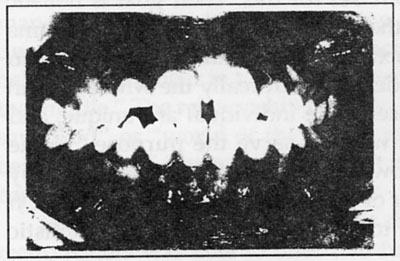
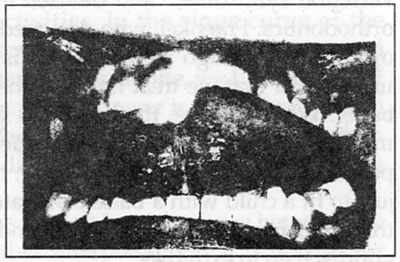
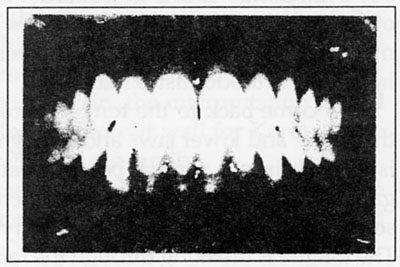
great deal of patient compliance. The Brazilian speech pathologist and former
Waldorf teacher, Mrs. Padovan, suspects that these problems are partly due
to developmental deficiencies in early childhood. Her treatment program,
therefore, includes going back to infant movements such as crawling.
Another problem going back to early childhood has been pointed out by Dr.
Wellmann, Waldorf school doctor in Wuerzburg, Germany. He noted that
children who prefer to lie in the prone position are liable to develop
crowding of teeth. He would be grateful for substantiation of this.
Finally, I'd like to emphasize that extreme caution is indicated in establishing
this kind of connection and interpreting it. With interpretation, I stick
as far as possible to imagery and never impose my views on others. What
matters, I think, is not to have great thoughts about these things nor a theory,
however magnificent, but the encounter, always unique, with human beings
who may come to see me on account of their teeth but should not have a label
attached to them just because of certain dental phenomena.
Let us recall the words of our doyen. Dr. Angle, who called the dentures
a secretum apertum - an "open secret." It is for us to increase our understanding,
not by applying "screws and levers." Goethe himself considered
these inappropriate although they are justified and necessary for some of the
mechanical problems that have to be solved in orthodontics. But to uncover
the mysteries of human dentition we need a different tool and that is a good,
Goethean way of thinking.
Hermann Hoffmeister, D.D.S.
Note
1 This may mean a temptation for patients to want to and for dentists to actually 'overdo' things.
To limit abuse, the insurance companies now only pay 80 percent of the cost, or 90 for
additional children in the same family, with accounting done quarterly. The rest has to be paid
in advance by the insured and is only reimbursed when treatment has been concluded
according to plan.