Medicinal Substances-Oak.doc
(Original title: Eiche und Birke.
Heilmittel fur allergische und dermatologische
Erkrankungen. Teil 1. Der Merkurstab 1997; 50:169-74.
English by A. R. Meuss, FIL, MTA.)
Prelude
The Birch
The arabesque of a poet's dreams
would not show finer branches,
give itself more easily to the wind,
nor rise into the blue with greater glory.
Tender, young and over slender
you let your light, long
branches droop, a little timid,
letting them move with every breath of air.
Moving gently as you sway,
the shimmering, shivering movements
may bring to mind the tenderness
and purity of love's young days. - Hermann Hesse
Tree and man
In an herb, a shrub or a bush, the observer takes greatest delight in the flowers. We relate differently to a tree. We are impressed by the tremendous size, characteristically made possible by doing without the energy-consuming
abundance of flowers. A tree fills us with awe. It occupies a space far greater
than that occupied by a human being and has a life span well beyond that of
human life. It is not for nothing that large individual trees are put under
protection as "natural monuments." Like the monuments of civilization, they
go far back into the past. We can experience ephemerality in the life cycle of
an annual plant; thinking about a tree we are made aware of the time-bound
nature of our own existence.
Goethe, who described the development of a "typical" herbaceous plant
in his Metamorphosis of Plants, was well aware of the special position trees
hold in the plant world. In his work on morphology, he wrote in the chapter
entitled: "Our Objective Is Stated":
If one looks at plants and animals in their most rudimentary stages, they
are scarcely distinguishable from one another. Such nuclear organisms -
whether rigid,
mobile, or semi-
mobile - are just
barely perceptible
to our senses.
Whether these first
beginnings could
be conclusively
traced in opposing
directions, to the
plant through light
and to the animal
through darkness,
I do not make bold
to decide, although opinions
and analogies are
not lacking on this
subject. This much
we can say: creatures, emerging
gradually from a
relationship in
which they can
scarcely distinguish between
plant and animal,
are perfected anti-
thetically: the plant
being ultimately glorified, fixed and rigid in the tree, and the animal, with
utmost mobility and freedom, in mankind.
Birch and oak - polar opposites as tree forms
The birch (Betula pendula) is a member of the Betulaceae (birch family), the
oak (Quercus robur) of the Fagaceae (beech family). The two families make up
the order Fagales (beech-like), the main woodland trees of Central Europe.
Wolfgang Schad published his fundamental paper on the biology of the mor-
phology of Central European beech-related trees in 1967. We are able to draw
on this for the morphological aspects. Later, Thomas Goebel sought to make
this bear fruit for the choice of mistletoe host trees for medicinal purposes. His
work has provided further insights as well as the two illustrations reproduced
in this paper. Let us attempt to study and compare the configuration of these
two trees.
The oak penetrates deep into the
soil with its mighty
roots.
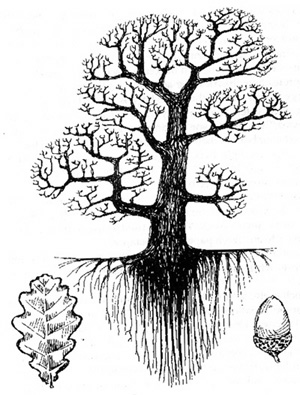
Its tap root is
said to go down as
deep as its crown
extends up into the
sky. In spite of this,
it does not exhaust
the soil but rather
tends to improve it. It does, however, require a certain soil quality
and maturity before it will grow.
Pliny thought it
a particularly remarkable observa-
tion concerning
the strength of an
oak root when he
wrote:
The coast of
Germania is
lined with oaks
growing most
luxuriantly.
Washed out by floods and pushed by the wind they take large islands with them,
holding them fast with their roots, thus floating upright and in balance.
Oaks do well on lime and avoid really acid soils. They also grow in the
warm Mediterranean regions - the cork oak (Quercus suber) is cultivated
there, its bark regularly removed to provide cork stoppers for jars and bottles.
The birch hardly dares to connect with the soil.
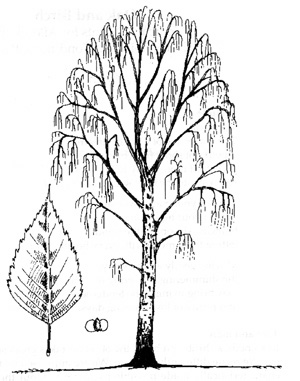
It produces a "plate" root
that only takes hold of the soil superficially. It will grow in poor soils but depletes them even further. This is why other plants find life hard growing near
birches, though there would certainly be no lack of light. Birch is an out-and-
out pioneer plant. When people abandon a house, birches soon grow from
roof and windows. The tree also appears early on newly graveled areas and
waste land. It became a colonizer when the glaciers receded after the last ice
age in Europe. Oaks seek warmth, while birches show an ability to cope with
cool climates. Their distribution now goes well up into Norway though they
are not found in Mediterranean regions. This also explains why birch does
not play a role in the medical texts of antiquity, but has regularly appeared in
the German literature since Hildegard von Bingen's day (12th Century).
Whereas oaks prefer lime, birches like acid soils and even grow on the
edges of peaty, boggy waters, where the white bark is in marked contrast to
the usually blackish, dark water. The relatively fragile bark of particular birch
species was "harvested," the light color making it a good paper substitute.
Birches normally shed their bark of their own accord, having a "ringed bark,"
as it is called. The unusually light bark also gives the tree its name, which
derives from the Indogerman bhereg, "shiny" or "white." It is the stem of
"bark" and probably first used for birch bark.
Compared to birch bark, oak bark is dark and firmly adherent to the
trunk. If a decoction is made and a small amount of iron salt (e.g. FeC3)
added, the solution turns greyish black. This was used as ink in the old days
and could be used to write on "birch paper," for instance.
The main trunk of a birch can usually be seen all the way up into the
crown. It rises steeply, while the branches are pendant and easily set in
motion by the wind.
Oak trunks branch early, so it is not always easy to determine which is
the main trunk, m some situations, the trunk may divide at soil level. The
Ravenseiche oak in Erie near Dorsten, believed to be more than 1,500 years
old, developed into two trees over the centuries. The lateral branches often
bend sharply, like a knee, to come upright again as a secondary element.
They look rigid and offer resistance to the wind - "he stands like an oak" is a
popular German saying. Oak was therefore always seen as a male tree,
assigned to Mars, and used as a symbol for the power of the State (especially
by National Socialists). The victor's crown might be made of oak leaves or the
classical laurel. Birch was considered feminine ("lady of the woods"),
belonging to Venus, and stood for fresh, light-hearted love, for wooing a
bride (May tree).
Oaks may reach a venerable age. A birch, on the other hand, will live
scarcely beyond 100 years and therefore was seen as a symbol of youthfulness and renewal.
Birch leaves are doubly serrated and pointed. The foliage always seems
open by nature, with the tree not casting much of a shadow. Birches produce
their leaves early, their light green a harbinger of Spring. At this time, holes
drilled in the trunk yield sap rich in sugar that is said to help hair to grow and
is still used in hair tonics today. Use of the leaves for "Spring cures" is a
popular tradition. Birches drop their leaves relatively early in the Fall starting
from the inside so the last yellowy leaves flutter from the tips of the branches.
Oak leaves are coarsely lobed, their tips looking flattened. They often
curl under slightly in the margins. It is quite dark beneath an oak. They bud
later in the year and keep their leaves longer than birches do. A few leaves
will persist throughout the Winter months on branches inside the crown.
Many animals seek shelter in the crown of an oak. 200 insect species have
been counted that absolutely depend on this tree. Gall wasps enter into close
symbiosis with a particular oak species (Quercus infectoria) which will be
discussed later.
Birches are rather removed from the animal world. Only one beetle
depends on them; magpies nest in them - not surprisingly building their own
"roof" above their nests.
Humans have also sought protection from oaks, which have always been
given preference as wood for building. If there was a shortage, at least the
front door, as the most endangered part of the house, would be made of oak.
Birches pollinate very early, as do elder and hazel. Pollen from these
trees, as from grasses, is the major cause of hayfever. Oak pollen scarcely
plays a role as an allergen; quite the contrary, suitable oak preparations may
be medicinal in acute allergic reactions.
After pollination, small, butterfly-shaped fruits develop on birches. The
wind carries them far and wide in Spring. These "fly weights" have no
nutrient value. Oaks bear heavier fruit, the acorns, which drop to the ground
in the Fall and provide food for doormice and squirrels. People have tradi-
tionally roasted them as a coffee substitute, and in times of need a flour made
of them was used to bake bread.
Farmers have always driven their pigs into the woods to fatten them up.
Hieronymus painted a swineherd and his lively charges beside an oak tree in
his 1546 herbal. The acorns produced thus played an important role in
determining the value of a woodland area.
Wolfgang Schad coined the terms "creation of individual space" and
"openness to surrounding space" to contrast space occupancy for oak and
birch. The dark crown of an oak harbors and feeds a rich variety of life, while
the open, mobile birch remains a plaything of the winds.
Constituents and medicinal properties of oak
The bark of oaks is mainly used for medicinal purposes as are oak galls. These
are spherical structures that grow in response to gall wasps laying their eggs
in young leaf buds of Quercus infectoria and the growing larvae. Oak bark and,
even more so, oak galls have a high tannin content. The best way of getting to
know this substance is to make a concentrated decoction of oak bark and rinse
one's mouth with it for some time. A furry, sometimes slightly numbed,
distinctly astringent effect is soon noted. Compared to the astringent effect of
lemon juice, for instance, it is not "sharp" and "light" but "dull" and "dark."
It is important not to be misled by the term "tannic acid," though it is correct
in terms of chemical structure and was also used by Rudolf Steiner.
Tannins were widely used in the past to make animal skins durable, i.e.
produce leather. They have the ability to form more or less stable complexes
with proteins. This gives them their anti-inflammatory, astringent, mildly
local-anesthetic and drying effect on mucosa and skin. They stabilize the
"limiting surface" of human beings, which is always unstable and becomes
too permeable, too close to metabolism, in weeping eczemas. Skin cells go
through a dying and drying process as they migrate from the stratum basale
to the stratum corneum. This alone makes them able to function as limiting
structures, a function performed by the bark in perennial woody plants.
Goethe realized that peripheral dying processes are a precondition for internal
vitality, putting it as follows in the chapter entitled, "Our Objective Is Stated":
As we now observe this magic structure, and acquire greater insight into the
way it lifts itself upward, we again encounter an important principle of organization: that no life can operate on an exposed surface or exercise its reproductive power there; that instead all life activity demands a covering to shield
it against the outward rough element, be it water, air, or light, and to safeguard its delicate existence, in order that it may fulfill the specific function of
its inner nature. Whether the covering has the appearance of bark, skin, or peel,
everything that emerges into life, everything that has a vital function must be
enveloped. Thus, too, everything that is turned to tlie outside is gradually and
prematurely subject to death, to decomposition. The bark of trees, the skin of
insects, the hair and feathers of animals, even the epidermis of humans, are
coverings which are eternally detaching themselves, sloughing off, resigning
themselves to death, behind which new coverings are constantly forming, and
under which, near the surface or deeper, life weaves its creative webwork.
The "signature" of tannin actions immediately suggests its use in allergic
conditions, but little use has been made of it so far in herbal medicine or
homeopathy, though it appears that tannin (a special form of tanning agent)
was given by i.v. injection to treat urticaria and allergic edema "with good
results" in Hungary after the Second World War, with "clinical results .. .
largely resembling those of antihistamine preparations."
Apart from tannins, oak bark contains calcium.
Pharmacology of calcium
Calcium has been used to treat allergic conditions since 1996. The discovery
was primarily connected with serum treatment of diphtheria. In the early
years, it caused exanthemata, as the serum had not been adequately purified.
Wright in England was the first to treat such patients by giving calcium by
mouth.
Calcium treatment soon found its way to the Continent, with the originally weak doses progressively increasing. Calcium was also given intravenously for severe allergic reactions including anaphylactic shock and
angioneurotic edema. Intramuscular injections were given to get a depot effect, and long-term elevation of serum calcium levels.
Capillaries were believed to be the main point of calcium attack, and this
led to the idea, which is still around, that calcium sealed the capillaries
(though pharmacologists do not find it adequate). It is interesting that the
early users of calcium spoke of a "long-distance astringent action," so that
even the terminology established a parallel to the astringent quality of tannins. Calcium also played an important role in the treatment of hemorrhages
- certainly a plausible indication in view of the central role calcium plays in
the coagulation cascade. Increasingly massive doses of calcium caused local
reactions with parenteral use, and the search for more easily-tolerated
calcium compounds held center stage for years.
Only one man. Professor Hugo Schuiz of Greifswald (1853-1932), the only
German pharmacologist to show open interest in homeopathy - low potency
- and attempt to give it a scientific basis, advised caution with calcium dosage,
actually believing high doses to be counterproductive: "As I told you,
gentlemen, you should use calcium in low doses if you want it to be really
effective." It is evident from his lectures on inorganic medicinal substances
that he had a real idea of the "boundary-forming" quality of calcium and was
therefore skeptical toward the unending efforts to increase doses even further:
We also encounter calcium under very different conditions, when it is a kind
of protective against tissue irritation, especially highly vascular tissues.
Chronically inflamed vessels - you know this from pathology - have the
peculiar and highly interesting tendency to deposit often auite considerable
amounts of calcium in their walls. We also see such calcium deposits else-
where. Let me just remind you of the calcification of old tubercular nodes, the
forming of calcium deposits in chronically inflamed lymph glands, in the walls
of old abscesses. Another highly characteristic phenomenon occurs when
Trichinae penetrate into muscle and become encapsulated there. This happens
because of the peculiar reflex action evoked by their presence in muscle tissue.
Composition of Calcium carbonicum/Cortex Quercus
This preparation, developed under the aegis of Dr. Margarethe Hauschka in
1952, is designed to combine the active principles of calcium and tannin,
creating a new whole.
On one hand, oak bark goes through intense decoction to release tannins
that are not easily soluble. On the other hand, the bark is heated to incan-
descence to obtain pure calcium oxide (CaO). This combines with carbon
dioxide from the air to CaCO2 (calcium carbonate). The tannin extract and
the calcium preparation are then potentized together up to the 6x.
The idea for this preparation may have come from the 5th lecture in
Rudolf Steiner's Agriculture course where he spoke of oak bark as one of the
6 compost preparations. He said emphatically that the calcium must remain
within the sphere of life if it was to have "healing qualities." Nothing could
be done with ordinary calcium carbonate. He spoke of oak bark as the source
of such "live calcium." Goethe's perception of the beginnings of a dying
process in bark may also be found with Steiner:
And it is, above all, the bark of oak which is a kind of intermediate product
between plant nature and living soil, wholly in the way I have spoken of
concerning the relationship between living soil and the earth. With reference
to the calcium principle that shows itself here, the calcium structure found in
oak bark is the most ideal.
The skull of a domestic animal was to be used for making the compost
preparation. Elsewhere Steiner would be very definite about the kind of
animal to be used (e.g. the bladder of a red deer, which will no doubt often be
difficult to get); here, he said briefly, "It hardly matters from which of our
domestic animals." What matters, clearly, is the "skull principle," an exo-
skeleton providing a firm protective envelope.
The skull filled with oak bark is buried in soil well soaked with rain
water and left to winter over. Rudolf Steiner added one might "put plant
matter there that will always ensure that plant sludge is present." A transi-
tion from living to dead matter is, therefore, created to match the situation in
which oak bark develops. The "composting" and, therefore, partial minerali-
zation of oak bark is taken to a higher level in pharmacy by ashing. If one
lives for a time with the image of a skull wintering over in damp, "muddy"
soil, it can become the counter image of the allergy sufferer who is flowing
apart under innumerable sensory stimuli in Summer.
Calcium Carbonicum /Cortex Quercus is available in 1 and 10 ml am-
pules and impregnated pilules. The 10 ml ampules have proved particularly
effective in controlling acute allergic reactions, which is in accord with
experience gained in conventional calcium therapy. Highly positive results
have also been seen with marked pruritus of non-allergenic origin, e.g. in
pregnancy. Mothers-to-be tolerate the injections well, as they are highly
effective. Calcium carbonicum/Cortex Quercus may also be considered for
acute hayfever attacks when Citrus/Cydonia (Gencydo) on its own proves
insufficient. The 1 ml ampules and pilules serve mainly to continue the
treatment of acute conditions and for more chronic situations. More recently,
the solution for injection has been used in inhalations to treat asthma, also in
combination with Levico 3x. This merits attention in view of growing advo-
cacy of anti-inflammatory basic treatment for asthma. It needs systematic
investigation and development, as do all inhalation treatments using
anthroposophical medicines. The use of 10 ml ampules of Calcium carboni-
cum/Cortex Quercus to treat hemorrhages also requires closer investigation,
and work needs to be done on differential treatment (e.g. as an alternative or
complement to Stibium met. prep. 6x).
It is interesting to note that the styptic properties of calcium were dis-
covered no later than the end of the 18th Century, while its anti-allergic
properties were only noted by Wright 100 years later. Apart from the "ex-
ternal" aspect of serum treatment, this no doubt also has a deeper reason. The
allergy problem appears to have become genuinely topical around the turn of
the century, with the term "anaphylaxis" first used by Charles Richet and
Paul Portier in 1902. Clemens Pirquet introduced the term "allergy" in 1906,
having interpreted serum sickness as an antigen-antibody reaction a year
earlier. Finally, Henry Dale and Patrick Laidlaw established the pharma-
cology of histamine in 1910, showing the similarity between histamine-
induced and anaphylactic shock. Reading Rudolf Steiner on the Citrus/
Cydonia composition (1920s) one also gets the impression that hayfever in its
massive form was a "new" syndrome at the time.
Other oak preparations for use in dermatology include Quercus Essence,
Quercus comp. Ungt. and Quercus Hemorrhoidal Suppositories.
Acute inflammatory changes in patients who may be said to be "too
young" are the domain of the oak. Overall, the indications for oak bark
preparations are fairly well defined. This is not yet the case with birch bark. A
paper to be published shortly may encourage others to try it on a wider scale.
Postlude
Lopped Oak
How much they have cut you back, tree
so that you stand there alien and strange!
And you have suffered many, many times,
leaving you nothing but defiant will!
I am like you, for a life cut back
and oft tormented did not break me.
Day after day I raise my brow again
into the light though I've been roughly treated.
The world has scorned to death in me
all that was tender once and delicate.
But nothing shall destroy me;
I am contented, reconciled,
patiently bringing forth new leaves
from branches split apart a hundred times.
Defying all the pain, I'll always be
in love with a demented world. - Hermann Hesse
Ulrich Meyer, pharmacist
c/o Wala-Heilmittel GMBH
D-73087 Eckwaelden/Bad Boll
Germany
Bibliography:
Beuchert M. Symbolik der Pflanzen. Frankfurt/Main 1995.
Bohme H. Hugo Schulz-sein Leben und Werk. Med. Diss. Freie Universitat Berlin 1986.
Daems W. Die Birke und ihre heilspendenden Krafte. Arlesheim: Weleda AG o.J.
Friedrich C, Miiller-Jahncke WD. Geschichte der Arzneimitteltherapie. Stuttgart 1996.
Goebel T. die Bildung von Raum in der Baumwelt und im Menschen. Der Heilmittelbegriff bei
Rudolf Steiner. Referate der Tagung 1981 der Anthroposophisch-Pharmazeutischen
Arbeitsgemeinschaft. Stuttgart 1982.
Goethe's Botanical Writings pp. 25 & 27. Tr. Bertha Mueller. Honolulu, Hawaii: University of
Hawaii Press 1952.
Gyure D. Neue Anwendung des Tannins. Reported in Das Deutsche Gesundheitswesen 1949;
4:742.
Hesse H. Baume. Frankfurt/Main 1984.
Moog G. Gerben und Gerbstoffe. Pharmazie in unserer Zeit 1982; 11:129-37.
Sandoz AG. Calcium - Physiologic, Pharmakologie, Klinik. Numberg 1952.
Schad W. Zur Biologic der Gestalt der mitteleuropaischen buchenverwandten und ahomartigen
Baume. Wieder abgedruckt in Goetheanistische Naturwissenschaft Band 2 - Botanik.
Stuttgart 1982.
Schobel K, Schwanitz HJ. Gerbstoffe in der Dermatologie - Zusammensetzung, Eigenschaften
und therapeutische Erfahrungen. TW Dermatologie 1994; 24:98-117.
Scholz E. Pflanzliche Gerbstoffe - Phamakologie und Toxikologie. Dtsch Apoth Ztg 1994; 134:
3167-79.
Schuiz H. Vorlesungen iiber Wirkung und Anwendung der unorganischen Arzneistoffe. Berlin
1939.
Steiner R. Agriculture (GA 327). Tr. C.E. Creeger & M. Gardner. Kimberton PA:Biodynamic
Farming and Gardening Association 1993.
Throm C. Das Diphtherie-Serum - Ein neues Therapieprinzip, seine Entwicklung und
Markteinfuhrung. Stuttgart 1995 (Zugleich Diss. pharm., Universitat Heidelberg 1994).
Vogel HH. Wege der Heilmittelfindung 2 Bande. Bad Boll 1994.