Curative Education.doc
Introduction
Anthroposophical doctors are specially trained to work with the diagnosis of four-foldness: physical body, ether body, astral body and ego. This article reflects my struggle to understand the life processes better and to see how this knowledge could be helpful when treating a child with special needs.
Rudolf Steiner gave some indications about the life processes, but Dr.
Konig was one of the doctors who took it up again in relation to curative
education. Dr. Lotte Sahlman also worked on the life processes, and I quote
from one of her lectures: "Man had a different relationship to his environment on the Old Moon and, to a certain extent, in Lemuria and Atlantis."
Sensory experience had the character of the present life processes,
meaning that sense impressions caused actual organic changes and aroused
in early mankind greed or disgust of a deep, instinctive nature. She describes
how the second pre-earthly deed of Christ, by which the Christ made it possi-
ble for human beings to speak, changed the life processes, confining them to
their organic task and thus relieving the strong tendencies to egotism and
greed which ruled developing mankind. This event made it possible to
transform the purely emotional outcries and ejaculations into the beginnings
of human speech.
In the description of how the life processes were before they were
confined to their organic task we can recognize some of our children with
special needs. For example, we have children with no speech who are able to
show only sympathy or antipathy and are ruled by instinctive qualities.
The development of a child reflects the development of mankind. As a
baby, a child goes through this phase again and is totally dependent for his
well-being on feeling warm, fed and secure. Every strong sense impression
can disturb this well-being.
The twelve senses help us relate to the outside world. Within the bound-
ary thus created, our life processes weave unconsciously. The life processes
reflect the interplay between ether body and astral body.
On the Old Moon our present sense organs were still organs of life; they
worked as life organs. We had 7 senses, not yet the senses of touch and life
because we were not a separate human being and had not acquired the sense
of word, thought or ego.
In the diagram is shown how the senses relate to the life processes.
Sense of Ego
Sense of Thought
Sense of Word
Sense of Hearing - breathing
Sense of Warmth - warming
Sense of Sight - nourishment
Sense of Taste - secreting
Sense of Smell - maintaining
Sense of Balance - growing
Sense of Movement - maturing
Sense of Life
Sense of Touch
What happens to a person in whom the life processes become too
conscious, in whom the astral body works too consciously? If the astral body
works too deeply in the etheric, the life processes become over-ensouled.
In artistic work, Steiner describes how a certain ensoulment of life
processes takes place and is healthy; when listening to music and seeing art
this also happens. If this ensoulment is too strong, there arises almost a
"second" person who "pseudo" thinks, "pseudo" feels and "pseudo" wills.
Konig points out that we can recognize this in many of our children with
special needs: "it" thinks in them. Steiner describes how a sort of thinking,
feeling and willing then appear within us, but these have a different quality, a
more life-filled quality; the thinking, feeling and willing have a more dream-like quality not guided by the ego.
We can again recognize many special needs children in this description:
something "wills" in them or "thinks" through them.
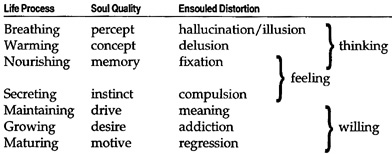
Here follows a diagram with the life processes. It identifies the effect of
each on the healthy soul and points to the effect each produces if too over-
ensouled.
Case study
Amanda is a 12-year old girl from a healthy family. There are 3 healthy, older
siblings. Her father is in the R.A.F., which involves frequent moves.
History: Normal pregnancy; mother felt happy and well. A rapid,
uneventful delivery. She was a fit, happy baby, contented and slept well. She
was breast-fed till 4 months. She sat at 8 months. She had baby babble, but
this gradually dried up at 9 months. She was diagnosed as being late in
development at 9 months with poor limb control and hearing problems. She
went into hospital to have grommets inserted at the age of 13 months, and
her parents described how she changed overnight.
From that time, she became increasingly demanding, frustrated and
overactive with a disturbed sleep pattern. She became obsessed with doors
being shut and flushing toilets. She would mouth most objects. She had to be
fed by mum.
It was difficult to take care of her at home, and her mother became
desperate. She was admitted to the Camphill Schools at age seven and a half.
Amanda is a tall, well-built girl. She is muscular, has dark hair, a pale
face and often has circles around her eyes. She has no eye contact (maybe
sometimes at night) and no speech. She will often make a low humming
sound when well or can have penetrating screams and howling when in
distress. This has become less over the years. She is always tense, making
small movements non stop with her head and upper body.
Since we found that she is left handed, she has been able to feed herself.
She can be very fast and will grab any food that she sees and stuff it into her
mouth before one can prevent it, grabbing bowls, etc. from the table. If it is
too noisy, she can stop eating and need an especially quiet place for her meal.
She cannot play; she just does some obsessional handling of blocks, etc.
She is a good walker, and this calms her down. She is not toilet trained and
seems to resist any attempt. Sleeping can be very difficult at home, and in the
respite center she hardly sleeps at all. With us, she sleeps well with a light
restraint. She can indulge in self-stimulation and throws herself on the bench
or floor to do so. Lately, she has been more settled, hardly screams and is
becoming more interested in her environment. She can even give her mother
a spontaneous hug. The other side is that she now finds it amusing to hit
people and to play with her saliva. She loves music and responds well to it.
Her life processes
In order to understand Amanda better, we tried to look at her life processes.
We recognized that her life processes are still not confined to their organic
task but determine her well-being and her relationship to the world.
Breathing: Her breathing rhythm is not established; it is very dependent
on her mood and the environment. There is a lot of out-breathing with
sudden in-breathing. She can hold her breath. How does she breathe with her
sense impressions? She perceives everything around her without any filter
and is overwhelmed by sense impressions. Maybe this explains why she
withdrew after the grommets were inserted: the noise was too much for her.
Her perceptions are too enlivened; they don't give her security.
Warming: She can be warm if properly dressed but easily loses her
warmth. Her warming is not independent from the outer world. With her
inner warming, she should transform her perceptions into concepts, but this
is very difficult for her, and she has a limited ability to form concepts
although has some basic concepts such as juice, bathroom, curtain.
Nourishing: She is normally a keen eater except when in an oversensitive
state. She seems to be nourished by her environment if it is a healthy
environment. She transforms this process into a very basic memory which is
place-orientated. This is the first normal memory which develops.
It seems that her first three life processes are so enlivened that she could
not develop her sense impressions, concepts and memory in a healthy way.
Being helped to develop an even rudimentary "pseudo" thinking through
experiencing art, she does feel better.
Secreting: If we look at her secreting process, we see that she spits and
dribbles; her face is wet, and she is in nappies.
The instinctive quality is a strong feature in her life. If the secreting
process flows out, then one experiences outer things as part of one's own
body; this is clearly a feature with her.
Maintaining: On one hand, she has a tendency to become too hardened
here, too muscular. She is often tense, her arms flexed. This process of
maintaining is also too much enlivened and is visible in her compulsions and
obsessions: she will grab food, she wants everything to be the same.
Growing: Her physical growth is normal. Her inner growth, her
possibility to develop her own identity is very limited and dependent on her
surroundings. If the will quality, which is connected with the astral body or
desire is over-ensouled, than destructive, negative tendencies can occur. This
is visible if she is upset; her screaming and behavior can destroy any positive
atmosphere.
Reproducing: She is not into puberty yet, but her ability to mature, to
create her own life and to be motivated is limited. This process can turn into
self-destruction, and in difficult times Amanda can start banging her head in
despair and screaming loudly.
Her four lower life processes are not penetrated by her individuality. If
we create boundaries for her where her secreting, maintaining, growing and
reproducing can be contained, then she is able to relax and to shine. She can
be a very dignified, normal-looking, attractive young lady when her needs
are met. However, it is quite demanding to look after her non-stop.
Therapeutic approach
How to translate this into our therapeutic attitude? We will have to focus on
giving her the feeling of well-being through the harmonization of her life
processes. She is not ready to perceive the objective world through the senses.
Every sense impression directly affects her life processes, so she will stop
eating if there are too many sense impressions.
The life processes tell something about the interplay between astral body
and ether body. Through the senses we relate with our ego to the physical
world. With this girl, whose ego is far away, it is clear that she does not relate
to the world in that sense.
To approach this, we tried to harmonize her breathing by a rhythmical
lifestyle. She reacted very well to that. More specifically, we gave her color
light therapy, where the very gentle interplay of colors, with music played
behind the child, allows the astral body to relax; it works specifically on the
light ether part of the ether body and engages that. This allows the ether body
not to be too attached to the physical body so the astral body can connect
more harmoniously to the ether body. The direct observation is that her
breathing comes to peace, just a soft tooth grinding remains.
We work on her warming by dressing her warmly, by surrounding her
with impressions which she can relate to. Oil baths with Melissa oil also
helped her to warm herself.
We work on the nourishing process by giving her healthy food, healthy
sense impressions. Again, color light therapy can be seen as a nourishing
process, directly related to the light ether.
The four lower life processes - secreting, maintaining, growing and
reproducing - were addressed through artistic work, music therapy and
especially live music. She has been fortunate to have had musical co-workers
around her who wrapped her in music. Artistic work can be seen as the way
to reach those over-ensouled, lower-life processes. Amanda clearly
responded to this.
The anthroposophical medication she received was directed to help her
ego to incarnate. PlumbumAurum D15 at lunch and
Argentum D6 in the evening in blocks of 6 weeks. Other medication used
during different times: Myrrh comp D20 to address her individuality. Cuprum
Aceticum D4:/Zincum Valerianicum D4 to help her relax. Argentiet D6 to
nourish the ether body. Ferri cinis per urticum D3 to address her obsessional
nature.
D30 in the morning,
It goes without saying that the ongoing love and commitment of the co-
workers are an integral part of the treatment, but this alone is not sufficient as
her mother is a very warm, loving and committed person. It is gratifying to
see her awakening awareness and to see how she can slowly be more part of
our earthly life.
Acknowledgements:
Dr. Theresa McCaffery,
Dr. Nicolas Blitz,
Mr. Henning Hansmann
Bibliography:
Kari Koenig - The Seven Life Processes. Newton Dee 3rd, 10th ,17th March 1996
Lotte Sahlman - The Seven Life Processes May 1989
Rudolf Steiner - The Sense-Organs and Aesthetic Experience. Domach 15 August 1916
Rudolf Steiner - The Twelve Senses and Seven Life Processes in Man. 12 August 1916 - Golden Blade 1975
Rudolf Steiner - The Pre-earthly Deeds of Christ