Rudolf Steiner did not say very much about massage, but what
he said (1) – when combined with the overall view of the human being described
in anthroposophy – provides us with the foundation on which we can build a
method of massage that is in keeping with body, soul and spirit. This article
will endeavor to approach Steiner's suggestions from the point of view of three
polarities that can help us pinpoint the essential in massage: conscious /
unconscious, above /below, inhalation / exhalation.
He began by pointing out that massage draws the awareness of
the patient to the part of the body being massaged. In other words, the spirit
and soul element is given support in that part of the body, so that a kind of
substance consisting of soul and spirit is formed there. This direct effect of
massage then leads on to the regulation of unconscious metabolic processes. The
alteration brought about in the patient's consciousness leads to regulation of
unconscious processes. Using the analogy of day and night we can approach this
phenomenon from a somewhat different point of view. The massage we apply during
the day only becomes fully effective during sleep the following night.
Observant masseurs know that the effect of treatment can only be properly
gauged the next day. Thus the first principle of massage is:
Massage applied during the day works during the night
The next step begins with a distinction we have to draw
between two directions in which massage takes effect. By massaging the arms we
create a substance of spirit and soul that possesses a quality of will, the
surplus of which streams into the anabolic metabolism, where it has a
regulating effect. Anabolism has its main focus in the lower part of the human
body. On the other hand, by massaging the legs we create a substance of spirit
and soul that possesses a quality of thinking and perceiving, the surplus of
which streams into catabolic metabolism, where it has a regulating effect.
Catabolism has its main focus in the upper part of the human body. This brings
us to the second principle of massage:
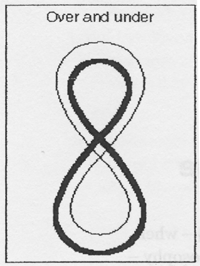 Massaging the upper body takes effect below
Massaging the lower body takes effect above
These two directions can now be examined from another point
of view. In the first case, when the arms are massaged, the direction is from
above downwards, while in the second, when the legs are massaged, it is from
below upwards. What is important is not the fact that massage in one place
takes effect in another but that there is a streaming movement between the two.
This streaming in two directions may be compared with the movement of the air
when we breathe. It moves downwards from above when we breathe in and upwards
from below when we breathe out. We therefore have more than an analogy when we
liken breathing to massage, for massaging the upper part of the body is truly a
kind of inhalation, while massaging the lower part is a kind of exhalation.
Against this background we can more easily understand Rudolf Steiner's
statement that massage acts primarily on the regulation of rhythmic activity in
the human being (which is not the same as regulatory action on rhythmic
activity in the human being). This is the third principle of massage:
Massage works primarily on the regulation of rhythmic
activity in the human being
To complete the picture I shall now take a step beyond what
Rudolf Steiner said in direct connection with massage. Regulating rhythmic
activity does not entail retaining a tepid mediocrity at all times. Our concern
is to regulate rhythmic activity in such a way that on one hand it accords with
the needs of the moment, making available the stimulus required by the actual
situation. On the other hand we have to assess what is appropriate for the
overall biography of the patient so that it accords with the intentions brought
by the individual into this present life on earth. We have to internalize the
regulation of rhythmic activity, and this brings us to the fourth principle of
massage:
The goal of massage is to help the individual regulate
rhythmic activity in a way that benefits his or her biography
Practice shows the validity of these phenomena. When their
legs have been massaged, patients have been known to exclaim: "At last I
can breathe out!" And after an arm massage they are sometimes seen to draw
a deep breath and positively shine with eagerness to get going.
Another aspect is the way these insights help us to
establish guidelines for the development of massage. Massage of the lower parts
has the aim of bringing health to the upper body, while massage of the upper parts
is to bring health to the lower body, and in this connection the concepts of
form and movement are important. In human beings the principle of form is more
pronounced higher up and that of movement lower down, but in massage we have to
reverse this. Massage of the upper parts must have a stronger quality of
movement whereas massage of the lower parts requires a greater quality of form.
By going into ever greater detail in our study of these
principles we shall increasingly be able to realize Rudolf Steiner's
suggestions for massage and achieve what he hinted would one day be possible:
that in some cases massage of the right kind would replace the surgeon's
scalpel.
English by Johanna Collis.
web nawroth.com (c)
planetmassage.org 2003