In Rudolf Steiner's first medical lecture course we read the
following on massage:
"If you investigate rationally, you will indeed find that
every part of the body has a certain connection with other parts and that the
efficacy of massage depends on adequate insight into these inter-relationships.
Massage of the abdomen will always be of benefit also to the breathing
function, a circumstance of special interest. And, in fact, the further we go
from above downwards, massaging immediately below the heart region, respiration
will be influenced more strongly, and further down the effect will be more on
the throat organs. Massage and its effect go in opposite directions: the
further down we go from the center, the greater the effect on the upper
organs.(4)"
Here Rudolf Steiner clearly demonstrates the lemniscate
principle of the astral body in connection with massage. (If I speak of massage
in the following paragraphs I refer to massage working through the astral
lemniscate). The following quotation complements the one above:
"And in quite a magnificent sense the astral body is the
whole human being. Only this astral body is very remarkably constituted; one
might say the astral body down to the diaphragm is something quite different
from the astral body below the diaphragm. Astral body activity directed towards
the head, the organization of nerves and senses, is the polar opposite of its
activity in metabolism and limbs.(5)"
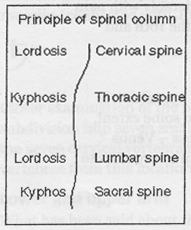
This twofold nature of the astral body is also reflected in
the spine, an organ of great importance in massage. The spine consists of two
smaller spines "stacked" one on top of the other. Above is the highly
mobile cervical spine with lordosis. Below this lie the less mobile thoracic
vertebrae which show kyphosis. Further down is the highly mobile lumbar spine
with lordosis. Walter Holtzapfel says: "A kind of second neck develops in
the lumbar region." (7) The bottom of the spine is almost completely
immobile with kyphosis. It is very important to be aware of this twofoldness
manifesting twice, within the upper and lower back, in the spine. (An
observation from my practice: in patients with much body hair, hair growth seen
on the legs often stops at the line between the upper and lower back as
described above).
Astral body and muscular system
Our muscles are closely related to our astral body. This
shows itself in various ways, one of which is that practically every muscle has
its antagonist. This reflects the tendency of the astral body to work in
polarities. A further connection is pointed out by Rudolf Steiner: "The
whole planetary system lives in our muscles." (8)
Getting to know the muscles of a human being we discover the
influence of the seven planets. Knowledge of these facts provides us with an
actual ruler – "an astral ruler" –which allows us to put into
practice what Rudolf Steiner explains in the first quote given in this section.
The upper back
Even the outer appearance of a human being can indicate the
influence of different planetary processes on the muscles. The neck presents a
kind of summary with its seven short vertebrae – a Saturn aspect. Jupiter
shapes the shoulders and the region between them. Mars exercises his influence
in the region of the shoulder blades. And so we might continue downwards with
Sun, Venus, Mercury and Moon.
Perceptive patients can experience the same massage grip
differently in each of these regions. We might say that the astral body
connects in different ways with various parts of the back. An interesting
observation I was able to make in several cases: if a patient had been at the
dentist

and amalgam fillings were removed, the muscles would tense
up considerably with pain especially in the upper back in the Mercury region
(in the proximity of the 10th and 11th thoracic vertebrae).
The lower back
In the lower back we can recognize a sevenfold form
principle that is in opposition to the upper back. Looking at the abdominal
organs we can see they are, to some extent, arranged from center to periphery.
Bladder – Moon at the center, kidneys – Venus further out, gallbladder – Mars,
liver – Jupiter and finally spleen – Saturn very close to the periphery.

A massage correctly applied in the region of the lower
counterpart to the shoulder blades — the hip bone — is an effective treatment
for tense muscles between the shoulder blades.
The muscular system of the extremities
Upper and lower extremities
In his second medical lecture course, Rudolf Steiner uses
different terms from the first course in relation to massage.(9) He now spoke
about the inner connection of the arms and hands with anabolism and of the legs
and feet with catabolism.
Thigh and calf
The head is the center of the catabolic metabolism in a
human being; but "lung development is a less intense form of head
development." (10) The lung is another focal point for catabolism but not
as important as the head. This duality is reflected by thigh and calf in the
legs. It is known that massaging the calf muscles mainly affects the head and
neck, whereas massaging the thighs is beneficial in the region of the lungs
including the thoracic spine.
If we take this a step further, we find points in the leg
muscles which are connected to the seven planets. At the top of the back of the
thigh is an area under the influence of the Moon. We move downward into regions
connected with Mercury, Venus, Sun and, finally, Mars. Jupiter and Saturn are
reflected in the calf muscles. For the perceptive massage therapist it is not
difficult to locate these points.
Let us continue with the practical example of Mars. It is
advantageous to complement massage of the hip bone with massage of the lower
part of the thigh to release tension between the shoulder blades. The quality
of the massage movement is of far greater importance here than in the case of a
back massage. Massage movements incorrectly applied can have a disastrous
effect.

Another practical example: a massage correctly applied to
the upper part of the calf muscles (connected with Jupiter) can relieve tension
in the shoulder and neck region.

Closer examination of the part of the calf connected with
Saturn shows a further subdivision into seven smaller parts, each of which has
an inner relationship to one of the seven cervical vertebrae. It is therefore
possible to treat the different cervical vertebrae from this location.
Lower and upper arm
What has been said about thigh and calf muscles applies also
to the upper and lower parts of the arm but in reverse order. Massage of the
upper part of the arm influences mainly the heart and blood vessels, whereas
massaging the lower arm reaches, among other things, the intestines. We get a
similar division as for the legs, so that massage of the upper arm relates to
centrally -positioned organs and massage of the lower arm to organs positioned
closer to the periphery. Massage of the lower arm after a careful preparatory
upper back massage directly benefits the intestines; the patient often
experiences a "rumbling" in the stomach. Massage of the upper arm can
also strengthen a weak connection between the will and the other soul
activities.
Conclusion
Rudolf Steiner said in a lecture given in Vienna: "In
reality they (the muscles) are crystallized karma. Their composition, right
down to the subtlest chemical level, is such that we carry our crystallized
karma in our muscular system." (11) We can gain orientation by reading the
destiny script in our muscles. This will deepen both diagnosis and treatment.
The fourfold nature of the body is characterized as: head,
lung, heart and intestine. In a medical lecture Rudolf Steiner said:
"This inverse relationship is such that we may say:
respiratory function is in an inverse relationship to sensory function, just as
the blood circulation is the inverse of digestive function. The digestion, to
put it crudely, is like a condensed blood circulation. or conversely: The blood
circulation is a refined digestive process. And the sensory process is a
refined respiratory process. I might also say: the respiratory process is a
less refined form of sensory perception. These two processes differ
quantitatively not qualitatively. (12)"
The form used to describe these phenomena actually
underlines the tendency of the astral body to work in polarities. It is also
important to note that Rudolf Steiner speaks of functions and processes. We
need to remember that the four regions extend over the whole human organism,
though they have their emphasis in specific areas.
Another fourfold aspect is due to an anatomical fact that is
part of a massage therapist's everyday experience. The upper back – neck and
thoracic region – is large in comparison to the lower back – dorsal and lumbar
region. The upper extremities, the arms, are small in comparison to the lower
extremities, the legs. Here we can see how the spirit and soul aspect of the
human being harmonizes human anatomy by creating this twofoldness small arms –
large upper back, large legs – small lower back.
English by Ulrike O'Callaghan.
web nawroth.com copyright
planetmassage.org 2003