Substances as Vessels for Forces: Using Silica as an Example
If physical matter, substance, is the end stage in the
process that has given rise to it, the nature of the substances must reflect
the nature of the forces that have been active in the process. Pure Si02 and
quartz, which is its mineral form, show the characteristic hexagonal form of
silica. A salt crystal is always cubic and never hexagonal. We shall not
attempt to 'explain' the phenomenon by considering the atomic infrastructure of
the crystal lattice, for it is the essential nature of the substance that has
given rise to its internal configuration, and not vice versa. The current way
of thinking has been programmed differently, and it is thought, for instance,
that an organism is built up from cells. It is not built up in this way,
however, for the cells have arisen from the organism, which is the primary
element. The first cell is an organism! In the same way, the hexagonal
structure of silica develops out of the essential nature of this substance. The
question then arises as to the essential nature of the number Six. A salt
crystal is cubic, and the number four dominates the configuration of a cube.
Much more was known about this in the past; people were aware of the
significance of numbers then. In Hebrew, every letter of the alphabet is also a
number. Numbering starts with the greatest there is, which is the number One.
Oneness, unity, is the beginning of everything. The first letter of the
Hebrew alphabet,
 Aleph, is the name
of God, the One, the source of everything there is. Leaving aside numbers Two
and Three, let us consider Four. The number Four always indicated that
something belonged to the earth. This can be shown to be true in every detail.
The number Six on the other hand is related to cosmic forces. It should not
merely be considered to follow Four and Five. Six can be divided into 2 x 3 or
3 x 2, which again is not the same thing. In the case of silica one is clearly
dealing with 2 x 3 in the form of two triangles, and not with 3 x 2.
Aleph, is the name
of God, the One, the source of everything there is. Leaving aside numbers Two
and Three, let us consider Four. The number Four always indicated that
something belonged to the earth. This can be shown to be true in every detail.
The number Six on the other hand is related to cosmic forces. It should not
merely be considered to follow Four and Five. Six can be divided into 2 x 3 or
3 x 2, which again is not the same thing. In the case of silica one is clearly
dealing with 2 x 3 in the form of two triangles, and not with 3 x 2.
 is the image
representing spiritual entities who in the perception of the people of past
ages numbered six—creative spirits accurately described in the Bible as the
Elohim, a divine power. The term may be translated as 'God', but in Hebrew it
exists only in the plural. Another translation would be 'gods' whose creative
activity is in the sphere of light. We find them in the light and on earth in plants, humans, and silica, for
instance. They are specifically in evidence in plant families such as the
Liliaceae. A transverse section through the ovary of a lily reveals the above
image. The floral diagram of a tulip shows 2 x 3 and not 3 x 2 elements. Every
member of the Liliaceae family has been formed out of this power, the essential
lily nature that was always felt to represent the cosmos. Paintings of the
Annunciation, with the angel Gabriel telling Mary that she is to bear a son,
always show the angel with a lily. It was felt that the angel was a cosmic
spirit and therefore required a lily, as something cosmic on earth, and not a
rose. The rose is the flower of Mary, and that is something entirely different.
Cosmic light forces come to an end in silica on earth. Silica is thus the
vessel or mediator of cosmic light forces. In its purest form, as rock crystal,
it is pervious to light, though one might also say it is pervious to cosmic
forces.
is the image
representing spiritual entities who in the perception of the people of past
ages numbered six—creative spirits accurately described in the Bible as the
Elohim, a divine power. The term may be translated as 'God', but in Hebrew it
exists only in the plural. Another translation would be 'gods' whose creative
activity is in the sphere of light. We find them in the light and on earth in plants, humans, and silica, for
instance. They are specifically in evidence in plant families such as the
Liliaceae. A transverse section through the ovary of a lily reveals the above
image. The floral diagram of a tulip shows 2 x 3 and not 3 x 2 elements. Every
member of the Liliaceae family has been formed out of this power, the essential
lily nature that was always felt to represent the cosmos. Paintings of the
Annunciation, with the angel Gabriel telling Mary that she is to bear a son,
always show the angel with a lily. It was felt that the angel was a cosmic
spirit and therefore required a lily, as something cosmic on earth, and not a
rose. The rose is the flower of Mary, and that is something entirely different.
Cosmic light forces come to an end in silica on earth. Silica is thus the
vessel or mediator of cosmic light forces. In its purest form, as rock crystal,
it is pervious to light, though one might also say it is pervious to cosmic
forces.
Where is silica to be found? In plants; material amounts of
it in grasses, for example. You know the phenomenon—the edge of a blade of
grass can be so sharp that one may cut oneself. This is due to the action of
tiny silica crystals. Grasses contain a considerable quantity of silica, and so
do quite a few other plants. Human beings contain only little silica—compared
to calcium—and for many years no attention was paid to silica. Nowadays more
accurate estimations have become possible. Voronkov's book Silizium and Leben
(Silicon and Life) gives a vast number of data. Silica has many different
aspects. Rock crystal, or quartz, is much harder than glass and can be used to
cut glass. Yet it also has a specific relationship to water. Finely dispersed
silica is able to absorb enormous quantities of water. One mole of silica will
absorb 330 moles of water, an incredible amount. It means that 1 gm of silica
is capable of absorbing approximately 100 gm of water; i.e., one hundred times
its weight. The result is organized, structured water, water that has form.
Where would one find this? The vitreous body of the eye is such organized,
structured water, and in fact all water in the human organism is of that kind.
Swelling and gelling processes occur everywhere, and that always means water
and silica.
How does the human form arise? Connective tissue is present
throughout. The liver, for example, is an extremely watery organ. Connective
tissue gives it form. Also in intervertebral discs, cartilage—the form-giving
element is always connective tissue, and this has a high silica content. The
fibrin which develops when blood coagulates has an extremely high silica
content. It is all a matter of organization in the watery sphere. Looking ahead
for a moment, it may be said that the watery element does of course relate to
the ether body. The principle that creates the human form goes beyond this,
however.
Before we consider this, let us take another look at the
human being as a growing organism. Silica levels depend on age just as much as
calcium levels, and the younger an organism is the more water does
it contain. This makes it pretty obvious that the organizing principle behind
it is—silica. Compare the hand of a one-year-old child with that of an adult
and the difference will be immediately apparent. The child's hand is dimpled
because the tissue layer is very thick and full of water. Going further back
you finally come to the first cells, and these contain more than 95% of water.
Where, then does the human being originate? In water.
|
|
Water content of the human embryo/ fetus in %
|
|
95.4
|
94.3
|
88.7
|
87.3
|
85.5
|
75.5
|
65 60
|
|
Age*
|
2.6
|
3.0
|
4.3
|
5.1
|
7.2
|
10.0
|
Adult Senior
|
*In lunar months.
Human beings originally consist of water. It is a perfectly
good image to tell children that the stork has brought them, having picked them
up out of the large pond. We have our origins in water and not in the earth.
The water in question does, however, have a high degree of organization. It is
also known that silica levels are the higher the younger the organism. The same
applies to water, and this water is fully formed out. If it were not, form
could not enter into it. Silica mediates the entrance of form. As we grow to
adulthood, both the water and the silica levels decrease.
The distribution is as follows. Silica relates to the
periphery. Organs with the highest silica levels are the skin, nails, hair, and
the connective tissue that is present in all parts of the organism. Here the
form-creative principle is at work. How is form given to the embryo? From the
outside. Much more important than the embryo itself or the germinal disc is the
environment of the embryo. Formative impulses come from it right until the
moment of birth. The tissues of the amnion, the skin enveloping the embryo,
have the highest silica content of all, with the ash containing more than 22%.
That is the peripheral source of the forces that bring form into watery, living
substance. It is now known that embryos are hairy all over, with hair covering
the face, the forehead, the nose and all other parts. Darwinism interprets this
as due to man's descent from apes, with the hair lost, to end up as a 'naked
ape'. It is beyond me why people refuse to see that this soft woolly hair known
as lanugo is something entirely different from the hairy pelt of apes and from
permanent human hair. Why do embryos have this hair cover, and indeed, what are
hairs? Hairs are antennae, organs of perception. People were aware of this in
times past. With the aid of hairs, i.e., appendages, the organism focuses on
the environment, perceiving forces radiating towards it and taking them in.
Take a spoon and stir your coffee and you will see a vortex forming in the coffee.
Forces coming from outside have an effect on the fluid. The same thing is to be
seen in the embryo. The hair forms a vortex that terminates in a point over the
posterior fontanelle at the back of the head. That is the exact spot where
these vortices enter. The second point is between the shoulder blades. Here we
have a still photograph of a process of becoming. You can literally put your
finger on it—this is where formative forces reach the center from the
periphery, and that is the reason why hairs have a high silica content. Here we
have a receptor organ, a substance that allows cosmic forces to pass through,
and we now understand why an embryo is covered with hair.
The embryo needs such a receptor organ for cosmic forces.
The route can be traced from the amnion, with its high silica content, via the
hair and into the organism, via epiphysis and hypophysis right into the nervous
system and then into every individual cell. The formative processes move from
periphery to center. How does an organism come to grow? How is an arm, a leg
produced? Not by the method we would think of using. If we had a lump of clay
we would start from the center and make it go thinner and thinner until we came
to the hand. Yet that is exactly how it does not happen. The formative process
starts from the hand, and this is formed first. Then the forearm is produced,
the upper arm and finally the shoulder. First comes the foot, then the lower
leg and only then the thigh. You can see that in children whose mothers took thalidomide.
It is possible to determine the exact day on which that happened. One therefore
does not see children who only have upper arms, as in the case of amputees.
Dysmelic children have a hand up near the shoulder. Development is from the
periphery, therefore, and not from the center outward. Unfortunately our
thinking follows a different line. We are still looking to the cell and the
cell nucleus for formative impulses, yet that is where we are bound not to find
them. They are in the environment. The whole of human development proceeds from
outside and not inside; embryos grow from outside. The formative trend
originates in the periphery or, to put it concretely, the cosmos. The human
being originates in the cosmos. It is of course utterly trite to say the child
emerges from the uterus; that is self-evident. But it does not tell us anything. What is a uterus?
A cosmic enclave. Cosmic forces prevail in the uterus. Within the amnion the
embryo is exposed to cosmic forces until it is born, and not to earthly forces.
So you see, the human being originates in the cosmos and not on earth. The
cosmos is the true home of the human being, as is evident from embryology.
Silica is the vessel for cosmic forces, not earthly ones. The younger the
embryo the greater the number of cosmic forces at work in it, creating
structure, the human form.
This human structure must, however, come to earth. To do so,
it needs material amounts of another substance, and that is calcium. At the
very beginning calcium is not present in material form. Calcification only
develops gradually during the final months in utero. At birth the infant will have
bones, but their calcium content will be low. After this the calcium content
increases, and silica and calcium are polar opposites in this respect. In
diagrammatic form it looks more or less like this:
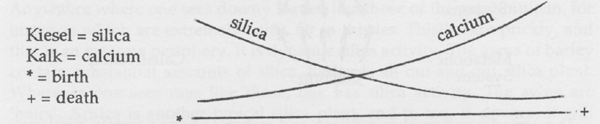
As calcification progresses, the human body becomes more and
more earthly and impermeable. Bone is not transparent, but the eye is. Another
fact is that the first cells are impossible to see because of their
transparency. This makes it difficult to find a fertilized ovum: it is
practically all water and completely transparent. Gradually the material grows
denser. The human being originates in the light and grows dark. The Greeks were
aware of this; they used the verb melainesthai, literally "growing
dark," for "maturing." Look at the facts: a child is born
fair-haired and later the hair darkens. Negro babies are not white at birth but
definitely much lighter-skinned than their parents. The skin darkens gradually,
except that the palms, soles and nails remain light. That is the periphery,
where silica mediates cosmic light.
The above diagram shows the relationship between silica and
calcium in time. The same relationship can also be seen in space. The
transparent aspect is localized in the head, with the eye transparent to light
and the ear to sound. The brain is transparent to thought. In alchemic terms
crystallization, the Sal process, makes things transparent to forces. Silica
belongs to this sphere. Rudolf Steiner put it like this: "Silica always
allows everything spiritual that is alive and active in the world to pass
through." The formative impulse comes from the head. What is it that
makes the human being really part of the earth and in extreme cases thoroughly
bourgois? What does such a person look like? He has a pot belly, and the head
counts for less. "Curvatures" are seen in the abdominal region, and
that is due to calcium activity. Calcium feeds the belly. Formative forces
derive from silica, from the head region. So we now have the differentiation in
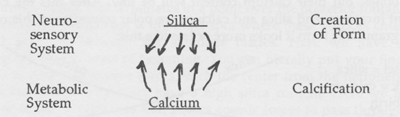
space. Silica always belongs to the neuro-sensory system. Eye, ear, nerves and
all sense organs have to be considered in terms of silica. It would be
possible to go into further detail about this.
Yet if you want to place someone firmly on this earth,
incarnating the soul, it is a question of calcium, a substance acting on
metabolism. Calcification of bone proceeds from below and within; form is
imposed from above and without.
The periodic system shows silicon and carbon to have a
certain similarity, as they are closely related chemically. Silica shows a
strange duality; in the form of quartz it is extremely hard, yet in the organic
sphere and in conjunction with water it may be said to be extremely ductile or
plastic. The same applies to carbon. Diamond is the hardest known material.
Organic carbon compounds on the other hand show infinite plasticity. What do
plants consist of?—carbohydrates; that is, compounds of carbon and water. A
plant is therefore watery carbon—or water organized by carbon! This makes plant
substance so tremendously responsive to form impulses. Plant forms show the
greatest richness of variety, and yet it is all carbon and water. The same
holds true for silica. Silica and carbon have the number Six and hexagonal
structure in common.
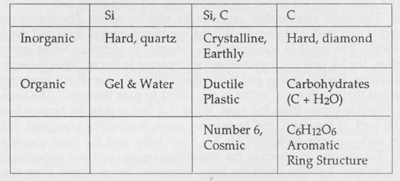
Kekule is unlikely to have been thinking of silica when he
developed the concept of the benzene ring. Silica and carbon are both totally
determined by the number Six, i.e., by cosmic forces. Light lives in both of
them. In the plastic sphere both are still entirely open; in the inorganic
sphere they reach their end points (see above table)—earthly above and more
cosmic below. Quartz and diamond are each the end state in a long process.
Initially, when everything is more wide open, we get an abundance of plastic
form, a dynamic principle. The same can be seen in the organism. The amnion,
skin and vitreous body contain substantial amounts of silica. Nerves have relatively
low silica levels. Yet the white matter has been produced by silica for- (here
something is omitted in the original journal article -ed)
What are the indications for silica forces in a plant?
Silica relates to the periphery. Silica activity is in evidence wherever the
periphery gets even more 'peripheral' and points are formed. Where do we find
points? Anywhere where one sees downy leaves, like those of the great mullein,
for instance, which are extremely hairy. Or in thistles. Thistles are prickly,
and that is an extreme periphery. It is dynamic silica activity. The awns of
barley contain substantial amounts of silica. Barley is an out-and-out silica
plant. Wherever one sees rays like those, one has silica activity. The awns are
'hairs'. Arnica is another typical silica plant, and it, too, is downy. It will
only grow on siliceous soil. Add just a handful of lime or artificial fertilizer—an
earthly element—and the plant dies. You will never find arnica growing on lime,
only in siliceous soil. In the Black Forest and the Vosges,
for example, one sees acres of arnica. Arnica really does have a potentized silica
process, exactly the same as in the nervous system. This makes it medicinal for
the nervous system and also for the form principle; for instance, when
injuries have been sustained and the 'form' destroyed.
In conclusion, let me refer to some scientific data. The
internal organs have relatively low silica levels. Little silica is found in
the lungs, relatively large amounts in the pancreas. What does this tell us?
Not long ago tuberculosis was still quite common, and a reciprocal
relationship was found to exist between TB and silica. What does TB represent?
It is a process of dissolution. What is lacking?—the capacity for form. Lung
tissue actually dissolves and cavities result. The capacity for form is
lacking. There is one organ that practically never develops TB, and that is the
pancreas. The function of the pancreas is to give form and structure to the
food in the intestinal region. Organs with high silica levels do not develop
TB. So there you have the capacity to give form, and on the other hand TB as a
disease with dissolving tendencies. What kind of treatment was given in the
past? Popular medicine made use of plants with high silica levels
 —horsetail,
for example, or hemp nettle, which I have mentioned already, or Teucrium
scorodynia, wood sage, a plant very common in the Black
Forest. TB was thus treated with typical silica plants.
—horsetail,
for example, or hemp nettle, which I have mentioned already, or Teucrium
scorodynia, wood sage, a plant very common in the Black
Forest. TB was thus treated with typical silica plants.
These examples show a way in which it may be possible to
gain understanding of the essential nature of silica. Silica is much more in
accord with human nature than calcium is. We have seen that calcium is a vessel
for the astral body and lets the soul enter into metabolism. It has also been
mentioned that water is the vessel for life, for the ether body. Where does
silica have its place? The question can only be answered if understanding has
been gained of the nature of the human being. It is part of the essential nature
of human beings, as distinct from animals, that they are able to have immediate
control of the spirit and have self-awareness. This is connected with the
ability to stand upright, walk, speak, and think. It calls for a specifically
human organization, and Rudolf Steiner called this the "ego-organization."
Silica provides the physical basis for it. With its aid, the human organism is
given the inner and outer form that makes it a vessel for the spirit. Because
of this, silica is tremendously important for human beings.
Let us take another look at the relative calcium and silica
levels shown in the diagram above. Both show definite age dependence, with
silica decreasing and calcium increasing with age. What is the danger an aging
person faces?—calcification, sclerosis. It was known right until the present
time that silica has antisclerotic properties. An example of such a silica
preparation is Sclerosol, which simply consists of silica. Present-day thinking
is very different, however, with attention focused on cholesterol and fats,
though these are entirely secondary where sclerosis is concerned. What is the
problem of people suffering from sclerosis?—They remain too earthly. They immure
themselves in living substance that has not been mastered so that it becomes
like a prison (atheromatosis). They and those around them experience the
process like this: Mind and spirit have become narrowed down and are
imprisoned. What do they lack?—wide open horizons, the cosmos, release into the
spirit. These people do not lack vitality, yet most geriatric agents contain
anabolics, vitamins, hormones, etc. Yet these people lack anything but that!
What is lacking is catabolism, form, conversion of body substance into
spiritual principles. Silica can be used to achieve this. Other substances will
serve the same purpose—an example being Scleron, a potentized lead
preparation.
Sclerotic subjects lack breadth, universality—in short, the
wisdom of old age. That, however, is among other things a silica process. This
was known in the past and such knowledge was, perhaps unconsciously, put to
use. Today it is no longer understood and attempts are made to deal with minor
aspects such as fat metabolism. People have lost sight of wider horizons, the
cosmos, the essential things, and because of this, wisdom has been largely obscured.
It would be wrong, however, to try and go back to the old wisdom. Evolution
must be such that we also make use of the achievements of the present age and
let the essential nature of things come to expression out of the infinite
number of phenomena we have before us. That is what we have attempted to do in
the case of silica.
The indications for silica and quartz (Silicea) may be
derived from the above. The relationship to the neuro-sensory system has been
discussed. Quartz is always indicated where the wrong kind of metabolic
processes, and particularly inflammatory processes, develop in the
neuro-sensory sphere. This may take the form of neuritis, encephalitis or
inflammatory conditions affecting sense organs. The skin, too, is a sense organ
in this respect. Quartz is therefore indicated for inflammatory skin
conditions. It will be given in relatively high potencies-20x, 30x—on the above
indications, ideally by injection. On the other hand there is the therapeutic
rule that the related plant drug should be given preference, particularly in
the early stages of treatment. In the sphere of the nervous system, arnica
would be the silica plant of the first choice, again in relatively high
potencies. When one is dealing more with the metabolic sphere, and especially
the kidneys, another silica plant, equisetum (horsetail) proves particularly
effective in form of Equisetum Silicea cult.*; here the growing plant has been
specially treated with silica, with the result that the mineral is "opened
up" and made more effective by the plant. This preparation will generally
stimulate the patients' formative forces where form has been lost in dysplastic
processes. (2x = 1% per os, 10 drops t.i.d.). This also addresses connective
tissue, where the root cause of the lack of form must be sought. Connective
tissue weakness frequently makes the whole habitus appear to be lacking proper
support; other aspects are flat feet, flaccid skin, growth disorders affecting
hair and nails.
Homoeopathy, who are masters of observation, have described
a type of individual who epitomizes the essential silica nature—sensitive,
skinny individuals who are rather weak, shy, and quiet. They have thin, fine
hair and tend to be hypersensitive. It is immediately apparent that the
neuro-sensory system predominates, and this needs silica if it is to function
properly.
Finally, silica may also be provided in the diet; e.g., by
giving barley and millet, both rich in silica. One reason why our usual diet is
low in silica is that the mineral cannot be made available in the form of a
fertilizer, plants are only able to utilize it if supplied in a more accessible
organic form.
If we compare the essential silica nature with the
constitutional type and the pathological symptoms that have been shown above, it
will be found that they correspond. The powers found lacking in these
individuals point to the very substance that is the vessel for such powers, and
that is silica.
* Weleda, Spring
Valley, N.Y. 10977, USA,
and other countries.